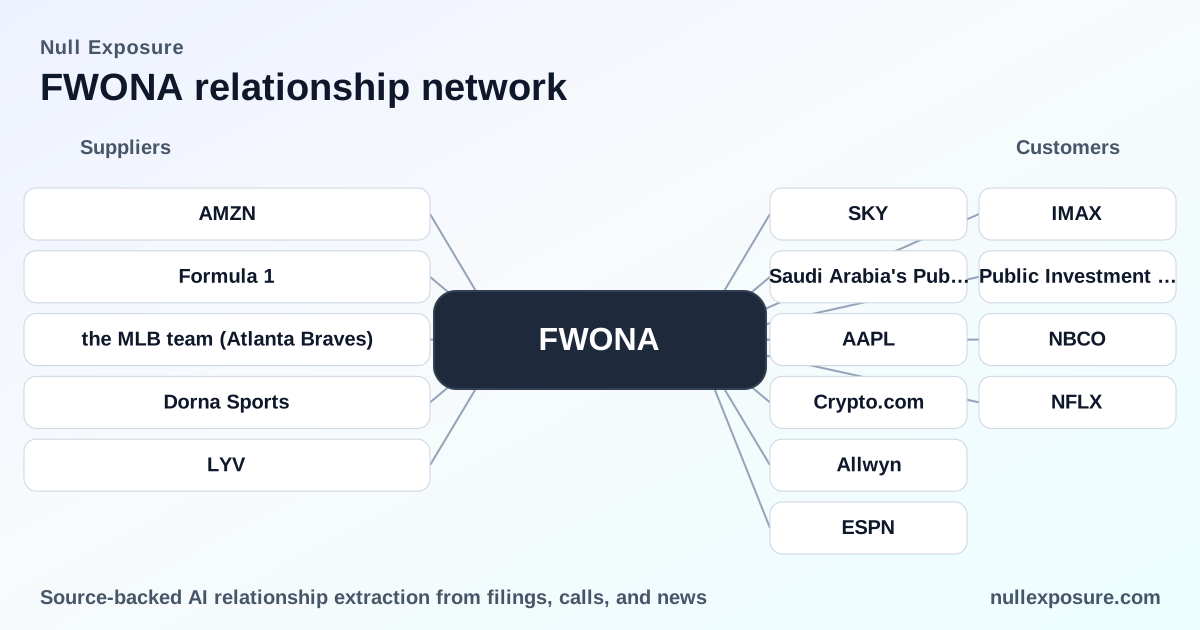
FWONA customer map: who pays, who promotes, and what drives Formula 1’s commercial engine
Thesis — Formula 1 (FWONA) monetizes a global live-sports franchise through a three-pronged commercial model: race promotion fees and ticketing, media rights and subscription distribution (including F1 TV), and sponsorship/brand partnerships and experiential tie‑ins. These revenue streams combine long-term promoter and rights contracts with event-level recognition and high‑value sponsor deals, creating recurring cash flows from global media and commercial partners while retaining meaningful event‑by‑event pricing flexibility.
For a deeper look at how this relationship map affects credit profiles and revenue durability, see NullExposure’s platform: https://nullexposure.com/
Strategic partners that matter — a quick tour of every named relationship
Below I summarize each partner cited in recent reporting and the role they play for FWONA’s commercial model. Each entry is drawn directly from the published sources in the results.
SKY / Sky
Sky holds regional broadcast rights in key European markets, under contracts that lock in local distribution of F1 content through 2027 in some territories. Source: GPBlog coverage of broadcasting rights (FY2022) — https://www.gpblog.com/en/general/liberty-media-revitalises-formula-1.html.
Apple TV (AAPL)
FWONA expanded U.S. exposure through a broadcasting rights deal with Apple TV, positioning Apple as a strategic distribution partner for live and premium content. Source: StocksToTrade summary of FY2026 reporting — https://stockstotrade.com/news/libertymediacorporationseriescformulaonegroupcommonstock-fwonk-news-2026_02_27/.
IMAX
FWONA is capitalizing on experiential distribution via live IMAX screenings, extending race viewing beyond home broadcast and adding an incremental revenue channel for marquee events. Source: StocksToTrade (FY2026) — https://stockstotrade.com/news/libertymediacorporationseriescformulaonegroupcommonstock-fwonk-news-2026_02_28-2/.
Crypto.com
Crypto.com extended its sponsorship agreement through 2030 at material annual consideration (reported as roughly $20 million per year), supporting FWONA’s sponsorship revenue base. Source: BlackbookMotorsport and MotorsInside reporting on FY2025/FY2024 disclosures — https://www.blackbookmotorsport.com/news/f1-revenue-q4-2024-liberty-media-motogp-february-2025/ and https://www.motorsinside.com/en/f1/news/35964-liberty-media-f1-revenue-up-6-in-2024.
DHL
DHL signed a sponsorship extension that the company reports as a $40 million‑per‑year commitment for the U.S. sponsorship footprint, illustrating the scale of corporate backers. Source: BlackbookMotorsport (FY2025) — https://www.blackbookmotorsport.com/news/f1-revenue-q4-2024-liberty-media-motogp-february-2025/.
LVMH
A ten‑year commercial contract with LVMH is referenced as a transformative long‑term partnership that largely begins contributing from 2025 onward, enhancing luxury-brand sponsorship income. Source: BlackbookMotorsport (FY2025) — https://www.blackbookmotorsport.com/news/f1-revenue-q4-2024-liberty-media-motogp-february-2025/.
Allwyn
FWONA signed a new contract with lottery operator Allwyn, adding category diversification to sponsorship and commercial partner revenues. Source: MotorsInside coverage (FY2025) — https://www.motorsinside.com/en/f1/news/35964-liberty-media-f1-revenue-up-6-in-2024.
ESPN
In select U.S. market shifts, ESPN secured broadcast access under arrangements tied to the cancellation of a prior NBC agreement, altering the domestic broadcast mix. Source: GPBlog reporting on distribution changes (FY2022) — https://www.gpblog.com/en/general/liberty-media-revitalises-formula-1.html.
NBC / NBCO
NBC previously held rights and at one point withdrew a material multi‑year bid (reported historically), a dynamic that underscores competitive pressure in U.S. broadcasting negotiations. Source: GPBlog historical note (FY2022) — https://www.gpblog.com/en/general/liberty-media-revitalises-formula-1.html.
Netflix (NFLX)
Original programming such as the Drive to Survive docuseries (Netflix, 2018–) has materially raised global audience awareness and demand, serving as a content‑marketing channel for the sport. Source: GPBlog on content strategy (FY2022) — https://www.gpblog.com/en/general/liberty-media-revitalises-formula-1.html.
Public Investment Fund / Saudi Arabia Wealth Fund (PIF)
There were exploratory conversations and reported interest by Saudi Arabia’s sovereign fund in acquiring F1, but Liberty Media did not pursue a sale; this indicates external interest in the asset and a baseline valuation signal from strategic buyers. Sources: BlackbookMotorsport (FY2023) and Bloomberg reporting (FY2023) — https://www.blackbookmotorsport.com/news/f1-liberty-media-fia-ben-sulayem-saudi-arabia-pif-sale/ and https://www.bloomberg.com/news/articles/2023-01-20/saudi-arabia-wealth-fund-explored-bid-to-buy-f1-motor-racing.
How the contract architecture shapes revenue durability and volatility
The constraint signals from FWONA’s filings and reporting describe a hybrid contracting posture: promoters are generally under multi‑year (three‑to‑seven‑year) agreements, while many commercial revenues are recognized on a per‑event (spot) basis. The company also operates a subscription channel (F1 TV) that generates recurring subscription revenue alongside large, long‑dated sponsorship deals. These characteristics collectively produce both stable recurring cash flows (media and subscription) and event-driven earnings volatility (race promotion and ticketing).
- Long‑term promoter contracts underpin geographic scale and provide predictable promoter fees across multiple seasons.
- Spot/event recognition keeps quarter‑to‑quarter revenue lumpy and tied to the event calendar.
- Subscription revenue from F1 TV is a recurring counterweight, improving revenue predictability where direct‑to‑consumer adoption grows.
These are company‑level signals drawn from the service and revenue recognition language in FWONA filings, not tied to any single partner.
Concentration, criticality and maturity — what investors should watch
Several constraints point to materiality and scale: race promotion revenue represented roughly 29% of total revenue in the cited periods, making promoter relationships and calendar expansion critical to top‑line performance. Reported reimbursement bands (~$10–100 million) for allocated expenses and shared services indicate meaningful intra‑group and partner cash flows that are not peripheral.
Key risk and opportunity signals:
- Concentration risk: Race promotion is material; losing key events or renegotiating promoter terms would compress revenue meaningfully.
- Sponsor and media maturation: New long‑dated deals (e.g., LVMH starting to kick in from 2025) will shift the revenue mix toward larger, contractually secured sponsorship income.
- Geographic scale: The championship is global (24 events across 21 countries in 2024), which diversifies venue risk but increases operational complexity.
Investor takeaways — how this shapes credit and strategy calls
- FWONA’s commercial model is diversified but not immune to event timing: a healthy mix of long‑term rights and event‑level recognition drives both durability and seasonality.
- Media partnerships (Apple TV, Sky, ESPN) and branded sponsorships (DHL, Crypto.com, LVMH) are the primary levers for scaling recurring revenue and monetizing viewership growth.
- Strategic interest from sovereign capital (PIF) validates asset value, while Liberty’s unwillingness to sell suggests management prioritizes long‑term growth over near‑term monetization.
For institutional subscribers evaluating counterparty concentration, payment timeliness, and contract tenor, this map highlights where contractual certainty is high (multi‑year broadcast and sponsorship deals) and where earnings remain event‑sensitive (race promotion, ticketing).
Explore a curated portfolio view and counterparty analytics on the platform here: https://nullexposure.com/
Overall, FWONA’s partner set is both a defensive moat—secured by long‑dated media and sponsorship agreements—and a growth frontier through experiential channels (IMAX) and distribution expansion (Apple TV). Investors should track the cadence of new long‑term deals, event calendar changes, and subscription uptake as the primary drivers of revenue stability and upside.