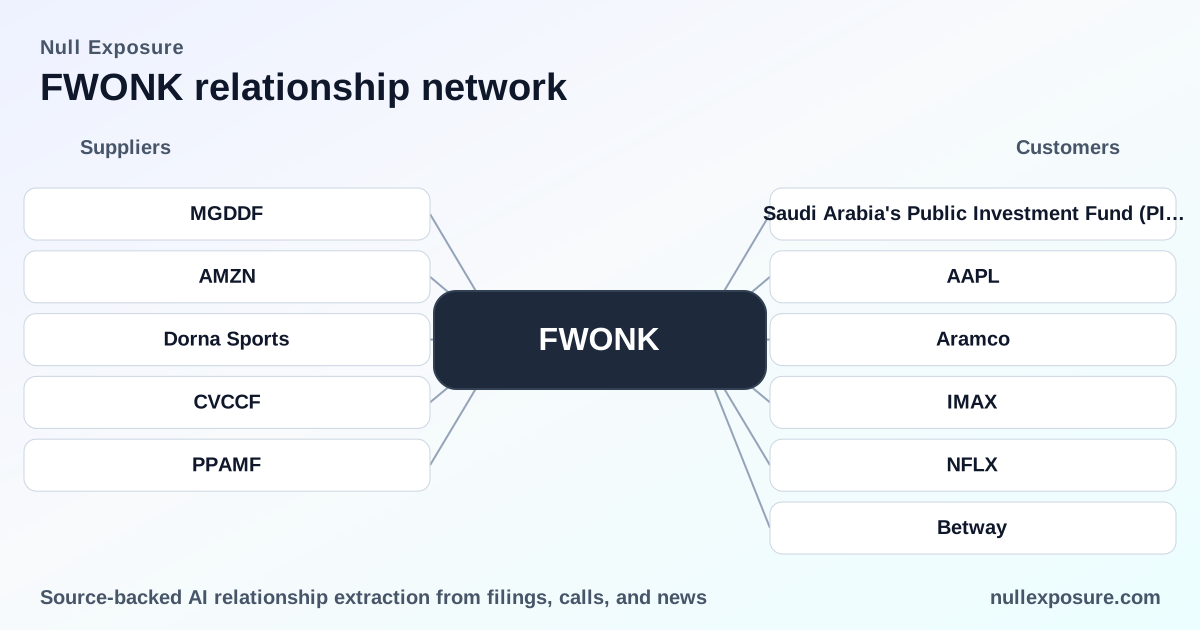
FWONK customer map: who pays Liberty Formula One Group and why it matters to investors
Thesis: Liberty Formula One Group commercializes the F1 World Championship by selling three durable products — media rights, race promotion (hosting) rights, and global sponsorship/advertising packages — and captures recurring cash through multi‑year contracts, advance payments and annual escalators. Revenue converts through direct ticketing and licensing (F1 TV, archival footage) and through distribution partnerships with broadcasters and streaming platforms that extend monetization into subscription and theatrical channels. For an investor, the critical axis is contract length and counterparty concentration: long-term rights deals and a handful of large media and sponsor partners drive predictable revenue but create single‑counterparty exposure that can swing near‑term growth. For deeper, structured coverage, visit the NullExposure homepage: NullExposure.
How the business actually operates and what that implies for cash flow
Formula 1 is a seller of exclusive commercial rights. The company licenses event hosting and broadcast rights, sells premium sponsorship inventory, and resells tickets and hospitality packages either directly or through authorized resellers. Contracting posture is explicitly conservative: contracts typically run three to seven years, often require upfront payments, and commonly include scheduled fee increases, which supports stable, near‑term cash flow and valuation visibility. Those same long terms create execution risk if a major distributor or sponsor walks away at renewal.
Company‑level signals from contract excerpts:
- Long‑term agreements underpin predictable revenue; media, sponsorship and promoter contracts typically run three to seven years and include annual fee escalators.
- Upfront payment mechanics shift working capital dynamics in favor of Liberty, supporting liquidity in peak calendar periods.
- Role diversity: Liberty functions primarily as the seller of rights, also acts through licensees and reseller channels (QuintEvents is cited as an example of an agent/reseller), and provides administrative services internally across group affiliates.
- Maturity and criticality: F1’s commercial model is mature — legacy broadcast deals and marquee sponsors supply scale — but revenue concentration around a handful of media partners and host promoters makes renewal outcomes a primary stock catalyst.
Relationship map: who the major customer and distribution relationships are
Below I cover every customer relationship surfaced in recent reporting and filings. Each short entry gives the commercial relevance and a concise source reference.
Saudi Arabia's Public Investment Fund (PIF)
PIF has been discussed publicly as an aggressive strategic bidder for F1 assets, signaling sovereign interest in motorsport as a platform rather than a simple sponsor. GrandPrix247 reported comments in 2026 referencing a Bloomberg story about PIF’s failed bid for F1 at an estimated $20 billion in FY2023, underscoring sovereign willingness to transact at scale. (GrandPrix247, March 2026)
Apple Inc. (AAPL)
Apple is now a core U.S. distribution partner after securing exclusive streaming rights, converting broadcast economics into subscription revenue and a recurring fee stream for F1. Multiple reports document Apple beginning U.S. F1 coverage in 2026 as part of a multi‑year deal and earlier talks in 2025 about U.S. streaming rights; analysts estimate Apple’s deal will deliver roughly $150 million per year in contractual value while shifting U.S. viewership onto a paid platform. (SahmCapital, March 12, 2026; Intellectia.ai reporting on Liberty commentary, March 2026; 9to5Mac, Aug 7, 2025)
Aramco
Aramco acts as a marquee sponsor and national corporate partner tied to Saudi Arabia’s hosting and promotion of races, reflecting the geopolitically linked sponsorship model that boosts event economics. BBC Sport noted Aramco’s corporate sponsorship and Saudi hosting fees in the context of FY2023 reporting, highlighting strategic commercial ties between national promoters and corporate sponsors. (BBC Sport, FY2023 reporting)
Netflix (NFLX)
Netflix’s ‘Drive to Survive’ represents an accelerator for global audience growth and downstream commercial upside in sponsorship and media monetization, rather than a direct cash customer relationship for broadcast rights. PlanetF1 documents how the Netflix series materially expanded F1’s fan base and social/video footprint, supporting better sponsorship yield and long‑term monetization. (PlanetF1, FY2023)
Walt Disney Co. (DIS)
Disney’s ESPN/ABC linear platforms historically supplied large U.S. viewership and advertising value; the shift from Disney to Apple changes distribution economics and pricing power for F1 in the U.S. market. SahmCapital noted that F1 achieved record viewership on ESPN and ABC in the prior season, underscoring Disney’s prior role as a core distributor. (SahmCapital, March 12, 2026)
IMAX (IMAX)
IMAX is an adjacent distribution partner that expands live broadcast exposure into theatrical venues, offering incremental audience and sponsorship inventory with potential revenue upside in premium experiential screenings. StockstoTrade reported on IMAX showing U.S. F1 race broadcasts, indicating a nontraditional monetization channel for major events in FY2026. (StockstoTrade, Feb 28, 2026)
Betway
Betway is F1’s first official betting operator under a multi‑year agreement covering Europe, MENA, Canada and Mexico, unlocking new sponsorship revenue and regulated wagering integrations across key markets. Intellectia.ai reported the multi‑year commercial betting deal commencing in 2026 and branded as a significant expansion of F1’s commercial ecosystem. (Intellectia.ai, March 2026)
What investors should watch next: concentration, renewals, and distribution economics
- Contract renewal risk is the dominant stock lever. With TRAs and sponsorships typically lasting three to five years (race promoters often three to seven), the timing of major renewals — particularly in the U.S. and with global sponsors — dictates forward visibility. Long terms help, but renewals concentrate decision risk in discrete windows.
- Distribution economics are changing fast. The U.S. move to Apple converts part of F1’s advertising audience into subscription revenue and shifts visibility on viewership metrics; investors must track sub‑NAR performance on Apple TV alongside reported contractual values (~$150m estimate in press coverage).
- Sponsorship geopolitics matter. Deals with national corporates and sovereign‑linked investors (PIF/Aramco) provide cash and promotional heft but increase political and reputational sensitivity around hosting and partner conduct.
- Diversification of channels is intentional. Tie‑ins with Netflix, IMAX and regulated betting operators show a deliberate strategy to monetize fandom across video, theatrical and wagering platforms, which increases aggregate addressable monetization while diluting single‑channel dependency.
Bottom line: durable cashflow with renewal windows that set the next inflection
FWONK’s commercial model is structurally defensive — long contracts, upfront payments and recurring sponsor/multimedia revenue — but investor returns will hinge on renewal outcomes with a small number of large partners and how distribution economics adapt to streaming and experiential channels. Monitor U.S. viewership metrics under Apple, the timing and pricing of upcoming TRA and promoter renewals, and sponsorship dynamics with national corporate partners. For ongoing customer and counterparty monitoring and a concise relational dashboard, see NullExposure.