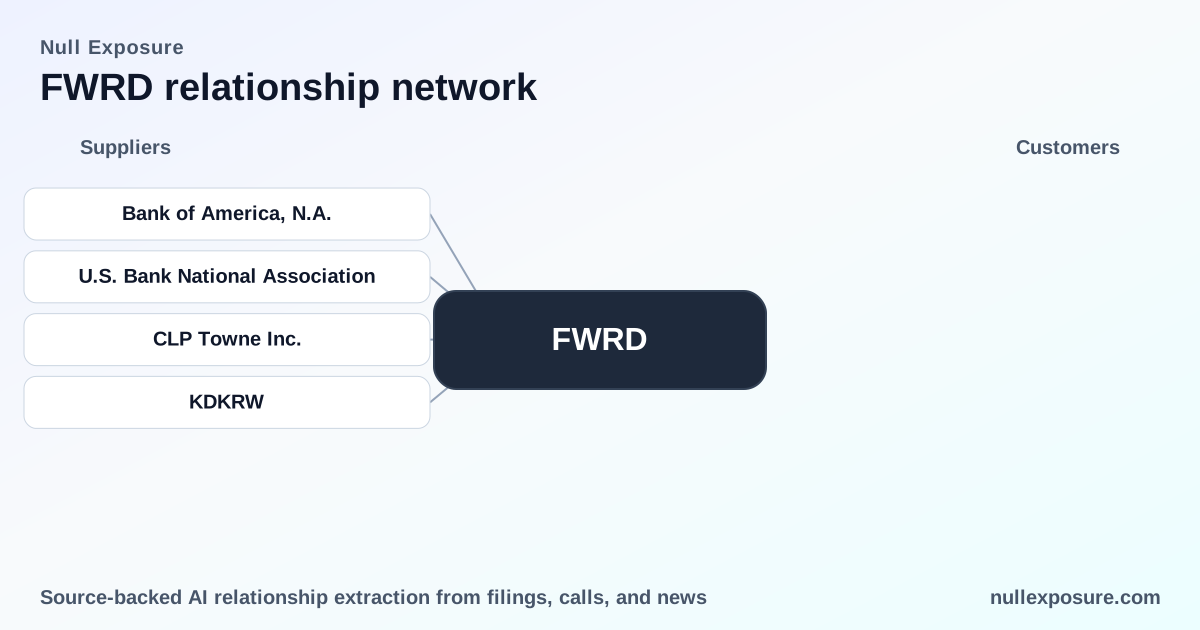
FWRD customer map: what the Revolve tie‑in and corporate disclosures mean for investors
Thesis: Forward Air Corporation (ticker FWRD) operates an asset‑light, service‑driven logistics platform organized across Expedited Freight, Omni Logistics and Intermodal segments, monetizing through per‑shipment transportation fees, value‑added fulfillment and brokerage services, and time‑sensitive forwarding contracts. Its revenue profile is driven by high‑frequency, short‑duration customer engagements across North America with selective international accounts; the combination of short contract tenors and broad geographic coverage creates both revenue flexibility and exposure to customer churn—factors that underwrite both upside from volume growth and downside from sudden demand shifts. For a concise briefing on provider and customer dynamics, visit NullExposure homepage.
How FWRD makes money and how customers fit into the model
Forward bills customers for freight movement, expedited deliveries, intermodal drayage and ancillary services such as customs brokerage and fulfillment. The business is transactional and service‑oriented: revenues scale with freight volumes and value‑added services rather than long‑term subscription lock‑ins. Public disclosures classify the business into Expedited Freight (domestic time‑sensitive lanes), Omni Logistics (freight forwarding, fulfillment, customs brokerage and distribution) and Intermodal services, which together create a diversified revenue mix across short‑haul, mid‑haul and international flows. According to company filings, Forward positions itself as a leading asset‑light freight provider offering LTL, truckload, intermodal drayage and brokerage across the Americas, Europe and Asia.
The single visible customer relationship: Revolve Group (RVLV)
Revolve Group will stage its new Los Angeles flagship with a two‑level design: the main floor for the Revolve brand and the second level dedicated to the FWRD luxury environment, signaling a retail and brand integration between Revolve and FWRD’s luxury merchandising experience. This is reported in a May 2026 news piece by MR Magazine highlighting the store layout and brand curation. (MR Magazine, May 3, 2026).
- Revolve Group (RVLV): Revolve’s new LA store will include a second level described as an immersive FWRD luxury environment, indicating a merchandising or branded retail relationship between Revolve and FWRD’s luxury unit. (MR Magazine, May 3, 2026).
What the corporate constraints and disclosures reveal about customer risk and contracting posture
Forward’s public disclosures and filings provide several consistent operating signals that shape how customers behave and how investors should think about revenue durability:
-
Short‑term contracting posture. Forward states it does not generally enter long‑term customer contracts; most customer arrangements allow cancellation within 30 to 60 days, which creates near‑term revenue flexibility for customers and exposure to rapid volume declines for Forward during market softness. (Company filing).
-
Geographic breadth with North America emphasis. The company’s Expedited Freight network covers approximately 96% of continental U.S. zip codes and includes service into Canada and Mexico; separate disclosures describe Omni’s domestic and international forwarding and the company’s operations across North and South America, Europe and Asia. This combination produces a broad routing footprint that supports scale in time‑sensitive freight while concentrating operational complexity in cross‑border flows. (Company disclosures).
-
Asset‑light service provider role. Forward self‑describes as a leading asset‑light provider offering freight, forwarding and fulfillment services, positioning the company as a network orchestrator rather than a capital‑intensive carrier. This model reduces fixed‑asset leverage but increases dependence on contract carriers and third‑party execution. (Company filing).
-
Dual signals on customer concentration and material risk. The company discloses that no single customer accounted for more than 10% of consolidated revenues for the years ended December 31, 2024, 2023 and 2022—indicating low customer concentration at the top level—yet it also warns that customer cost changes or loss of revenue could have a material adverse effect on the business. Together these statements highlight that risk is industry‑driven and dispersed, but individual large account losses or macro shocks could be materially disruptive. (Company filing).
-
Service and distribution focus. Forward groups its operations under service segments—Expedited Freight, Omni Logistics and Intermodal—with Omni explicitly delivering fulfillment, customs brokerage and distribution for time‑sensitive and international customers. That segmentation underscores a mix of recurring transaction flows (warehouse, fulfillment) and spot freight movements. (Company disclosures).
Implications for investors and operators
-
Revenue volatility is product of contract tenor, not concentration. Short cancellation windows mean Forward’s top‑line is responsive to real‑time market demand; while no single customer dominates revenue, aggregate churn across many small-to-medium customers can compress volumes rapidly in downturns. Investors should price in near‑term sensitivity to macro volumes, while operators should prioritize margin stability through yield management and contract levers.
-
Geographic diversification is a structural strength and an operational complexity. Coverage of nearly all U.S. zip codes and international lanes supports scale in time‑sensitive logistics, but cross‑border complexity amplifies cost and compliance risk—areas where Omni’s customs and brokerage services create differentiation and cross‑sell potential.
-
Asset‑light model creates capital efficiency and execution risk. Lower capital intensity supports higher returns on invested capital in expansions, but dependence on third‑party carriers requires robust carrier procurement and contingency planning to preserve service levels and margins.
-
Brand or merchandising partnerships (like the Revolve link) suggest cross‑sector opportunities. The Revolve-FWRD retail integration signals that Forward’s brands (or its branded B2B/B2C relationships) can extend into curated retail environments—an area to monitor for strategic customer wins that combine distribution and merchandising exposure. (MR Magazine, May 3, 2026).
Risks to monitor closely
- Rapid volume declines triggered by short contract terms.
- Cost pass‑through limits in intermodal and cross‑border freight during fuel or capacity shocks.
- Execution failures with third‑party carriers that could impair time‑sensitive service promises.
Bottom line for a diligence checklist
- Confirm current top‑10 customer revenue shares and recent churn trends beyond reported 2022–2024 disclosures.
- Validate carrier relationships and contingency capacity for peak seasons and cross‑border lanes.
- Track Omni’s customs and fulfillment margins for signs of durable cross‑sell economics.
For a quick reference hub and ongoing updates on customer linkages and corporate disclosures, visit NullExposure homepage.