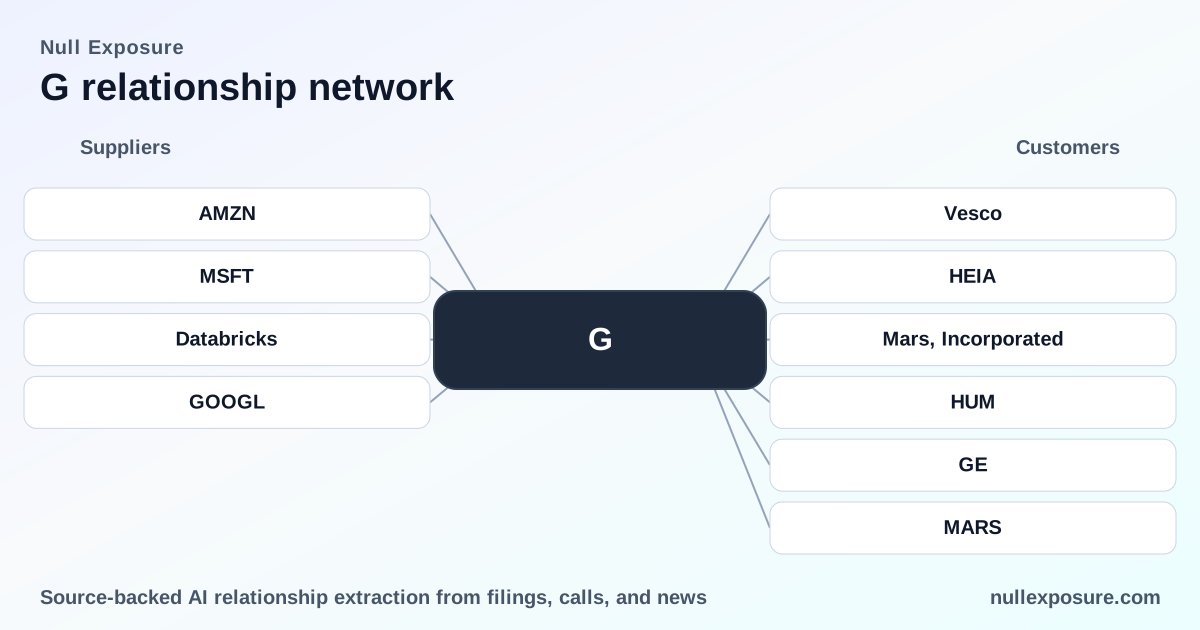
Genpact (G): Customer Relationships Drive a Services-Plus-AI Revenue Engine
Genpact sells managed operations and technology-enabled business process outsourcing to large enterprises, monetizing through long-running master services agreements (MSAs) supplemented by multi-year statements of work (SOWs), subscription licensing for Data‑Tech‑AI products, and time-and-materials or transaction pricing on services. The company’s commercial model is a hybrid of durable contract frameworks, recurring software economics, and transaction-driven services, and its investor case rests on scaling AI-enabled Digital Operations into existing Fortune‑class client relationships. For a quick look at the underlying coverage approach, visit https://nullexposure.com/.
Big-name clients and what each mention reveals
Below are every customer relationship instance captured in public materials. Each entry is a plain-English summary with source context.
Vesco — Q4 2025 earnings call (Genpact)
Genpact described a partnership with Vesco to reimagine Vesco’s finance function, including a comprehensive accounts‑payable overhaul, signaling a typical finance transformation engagement. This was stated on Genpact’s Q4 2025 earnings call transcript (March 7, 2026).
Heineken — Finviz article citing FY2026 commentary
A Finviz market piece cited Heineken as a real-world client where Genpact’s AI initiatives delivered measurable efficiency gains, underscoring the firm’s credibility in consumer goods. The article referencing FY2026 implementations was published March 9, 2026.
Mars, Incorporated — Finviz article citing FY2026 commentary
The same Finviz coverage used Mars as an example of tangible outcomes from Genpact’s AI-enabled solutions, reinforcing long-standing CPG relationships used to validate product-market fit. Finviz mentioned these FY2026 implementations on March 9, 2026.
HEIA (Heineken ticker) — Finviz article (duplicate mention, FY2026)
Finviz also referenced Heineken under its stock ticker (HEIA) to highlight measurable efficiency gains from Genpact’s client work in FY2026, effectively repeating the Heineken example in market reporting. (Finviz, March 9, 2026).
HUM — InsiderMonkey news sentiment (FY2026)
A news excerpt credited Genpact with expanding a partnership to support Humana’s AI-enabled transformation across revenue cycle management, procurement, and finance—indicating cross-functional deployment in healthcare. This appeared in an InsiderMonkey summary of Q4 2025 commentary (published March 9, 2026).
Humana — InsiderMonkey news sentiment (FY2026, same as above)
InsiderMonkey’s coverage named Humana directly and described Genpact’s expanded scope into revenue cycle management, procurement and finance, highlighting healthcare vertical expansion (InsiderMonkey, March 9, 2026).
Vesco — InsiderMonkey news sentiment (FY2026 duplicate)
InsiderMonkey also captured the Vesco AP modernization mention from Genpact’s Q4 2025 material, reiterating Vesco as a finance transformation client (InsiderMonkey, March 9, 2026).
Advantage Solutions (ADV) — SahmCapital press release (FY2025)
Genpact announced recognition for transformational work with Advantage Solutions in a Salesforce Partner Innovation awards release, indicating partnership-driven digital CRM and consumer‑goods solutions. The press release cited the award in November 2025 and was reposted March 9, 2026.
HUM — Q4 2025 earnings call (Genpact)
On its Q4 2025 earnings call, Genpact described Humana as a long‑standing digital operations client in finance and accounting, signaling multi-year institutional relationships in healthcare. (Q4 2025 earnings call transcript, March 7, 2026).
Humana — Q4 2025 earnings call (duplicate)
Genpact reiterated Humana’s status as a durable finance-and-accounting client in the same Q4 2025 call, confirming the depth of the engagement (Genpact Q4 2025 earnings call, March 7, 2026).
GE (General Electric reference) — MarketBeat filing commentary (FY2026)
MarketBeat’s filing alert detailed Genpact’s origin as GE Capital International Services and its IPO history, tying the firm historically to GE and signaling a legacy in process outsourcing dating to 1997. The MarketBeat notice appeared February–May 2026.
General Electric — MarketBeat article reiteration (FY2026)
A MarketBeat analyst note reiterated Genpact’s founding as GE’s BPO arm, reinforcing the company’s long-term heritage in industrial and financial services outsourcing (MarketBeat, early 2026).
HEIA — Q3 2025 earnings call (Genpact)
Genpact stated during its Q3 2025 call that it has partnered with Heineken for over 15 years, highlighting exceptionally long relationship tenure in beverage and consumer goods verticals (Q3 2025 earnings call transcript).
Heineken — Q3 2025 earnings call (duplicate)
The Q3 2025 call explicitly used Heineken as a marquee, 15‑year partner, underlining client stickiness and cross-border scope in Europe (Genpact Q3 2025 earnings call).
Mars — Q3 2025 earnings call (Genpact)
Genpact referenced Mars as a long‑standing partner, built on operational excellence and innovation—an example of strategic enterprise relationships in the CPG sector (Q3 2025 earnings call transcript).
How Genpact’s contracts and operating model shape those relationships
Genpact’s public disclosures paint a coherent procurement and delivery posture that drives customer economics:
- Framework contracting with embedded multi-year SOWs: Genpact operates primarily under MSAs that are supplemented by SOWs; most revenues come from SOWs with two‑ to five‑year terms, while MSAs commonly span three to seven years. This creates durable intake channels for upsell and productizing AI capabilities.
- Mixed monetization: services, subscription, licensing and usage: Revenue mixes include fixed-price or time‑and‑materials services, subscription SaaS for Data‑Tech‑AI, and occasional license sales; this hybrid allows margin expansion when software and subscription components scale.
- Large-enterprise customer base and geographic concentration: The client roster is skewed to Fortune Global 500 / Fortune 1000 customers, with over 70% revenue exposure to North America and meaningful exposure to Europe—this concentrates revenue but also validates global solution capabilities.
- Ramping and implementation complexity: Projects have long ramp periods, reflecting integration, change management and data work; long ramps protect renewal value once platforms are live.
- Materiality is sector- and market-dependent: A small set of clients can contribute disproportionate revenue in specific geographies or service lines; this raises client concentration risk even as it drives scale economics when deployments expand.
- Service-provider posture with Global delivery scale: Genpact’s role is explicitly as a global service provider leveraging operational excellence and advanced technology across finance, supply chain and industry operations.
All of the above are company-level signals drawn from Genpact’s disclosures about contracting and service delivery; they are material to how each client engagement (like Mars, Heineken, Humana, Vesco) converts into recurring revenue and margin.
Investment implications: catalysts and risks
- Catalyst — AI productization across existing large accounts: Long-tenured relationships (Heineken 15+ years, Mars, Humana) create upsell runway for Genpact’s Data‑Tech‑AI offerings and subscription licensing, which should lift margins and improve revenue visibility.
- Risk — concentration and long ramp cycles: Heavy North American/EMEA concentration and the fact that select large clients can materially move results create downside if a Fortune client delays spending; long ramps also compress near-term revenue recognition versus long-term value capture.
- Operational leverage: As software and subscription mix rises, Genpact can convert legacy time-and-materials revenue into higher-margin, repeatable streams — a structural margin opportunity for investors.
If you want an operational map of these client relationships and how they feed product adoption, explore our research hub at https://nullexposure.com/.
Bottom line
Genpact’s customer mentions in recent earnings calls and market coverage confirm a predictable playbook: large, long-tenured enterprise relationships converted into recurring revenue through MSAs and SOWs, with AI and platform features now the lever for margin and growth expansion. Investors should weigh the upside of productization inside entrenched clients against concentration and implementation‑timing risks when sizing conviction.