Gaia’s distribution partnerships: what investors need to know
Gaia operates a global subscription streaming business focused on niche wellness, mindfulness and alternative-lifestyle programming. The company monetizes primarily through member subscription fees sold both directly at Gaia.com and through third‑party platform storefronts and in‑app purchases; distribution partners therefore serve as both customer acquisition channels and billing conduits for the service.
For a concise, platform‑level read of Gaia’s partner footprint and its financial implications, see Null Exposure’s coverage at https://nullexposure.com/ — the overview there complements the partner detail below.
Why platform relationships matter for a small streamer
Gaia’s economics are subscription driven and its content is delivered through device and platform partners that determine reach, discoverability and payment flows. The company reports members across the U.S. and over 185 foreign countries and lists the U.S., Canada and Australia as major territories, so these distribution agreements are core to scale and retention rather than peripheral licensing deals (Gaia corporate disclosures, FY2025–FY2026).
This means two structural characteristics define the business model: Gaia is a service provider in a subscription segment with a predominantly individual customer base and a global footprint, with concentration in North America and APAC as stated in disclosures (company filings and investor releases, FY2025–FY2026).
You can review platform-specific relationships below and the potential operating constraints they create.
Platform partners that host, sell or bill Gaia subscriptions
Below are the platform counterparts that Gaia cites repeatedly in investor releases and media announcements. Each entry provides a 1–2 sentence plain‑English description and the source where Gaia lists availability.
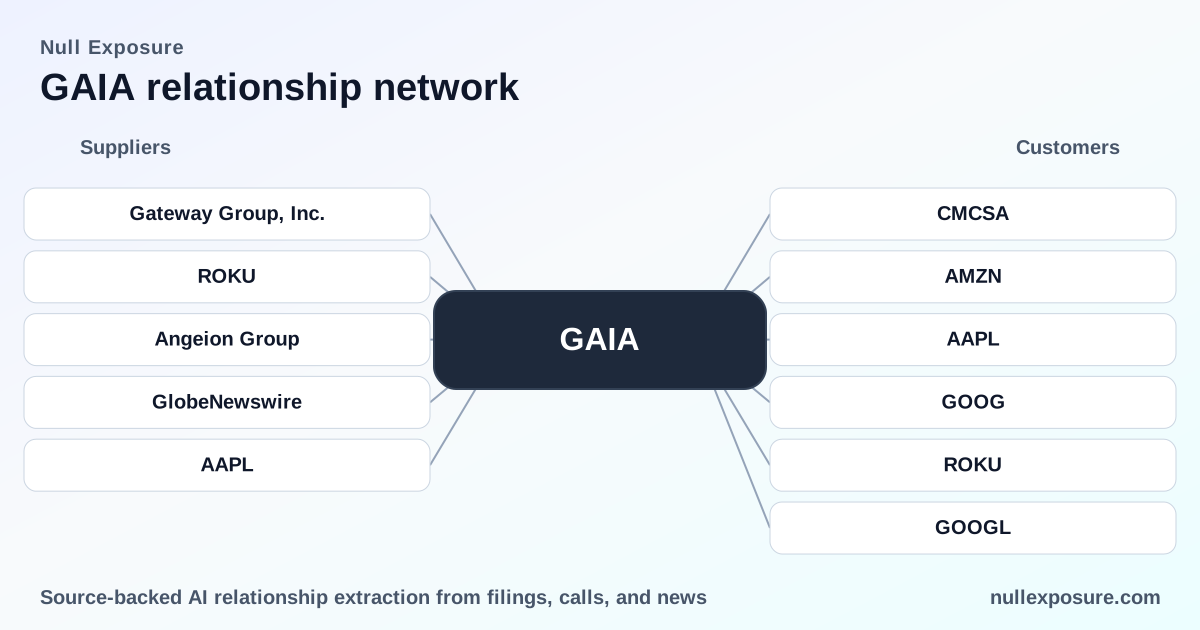
Comcast Corporation / Comcast Xfinity (CMCSA)
Gaia is distributed through Comcast’s Xfinity ecosystem, meaning Gaia+ content is available to Comcast subscribers and listed on Comcast storefronts. (Gaia investor release on GlobeNewswire, March 2026; QuiverQuant conference notice, FY2025.)
Amazon.com, Inc. / Amazon Prime Video / Amazon Fire / AMZN
Gaia sells subscriptions and distributes apps via Amazon devices and through Amazon Prime Video, giving access to Amazon’s device installed base and Prime storefronts. (Finance Yahoo announcement of Gaia platform availability, FY2024; GlobeNewswire Q2 results, August 2025.)
Apple Inc. / Apple TV / iOS / AAPL
Gaia offers in‑app purchases and a native app on Apple platforms including Apple TV and iOS devices, enabling direct App Store billing and exposure to Apple’s ecosystem. (Finance Yahoo product launch coverage, FY2024; SahmCapital investor release, FY2026.)
Google / Alphabet Inc. / Chromecast / Android / GOOG / GOOGL
Gaia publishes apps for Android phones, Android TV devices and Chromecast‑enabled devices, allowing signups and playback within Google’s device ecosystem and Google Play billing pathways. (Finance Yahoo platform disclosure, FY2024; SahmCapital investor notices, FY2026.)
Roku / ROKU
Gaia is available as a channel on Roku’s streaming players and Roku TV models, which supports a lean distribution path to cord‑cutting households and Roku’s ad/storefront discovery. (Finance Yahoo launch note and SahmCapital investor announcements, FY2024–FY2026.)
Platform string variants recorded in filings and press notices
Gaia’s public statements list multiple variant names for the same underlying partners — for example “Amazon Prime Video,” “Amazon,” and ticker strings like “AMZN”; “Comcast Xfinity,” “Comcast,” and “CMCSA”; and device references such as “Apple TV,” “iOS,” “Chromecast,” and “Android.” Each variant reflects the same commercial availability statements in Gaia’s releases and investor communications (QuiverQuant, GlobeNewswire, SahmCapital and Finance Yahoo press coverage, FY2024–FY2026).
Operating model constraints investors should treat as company signals
Gaia’s disclosures and investor materials produce several clear, company‑level signals about how its customer relationships function:
- Contracting posture — subscription: Revenue is “primarily derived from subscription fees” for streaming services, which means recurring revenue depends on member acquisition and churn management rather than one‑off licensing deals (company filings, FY2025).
- Counterparty type — individual members: The company’s customer base is composed of individual members worldwide, so payments and retention dynamics are retail and consumer‑facing rather than enterprise contracts (corporate description and member counts, FY2025).
- Geographic reach — global with NA and APAC concentration: Gaia reports members across 185 foreign countries, and calls out the U.S., Canada and Australia as major billing territories — this affects marketing mix, currency exposure and regional product priorities (company filing language, FY2025–FY2026).
- Relationship role — service provider: Gaia functions as a service provider: it operates, hosts and bills for streaming content to its members and relies on third‑party platforms for distribution and payment capture (company disclosures, FY2025).
- Segment positioning — services: The company is squarely positioned in digital streaming services, where scale, platform economics and content differentiation drive profitability (company description, FY2024–FY2026).
These signals collectively imply an operating model where third‑party platforms are channel partners with outsized influence over member discovery and billing mechanics.
Financial and strategic implications for investors
- Distribution breadth is a strength: Presence across Apple, Google, Amazon, Roku and Comcast increases discoverability and global reach, which is essential given Gaia’s modest market cap and sub‑scale content budget.
- Platform economics are a material operational lever: In‑app billing through major app stores and device ecosystems routes revenue through platform fee structures and discovery algorithms, affecting margins and customer acquisition cost. Gaia’s disclosures confirm these distribution channels are primary sales conduits (investor releases, FY2024–FY2026).
- Concentration and dependency risk: Although Gaia lists many platforms, the company’s economics remain subscription driven and retail‑facing; any material change in platform terms, app store rules, or de‑prioritying on a major storefront could have outsized impact on growth and retention.
- Execution risk is product and marketing dependent: Global membership counts require localized engagement and platform optimization across iOS, Android, and device channels; success depends on Gaia’s ability to translate platform availability into paid recurring members.
Key takeaways for active investors: platform distribution is necessary but not sufficient — it enables reach, but Gaia’s margin profile and growth hinge on converting that reach into retained, paying members while managing platform economics.
For a deeper read on how Gaia’s platform relationships influence subscription economics and competitive positioning, visit https://nullexposure.com/ for our broader coverage.
Bottom line
Gaia’s public filings and investor announcements consistently list the major platform partners that handle distribution and billing: Amazon (Prime Video and Fire devices), Apple (iOS and Apple TV), Google/Alphabet (Android and Chromecast), Roku, and Comcast/Xfinity. These partnerships are integral to Gaia’s subscription monetization strategy and create both scale opportunities and dependency risks that investors must monitor through churn, ARPU evolution, and any announced changes to platform terms (company investor releases and press coverage, FY2024–FY2026).
Bold questions for diligence: assess Gaia’s net revenue per platform, churn by device cohort, and marketing spend efficiency on each storefront — these metrics will determine whether distribution breadth converts into sustainable subscriber economics.