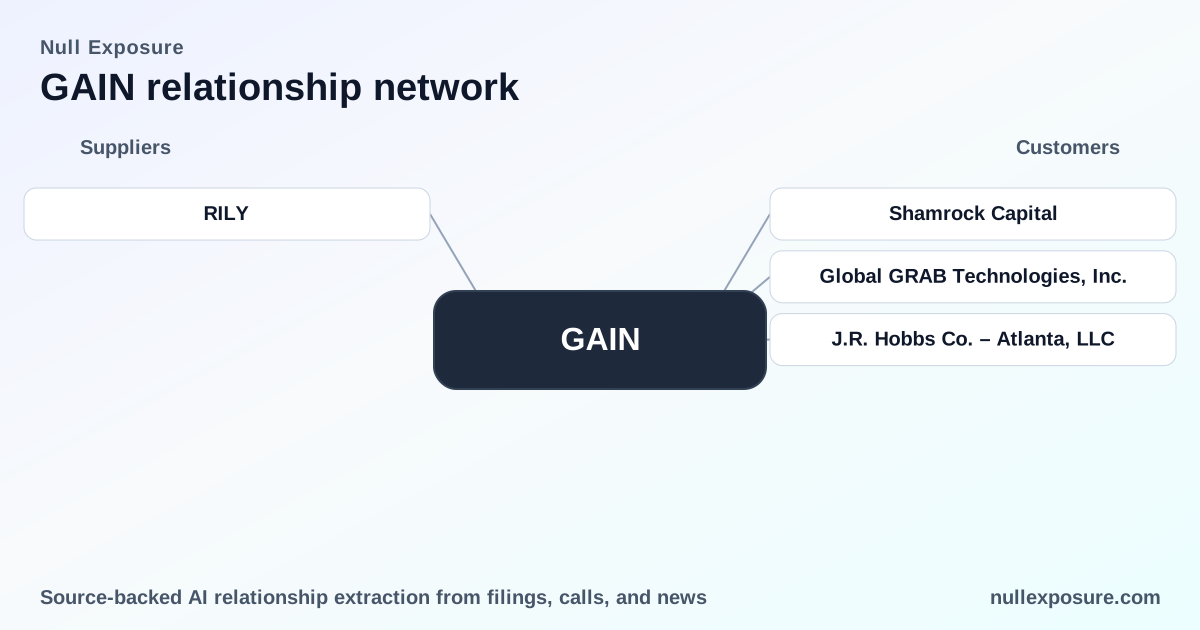
GAIN’s customer footprint: how Gladstone Investment converts private-company finance into shareholder income
Gladstone Investment Corporation (GAIN) is a publicly traded business development company that originates and holds five-year senior loans and complementary equity positions in U.S. lower middle‑market companies, monetizing through interest income, fees, preferred dividends and periodic realized gains or losses on exits. The firm’s operating model is capital‑intensive and relationship-driven: management underwrites and holds sizable positions (often $10–$75 million) where active governance and tailored structuring determine returns. For investors, GAIN is a yield instrument with concentrated private‑credit upside and intermittent mark‑to‑market volatility; read on for how recent customer actions reshape that risk/reward profile.
For a quick look at firm-level signals and relationship dynamics, visit https://nullexposure.com/.
The simple company-level thesis investors need to hold in mind
Gladstone invests primarily in U.S. lower middle‑market companies using a mix of secured first‑lien debt, term loans and preferred equity. The firm’s cash flow comes from contractual coupon and fee schedules on long‑dated loans and from realized equity appreciation when portfolio companies are sold. Management also provides managerial assistance and other services to portfolio companies, embedding operational leverage into the capital structure but also increasing exposure to borrower performance.
Key operating constraints that shape portfolio behavior:
- Contracting posture — long‑term: GAIN generally makes roughly five‑year term loans and intends to hold positions to maturity or exit on its own schedule, so liquidity events are episodic rather than frequent.
- Counterparty focus — mid‑market: GAIN’s borrowers are lower middle‑market U.S. businesses with an emphasis on sustainable cash flow and asset collateralization.
- Geography — U.S. centric: Portfolio activity concentrates on North American companies.
- Concentration — material: The top five investments represented roughly 41% of fair value as of March 31, 2025, signaling meaningful single‑name concentration risk.
- Role and criticality — active service provider and lender: Beyond financing, GAIN provides managerial assistance as defined under the 1940 Act, making it a critical partner to portfolio companies.
- Maturity and spend band: Typical deal sizes sit between $10M–$100M with individual investments generally up to $75M, reflecting the firm’s appetite for material, control‑oriented positions.
These characteristics together create a business that delivers steady yield but carries idiosyncratic credit and liquidity risk, where exits and restructurings materially influence quarterly results.
Customer moves investors should track right now
Shamrock Capital — exit of Nth Degree
Gladstone announced the sale of its portfolio company Nth Degree, Inc. to Shamrock Capital, representing a realized exit from that holding. According to the company press release reported on Yahoo Finance (March 9, 2026), this transaction is an example of GAIN converting an equity/loan position into liquidity through a strategic sale: https://finance.yahoo.com/news/gladstone-investment-corporation-exits-investment-123000653.html.
Global GRAB Technologies — $67.6 million new investment (July 2025)
In July 2025, GAIN committed $67.6 million to Global GRAB Technologies in a blended package of $46.5 million secured first‑lien debt and $21.1 million of preferred equity, enlarging exposure to a single new portfolio company with mixed seniority economics. This deployment was disclosed in GAIN’s Q2 FY2025 financial release and reported via Tallahassee.com (press release): https://www.tallahassee.com/press-release/story/11107/gladstone-investment-corporation-reports-financial-results-for-its-second-quarter-ended-september-30-2025/.
J.R. Hobbs Co. – Atlanta, LLC — restructuring into a $20.0 million term loan and realized loss
In September 2025, Gladstone restructured prior exposure and extended a new $20.0 million secured first‑lien term loan to J.R. Hobbs Co. – Atlanta, LLC, replacing an earlier aggregate cost basis of $49.9 million and recording a realized loss of $29.9 million related to the transaction. This restructuring and loss were disclosed in the same Q2 FY2025 release (Tallahassee.com): https://www.tallahassee.com/press-release/story/11107/gladstone-investment-corporation-reports-financial-results-for-its-second-quarter-ended-september-30-2025/.
What these relationships reveal about portfolio health and risk
- Exit capability exists, but is selective. The Nth Degree sale to Shamrock Capital demonstrates GAIN’s ability to realize liquidity through strategic buyers, supporting upside capture when market interest is available. That is a positive signal for eventual crystallization of equity gains for shareholders.
- Large new, illiquid commitments drive concentration. The $67.6M commitment to Global GRAB is emblematic of the firm’s approach: take meaningful positions with mixed seniority to increase yield, which also raises single‑name exposure and holding‑period risk.
- Restructurings can produce headline losses. The J.R. Hobbs restructuring — a smaller new loan but large realized loss — underscores how workout outcomes and credit deterioration feed directly into reported earnings and NAV volatility. Credit risk translates quickly into realized P&L in the BDC model.
- Active governance is part of the product. Management’s provision of managerial assistance is a dual‑edged lever: it increases the probability of successful turnarounds but concentrates operational exposure and requires in‑house expertise.
How this impacts valuation and capital allocation decisions
From a capital markets perspective, GAIN trades as a yield vehicle with a track record of income and episodic gains/losses. Key financial anchor points include a dividend yield near 5.7% (DividendYield 0.0571), price‑to‑book around 1.13, and a trailing P/E of 5.33, signaling a market discount that reflects credit and concentration risk. Investors should underwrite GAIN on three vectors:
- expected coupon and preferred dividend income from the held portfolio;
- probability and timing of future exits or restructurings (given the 5‑year hold posture); and
- the impact of any single‑name workout on near‑term NAV and distributable cash.
Capital allocation decisions within Gladstone will continue to tilt toward larger, U.S. lower‑middle market credits where the firm can negotiate control and governance, and investors should price in episodic mark‑to‑market shocks from restructurings.
Final read: an informed framework for monitoring relationships
For investors and operators evaluating GAIN’s customer relationships, the operating model is straightforward: long‑dated, concentrated loans with active operational involvement. Monitor new deployments for size and seniority (which drive immediate income and longer‑term upside), track restructurings for realized loss potential, and watch exits for proof of value realization. If you want a compact feed of these signals and relationship‑level commentary, visit https://nullexposure.com/ for a focused view.
Bold takeaway: GAIN delivers attractive yield through concentrated, actively managed private‑credit positions — investors earn income but must accept idiosyncratic credit and liquidity risk driven by a small number of material holdings.