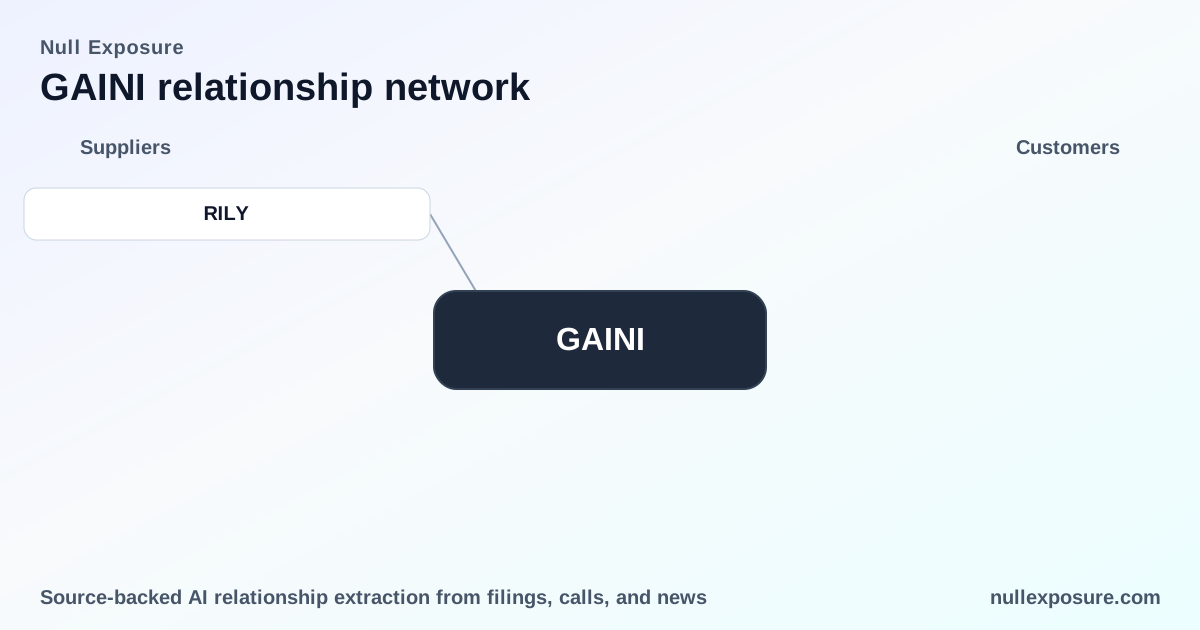
GAINI: Where Gladstone’s capital meets concentrated, outcome-driven private companies
Gladstone Investment Corporation issues high-yield securities while deploying capital directly into small and mid-sized private companies; the firm monetizes through interest income, structured term debt, and realized exit gains that supplement regular distributions to note and equity holders. The 7.875% notes due 2030 (GAINI) sit alongside a portfolio strategy that mixes multi-year term loans and short-duration credit facilities, producing steady coupon cashflow for noteholders while leaving NAV exposed to discrete credit and exit outcomes.
If you evaluate counterparty risk or capital concentration for fixed-income allocations, review how Gladstone’s underwriting translates to single-name exposures and exit-dependent supplemental payouts. Learn more at https://nullexposure.com/.
Portfolio posture: a mix of long-dated term loans and short-lived credit lines
Gladstone’s public commentary and coverage show a deliberate mix of contract types. The firm holds long-term term debt on some credits and short-term lines on others, creating a maturity ladder that supports yield but concentrates event risk when exits or losses occur. For example, a disclosed term loan to ImageWorks Display and Marketing Group carries a long-dated maturity, while a line of credit tied to J.R. Hobbs had short-term repayment risk. These structural choices produce predictable coupon streams but introduce timing concentration: realized losses or outsized gains in a single quarter directly affect NAV and supplemental distributions.
- Evidence of a long-term posture: ImageWorks Display and Marketing Group has a term debt instrument priced at SOFR + 11.0% with cash interest and a contractual maturity in November 2028, signaling multi-year yield capture.
- Evidence of short-term exposure: J.R. Hobbs carried a line of credit with SOFR + 6.0% and a due date in June 2025, indicating near-term liquidity and default risk.
Both datapoints come from Gladstone-related reporting and curated coverage that details deployed capital and realized outcomes.
The relationships, one by one — what matters to investors
Global GRAB Technologies
Gladstone deployed $67.6 million of capital into Global GRAB Technologies during FY2026, reflecting a sizeable single-company exposure that contributes meaningfully to portfolio concentration. This allocation is documented in market coverage of Gladstone’s FY2026 deployments. Source: 247wallst investing coverage, April 18, 2026 (reporting FY2026 deployments) — https://247wallst.com/investing/2026/04/18/monthly-dividend-check-at-risk-what-gain-investors-should-watch-right-now/.
Rowan Energy
Rowan Energy received $33.1 million of invested capital from Gladstone in FY2026, representing a mid-sized position by Gladstone’s private-company standards and one that will influence near-term income and capital recovery timing. Source: 247wallst investing coverage, April 18, 2026 — https://247wallst.com/investing/2026/04/18/monthly-dividend-check-at-risk-what-gain-investors-should-watch-right-now/.
Smart Chemical Solutions
Smart Chemical Solutions was funded with $49.5 million by Gladstone in the same reporting window, another materially sized credit investment that drives interest income and creates discrete repayment or exit timing risk for the portfolio. Source: 247wallst investing coverage, April 18, 2026 — https://247wallst.com/investing/2026/04/18/monthly-dividend-check-at-risk-what-gain-investors-should-watch-right-now/.
J.R. Hobbs
Gladstone recorded a $29.9 million realized loss on its J.R. Hobbs position in Q2 FY2026, an outcome that was absorbed by the portfolio but which demonstrates how a single credit event can erode NAV and the firm’s supplemental payout engine. Reporting on Gladstone’s Q2 outcomes highlights this realized loss and its implications for supplemental distributions. Source: 247wallst coverage, April 24, 2026 — https://247wallst.com/investing/2026/04/24/gladstone-shares-up-18-this-year-on-hidden-supplemental-payouts/.
Nocturne Luxury Villas
An exit of Nocturne Luxury Villas delivered $19.8 million in realized gains and $3.5 million in success fees, enabling Gladstone to pay shareholders a $0.54 supplemental distribution on June 13, 2025; this demonstrates the upside mechanics of Gladstone’s model where successful realizations directly boost per-share payouts. Source: 247wallst coverage, April 24, 2026 — https://247wallst.com/investing/2026/04/24/gladstone-shares-up-18-this-year-on-hidden-supplemental-payouts/.
What the constraints tell you about operating risk and maturity profile
Gladstone’s contracts show heterogeneous maturity and pricing mechanics, a company-level signal with implications for liquidity and credit risk management:
- Contracting posture: the mix of SOFR-linked term debt (example: ImageWorks at SOFR + 11.0%) and short-term credit facilities (example: J.R. Hobbs LOC at SOFR + 6.0%) indicates Gladstone uses market-referenced floating rates to preserve yield while bearing rate and roll risk.
- Concentration: single-company investments documented in FY2026 range into the tens of millions, which creates idiosyncratic NAV volatility when exits or write-downs occur.
- Criticality: relationships are revenue- and cashflow-generating for Gladstone (interest, fees, success fees), so individual realizations are portfolio-critical—positive exits fund supplemental distributions and negative outcomes compress NAV.
- Maturity: the presence of both near-term due dates (e.g., a LOC due in June 2025) and multi-year term loans (e.g., ImageWorks due in November 2028) produces a maturity ladder but concentrates refinancing and exit risk into specific calendar windows.
The ImageWorks term debt citation and the J.R. Hobbs LOC details come from Gladstone-related disclosures and supporting reporting aggregated in FY2026 materials.
If your decision process requires structured counterparty mapping or a snapshot of maturity concentration across Gladstone’s private loans, NullExposure provides curated relationship views and provenance for each exposure. Visit https://nullexposure.com/ to review our approach.
Investment implications — what to watch next
- NAV sensitivity to single-name outcomes is high: realized losses of ~$30 million can meaningfully compress NAV and disrupt supplemental distributions. This is proven by the J.R. Hobbs write-down and the linkage between Nocturne’s exit and a supplemental payout.
- Contract mix matters: floating-rate term debt captures yield but embeds market rate exposure and refinance timing risk; short-term facilities can create near-term liquidity stress.
- Concentration is an active risk: multiple FY2026 deployments at $30–$70 million per name signal that Gladstone manages a compact, high-conviction book rather than a widely diversified loan pool.
For fixed-income investors focused on yield with credit exposure, track Gladstone’s upcoming repayment and exit schedule, monitor NAV trends after any realized losses or exits, and assess how supplemental payouts are funded quarter-to-quarter.
Bottom line
Gladstone’s capital deployment profile delivers attractive yield mechanics via term loans and success fees, but it also produces concentration-driven NAV volatility and discrete maturity risk windows that fixed-income investors must model explicitly. For a structured view of each counterparty and the documents that support deployment and exit figures, see our coverage at https://nullexposure.com/.