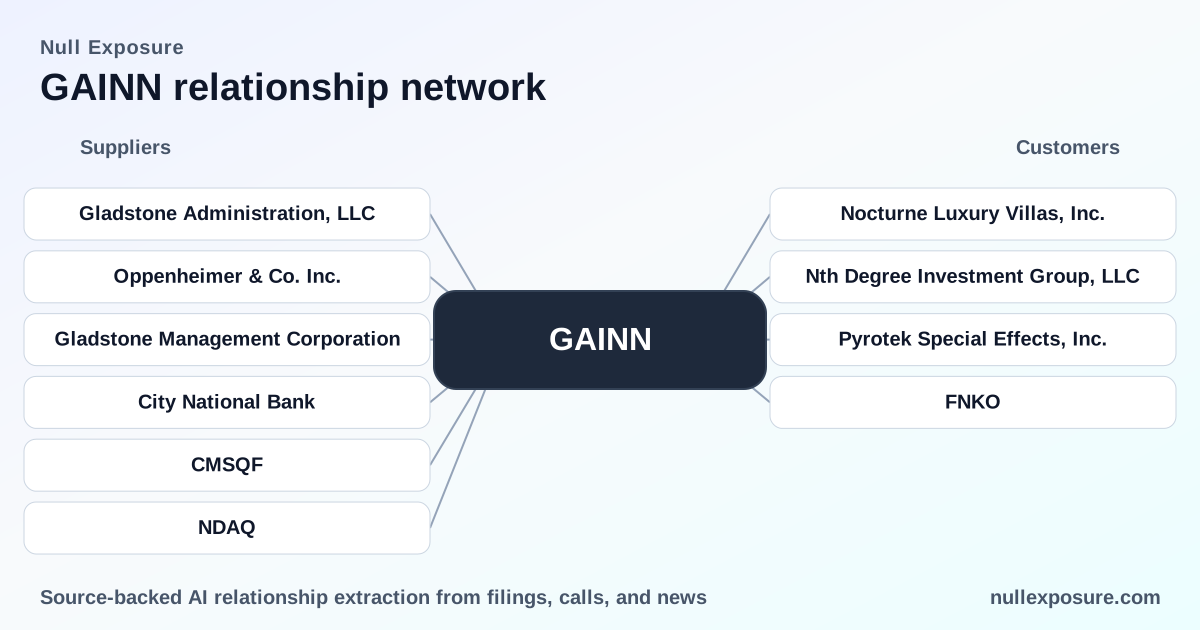
GAINN customer relationships: what the FY2025 filing tells investors
Gladstone Investment Corporation operates as a business development company that originates and holds primarily five‑year term loans and complementary equity positions in lower middle‑market U.S. companies, monetizing through interest income, success fees and realized gains on exits, while returning cash to investors via regular distributions and the income profile of its 5.00% notes due 2026. The firm’s strategy mixes secured first‑lien lending with preferred equity stakes, concentrating capital where it can both earn contractual yield and capture upside on equity realization. For a consolidated view of portfolio actions and counterparty exposures, visit https://nullexposure.com/.
The company’s FY2025 Form 10‑K is the authoritative source for recent portfolio activity and confirms an active program of selective new investments, partial exits, and add‑on financing to support portfolio company growth. Below I walk through every customer‑facing relationship disclosed in that filing, then discuss how those entries fit into Gladstone’s operating model and the implications for investors.
Portfolio actions that matter — four relationships investors should know
Nocturne Luxury Villas, Inc.
- In July 2024 Gladstone provided an additional $18.5 million of secured first‑lien debt to Nocturne to fund an add‑on acquisition, demonstrating a willingness to follow existing portfolio companies with material debt support. According to GAINN’s FY2025 Form 10‑K, this was described as an add‑on acquisition financing event. (GAINN FY2025 10‑K)
Nth Degree Investment Group, LLC
- In September 2024 GAINN exited its investment in Nth Degree, recording $0.1 million of success fee income, a $42.3 million realized gain on preferred equity, and repayment of $25.0 million of debt at par, a clear example of the portfolio’s ability to produce outsized realized equity gains alongside return of principal on debt. (GAINN FY2025 10‑K)
Pyrotek Special Effects, Inc.
- In November 2024 GAINN committed $27.2 million to a new portfolio company, split between $20.1 million of secured first‑lien debt and $7.1 million of preferred equity, reflecting the firm’s blended capital approach at initial entry. (GAINN FY2025 10‑K)
FNKO / Funko
- In May 2024 Gladstone sold its remaining shares in Funko (FNKO), generating a return of the equity cost basis of $21 thousand and a realized gain of $2 thousand, an immaterial exit that nonetheless demonstrates portfolio housekeeping and cash recycling. Both the FNKO ticker entry and the Funko name are used in the filing to describe this disposal. (GAINN FY2025 10‑K)
What these relationships reveal about Gladstone’s operating model
The FY2025 disclosure provides a coherent signal set about how Gladstone runs its business and the structural characteristics of its customer relationships:
- Long‑term contracting posture. The firm generally makes five‑year loans and holds loans and equity positions to maturity or exit, which creates structural illiquidity and a longer realization horizon for returns. This is a company‑level policy stated in the filing. (GAINN FY2025 10‑K)
- Mid‑market focus and U.S. geography. Gladstone explicitly targets lower middle‑market U.S. businesses with sufficient free cash flow and collateral, indicating a concentrated operating footprint and borrower profile that is sensitive to U.S. economic cycles. (GAINN FY2025 10‑K)
- Material concentration risk. The five largest investments represented 41.0% of fair value of the portfolio as of March 31, 2025, which underscores how single‑name or small‑basket events can materially affect distributable earnings. (GAINN FY2025 10‑K)
- Active managerial posture. Under the 1940 Act the Adviser provides significant managerial assistance to portfolio companies, positioning Gladstone as a service provider that takes governance and operational roles beyond pure lender behavior. (GAINN FY2025 10‑K)
- Investment sizing and ticketing. Individual investments generally total up to $75 million, consistent with the observed $10m–$100m spend band and the $20–$30 million entries shown in FY2025 activity. (GAINN FY2025 10‑K)
- Sector tilt toward services. The largest industry concentration is in Diversified/Conglomerate Services at 17.4% of total investments, indicating sector concentration risk and potential sensitivity to service‑economy dynamics. (GAINN FY2025 10‑K)
These signals translate into a predictable profile: highly selective, concentrated, and illiquid exposures with active oversight and the potential for outsized realized gains when exits occur.
Visit https://nullexposure.com/ for a consolidated index of filings and relationship-level summaries.
Investment implications for noteholders and credit investors
- Credit profile: The portfolio’s emphasis on secured first‑lien debt supports recoverability in downside scenarios, but the concentration of fair value in a handful of names elevates idiosyncratic credit risk. Investors in the 5.00% notes due 2026 should value the security provided by lien positions against the portfolio’s concentration metrics.
- Earnings drivers: Interest income from loans is the base; success fees and large realized gains (as with Nth Degree) are episodic but materially amplify returns when they occur—this creates volatility in distributable income and NAV. The Nth Degree exit is a salient example of equity upside contributing meaningfully in a single period. (GAINN FY2025 10‑K)
- Liquidity and timing: The five‑year holding bias constrains near‑term liquidity; note maturities and refinancing dynamics around 2026 require active monitoring of cash flows and exit schedules.
- Operational leverage: The Adviser’s managerial assistance increases the probability of successful operational turnarounds but also concentrates execution risk in the Adviser’s capabilities.
Key risks and monitoring checklist for operators and research teams
- Concentration risk: Track changes to the top‑five holdings percentage and any single‑name exposure exceeding company ticket norms. (GAINN FY2025 10‑K)
- Realization cadence: Monitor realized gains and success fees line items quarter‑to‑quarter to understand when equity upside is crystallizing versus being accrued. The Nth Degree exit illustrates the potential variability.
- Follow‑on financing: Instances like the Nocturne add‑on loan show the firm will deploy incremental capital to support portfolio companies, which can be constructive for returns if it protects downside, but also increases funded exposure to individual credits. (GAINN FY2025 10‑K)
- Sector and geography concentration: The U.S. mid‑market and services tilt requires macro surveillance for demand and cost‑pressure shocks.
Bottom line and investor action
GAINN runs a concentrated, active lending and equity program focused on U.S. lower middle‑market companies, combining secured debt with selective preferred equity to generate both steady yield and episodic realized gains. The FY2025 filing shows concrete examples of that playbook in action—follow‑on lending to Nocturne, a sizable realized gain at Nth Degree, a new blended investment in Pyrotek, and an immaterial equity exit at Funko—each event reinforcing the firm’s blended capital approach. For credit investors, concentration and timeline risk are the dominant themes; for total‑return investors, realized equity gains are the asymmetric upside to watch.
If you require a tailored exposure briefing or a consolidated view of GAINN’s counterparty network, visit https://nullexposure.com/ for detailed relationship summaries and filing‑level documentation.