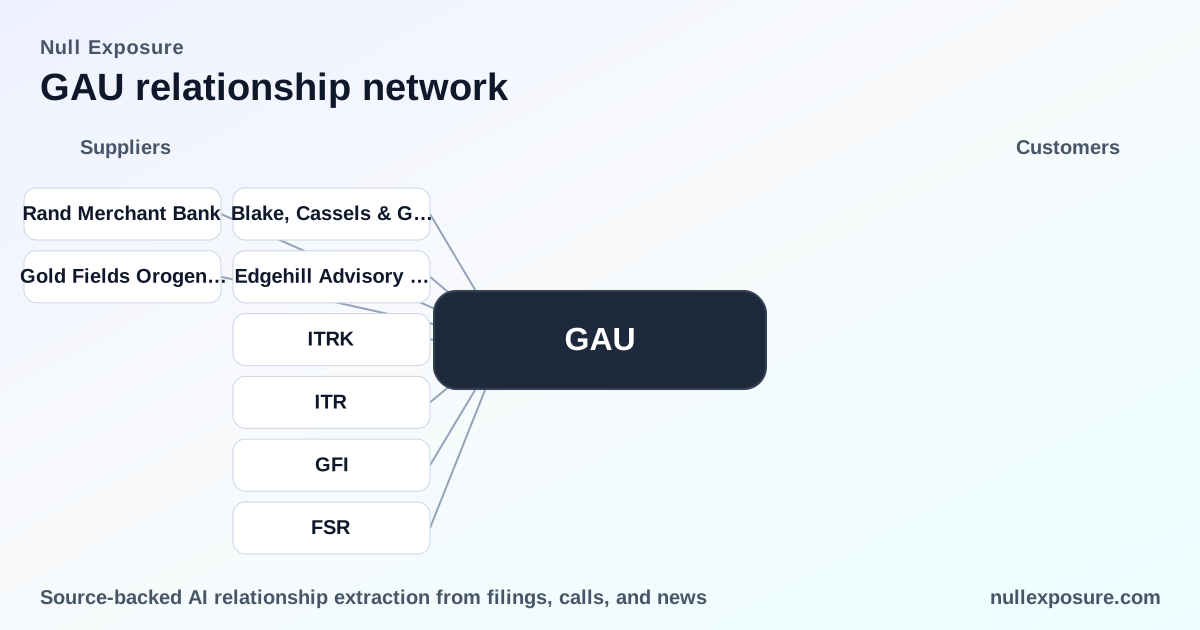
Galiano Gold (GAU): ETF Inclusion Amplifies Liquidity, Not a Strategic Customer Contract
Galiano Gold operates as an integrated gold explorer, developer and producer that monetizes primarily through gold sales from its producing assets and near-term development projects. The company’s cash flow profile is commodity-driven: revenue and margins fluctuate with realized gold prices and production volumes, while capital intensity and development timelines shape contracting and financing posture. For investors and operators, the recent market-access events increase share demand and liquidity but do not change the underlying operating leverage to gold prices or project execution.
If you track corporate relationships and market signals for portfolio construction, you can explore more on Null Exposure: https://nullexposure.com/
How Galiano actually earns money — a concise business model view
Galiano Gold sells produced gold and advances development projects toward production, capturing value through physical metal sales and the step-up in asset value that accompanies de-risking and production scale-up. Revenue TTM of $328.4M and gross profit of $128.8M confirm active commercialization, while negative EPS (-$0.11) and operating margin signals highlight ongoing reinvestment and cost pressure. Cash generation today is real but remains exposed to cyclical commodity prices and the capital demands of mining operations.
Key commercial characteristics:
- Commodity exposure: Revenues are directly tied to gold price realizations and production volumes.
- Capital intensity: Development and sustaining capital needs create sensitivity to financing conditions and working capital.
- Market-financed growth: Valuation multiples (EV/EBITDA 5.27; EV/Revenue 1.17) imply markets are pricing in future cash generation while rewarding scale.
Operating constraints and business-model signals investors should weigh
Galiano’s corporate signals influence contracting posture, concentration risk, criticality to counterparties, and maturity as an operator:
- Contracting posture — project and commodity oriented. Contracts typically center on equipment, mining services, and commodity sales rather than long-term customer offtakes; procurement cycles and capex commitments are the operational drivers.
- Concentration — capital and ownership. Institutional ownership is high at ~74%, while insider ownership is negligible at ~0.44%, indicating investor concentration that can amplify flows into and out of the stock.
- Criticality — limited to the commodity channel. Galiano is critical to commodity buyers only as a marginal source of supply; it is not dependent on a small set of strategic customers for revenue, which reduces counterparty concentration risk but increases exposure to spot market dynamics.
- Maturity — producing with development upside. The company is engaged across exploration, development and production, which signals a mixed operating maturity: established cash receipts today alongside ongoing development execution risk.
These are company-level signals derived from publicly reported metrics and the firm’s stated operating scope.
Financial posture and market reception
Market metrics provide a lens into investor expectations and volatility:
- Market capitalization roughly $595M; EBITDA $83.5M; Price-to-Book ~2.77.
- Analyst coverage is positive-leaning with consensus target around $4.25 and ratings skewed toward Buy/Strong Buy.
- Liquidity and volatility: Beta of 1.55 and a 52-week range of $1.19–$3.62 suggest above-market price swings, appropriate for a mid-cap precious-metals operator.
- Profitability profile: While gross profit is healthy, negative operating margin and EPS reflect either elevated depreciation, exploration spend, or one-time items coupled with reinvestment for growth.
Together these figures imply that the market prices both current production value and development optionality, but also discounts operational and commodity risk.
Market relationship: inclusion in VanEck Junior Gold Miners ETF (GDXJ)
Galiano was added to the VanEck Junior Gold Miners ETF (GDXJ) as part of GDXJ’s semi-annual rebalancing, with the inclusion effective at market close on March 20, 2026. According to a Newsfile press release dated May 3, 2026, the ETF’s reweighting brought Galiano into the passive junior-gold index basket (https://www.newsfilecorp.com/release/288767/Galiano-Gold-Announces-Inclusion-in-the-GDXJ).
This inclusion is a market-access relationship: it increases passive demand for GAU shares and improves index-driven liquidity, but it does not create a commercial customer contract or change operating economics.
Why ETF inclusion matters for investors and operators
ETF inclusion has operationally neutral but market-significant consequences:
- Immediate liquidity and demand: Passive funds tracking GDXJ will purchase shares to replicate the index, producing a predictable near-term source of buy-side demand.
- Volatility dampening in the mid-term: Broader ownership via ETFs can reduce bid-ask spreads and improve depth, although it also exposes the stock to index rebalancing cycles.
- No change to production or counterparty exposures: This is a market-structure event rather than an operational partnership; it does not alter supply contracts, offtake arrangements, or project execution risks.
Investors should distinguish between capital-market relationships and operational customers — one shifts share demand, the other changes cashflow dynamics.
If you want structured coverage of GAU’s evolving market relationships, see our hub: https://nullexposure.com/
Risks and opportunities driven by relationships and corporate signals
- Opportunity: Index inclusion can attract new institutional holders and specialist mining ETFs, improving liquidity and potentially supporting multiple expansion if operational performance continues to improve.
- Risk: Elevated institutional ownership increases sensitivity to index flows and manager decisions; an ETF reweighting out could create outsized supply shocks. Operating leverage to gold prices remains the dominant earnings driver.
- Execution sensitivity: Development projects and sustaining capital schedules remain primary operational risks—market reception cannot substitute for on-the-ground delivery.
Bottom line: Galiano’s inclusion in GDXJ is a positive liquidity event, not a strategic revenue partnership. Investors should focus on production trends, realized gold prices, and project execution while treating ETF membership as a source of market demand that can amplify both upside and downside.
Final takeaway for portfolio and operations teams
Galiano Gold is a commodity-exposed producer with tangible revenue and EBITDA, complemented by development upside. The GDXJ inclusion strengthens the stock’s market plumbing and investor base, enhancing liquidity without altering the company’s fundamental operating profile. For allocators and corporate operators, the priority remains monitoring production execution, capital allocation, and sensitivity to gold prices; index flows are a market force to manage, not a substitute for operational performance.
For ongoing updates on GAU and comparable issuer relationships, visit Null Exposure’s research center: https://nullexposure.com/