Global Indemnity Group (GBLI): customer relationships and what they mean for investors
Global Indemnity Group underwrites specialty property & casualty products and monetizes through premiums on core Penn‑America lines while selectively divesting non‑core renewal rights. The company distributes via wholesale general agents, retail agents and direct channels, and extracts value both from ongoing premium flow and one‑time monetizations of renewal rights and legacy blocks. For institutional investors assessing counterparty exposure, the mix of active distribution, periodic divestitures, and a material premiums base underpins GBLI’s cash generation profile. For more relationship intelligence, visit https://nullexposure.com/.
Business model in plain English: where revenue and risk concentrate
GBLI operates two clear segments: Penn‑America (core) and Non‑Core Operations (legacy and transitional). Penn‑America houses the company’s active specialty product lines—Wholesale Commercial, Specialty Products, InsurTech, and Assumed Reinsurance—and generates the recurring premium stream that drives valuation multiples. Non‑Core Operations manages claims and transition service agreements tied to businesses that GBLI has de‑emphasized or sold; these units are a residual earnings drag or one‑time monetization source depending on management action.
Key operating characteristics to weigh:
- Contracting posture: distributed, agency‑led — GBLI relies on a network of roughly 360 wholesale general agents, 2,800 retail agents and direct offerings, which makes the company a distribution‑heavy insurer rather than a captive distributor. This implies consistent revenue access but also dependence on third‑party relationships for customer acquisition (signal from company filings).
- Concentration and criticality: material but diversified — Penn‑America reported gross premiums written of about $400 million in 2024, so the premiums base is material to revenue, but distribution across thousands of agents and all 50 U.S. states reduces single‑counterparty concentration risk (company filings indicate national licensing).
- Counterparty mix: individuals and small businesses — The underwriting footprint targets both individual retail policyholders and Main Street small businesses (artisan contractors, landlords, restaurants), which shapes product risk and claims volatility.
- Segment maturity: mixed — Core lines are active and growth‑oriented; Non‑Core is deliberately being wound down or monetized through renewal‑rights sales and transitional agreements, generating episodic cash flows.
- Spend and scale signal: enterprise‑level premiums — The scale of gross written premium places GBLI in a mid‑market specialty insurer category with >$100M premium scale in core operations, affecting bargaining leverage with distribution partners and counterparties.
Customer transactions observed: sales of renewal rights and portfolio exits
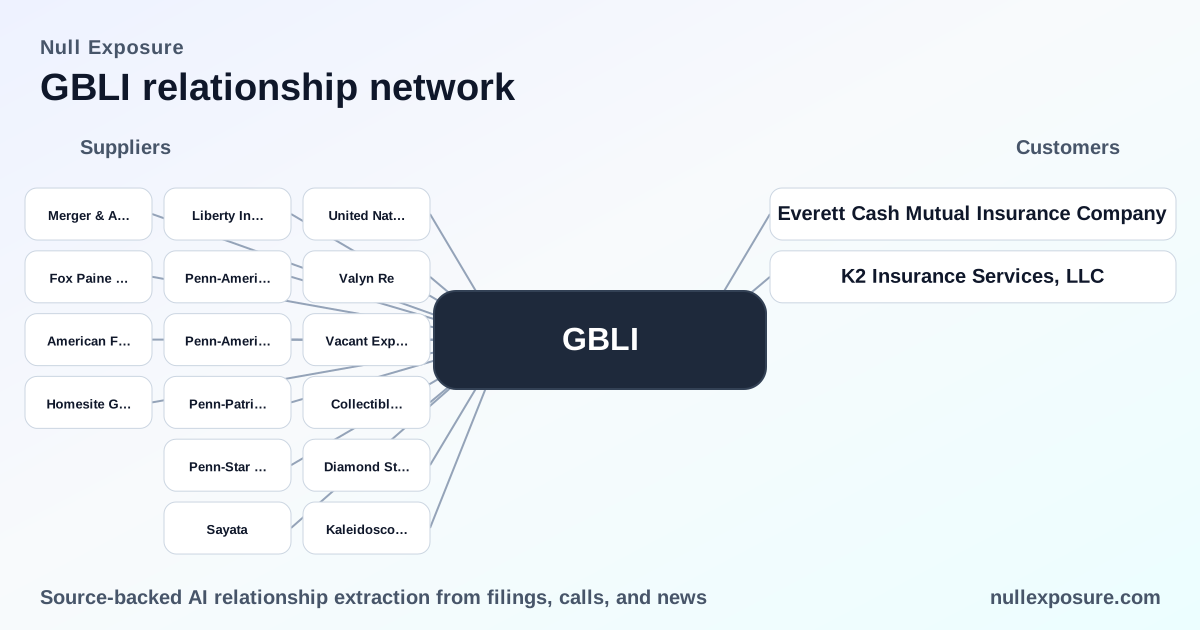
GBLI’s customer relationships have two documented transactional outcomes in recent filings and press reports: the sale of renewal rights for a farm-centric block to Everett Cash Mutual, and the divestiture of a specialty residential property business to K2 Insurance Services. Both are explicit operational choices that reduce legacy exposure and convert future renewal streams into current proceeds.
Everett Cash Mutual Insurance Company
GBLI sold the renewal rights for its Farm, Ranch & Stable business (policies written on or after August 8, 2022) to Everett Cash Mutual Insurance Company. This transaction represents a targeted exit of a legacy specialty line, transferring renewal economics and claims run‑off responsibilities. According to GBLI’s 2024 Form 10‑K, the sale of renewal rights occurred on August 8, 2022 (10‑K, FY2024).
K2 Insurance Services, LLC
K2 Insurance Services acquired GBLI’s American Reliable specialty residential property business, including manufactured home and dwelling lines, in a prior divestiture. That sale removed an active specialty residential block from GBLI’s portfolio and shifted associated distribution and underwriting responsibility to K2. A 2021 industry report on ProgramBusiness covered the K2 acquisition of the American Reliable specialty property business (ProgramBusiness, 2021).
What these relationships collectively say about GBLI’s strategy
- Purposeful portfolio pruning. GBLI is actively monetizing or shedding certain product lines via renewal‑rights sales and business transfers, signaling a strategy to concentrate capital and underwriting attention on core Penn‑America products.
- Decreased legacy tail, increased active product focus. Transfers of renewal rights reduce long‑tail claim uncertainty and free up capital that can be redeployed into growth segments or returned to shareholders.
- Distribution dependence remains central. Even as blocks are sold, GBLI’s economics remain tied to a broad agent network; managing those distributor relationships is a primary operational task (10‑K disclosures).
Investment implications and risk factors
- Earnings quality improves with divestitures when sales convert future premium runoff into present cash; however, recurring revenue growth depends on the success of Penn‑America’s distribution channels. The company’s 2024 gross premiums written for Penn‑America exceeded $400M, which is a meaningful revenue base.
- Counterparty and geographic diversification reduce single‑point failure, given licensing in all U.S. jurisdictions and thousands of retail and wholesale agents, but management explicitly recognizes that the loss of material distribution partners could adversely affect revenue.
- Valuation context. GBLI trades at a trailing P/E of approximately 15.5 with a forward P/E around 10.7 and a Price‑to‑Book near 0.58, reflecting market expectations that divestitures will improve future profitability while leaving material underwriting risk intact.
- Operational execution matters. The profitability swing from renewing and growing Penn‑America lines versus offloading legacy portfolios hinges on retention across the agent network and underwriting discipline.
Bottom line for investors
GBLI’s customer relationships show a deliberate move to streamline product mix and transfer legacy renewal economics to specialized buyers. That strategy strengthens the quality of recurring earnings but keeps the business dependent on a large, distributed agent network for growth. For investors focused on mid‑market specialty insurers, GBLI offers a clear trade: discounted book value and improving forward P/E against underwriting volatility tied to its chosen markets and distribution partners.
For a deeper read across GBLI’s counterparties and how similar deals affect carrier economics, explore more at https://nullexposure.com/.
Sources used in this note include GBLI’s 2024 Form 10‑K and contemporaneous industry reporting such as the ProgramBusiness coverage of the American Reliable sale.