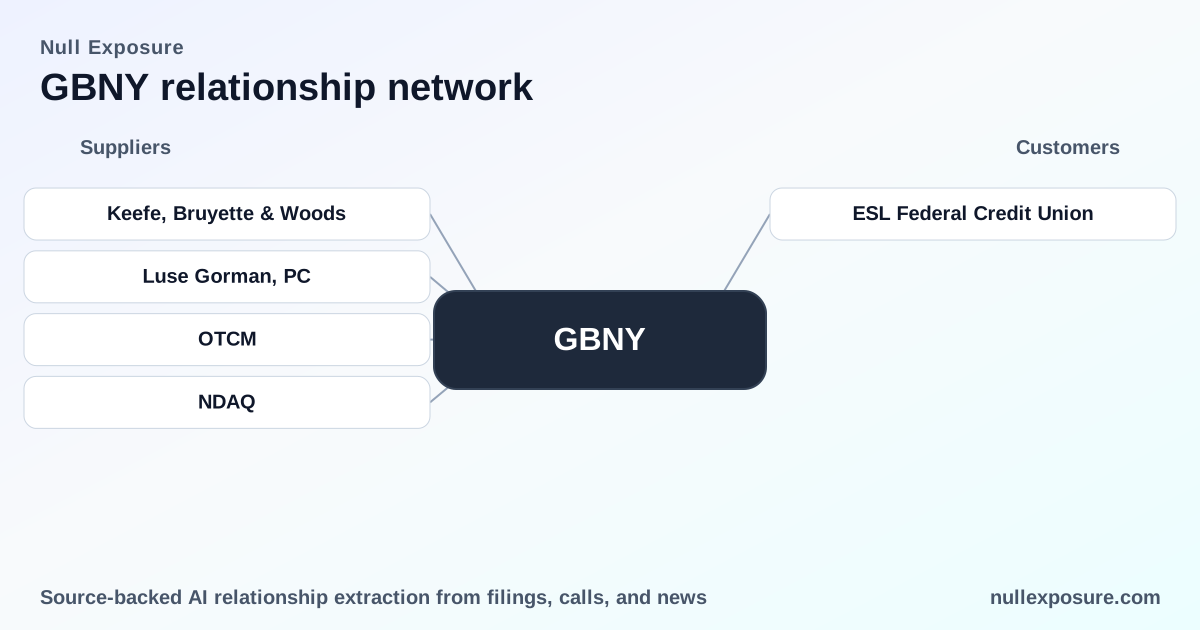
Generations Bancorp NY (GBNY) — local bank with community deposits, now in transition
Generations Bancorp NY operates as a community-focused savings and commercial bank: it collects retail and municipal deposits across the Finger Lakes region, then monetizes those funds through mortgages, one- to four-family residential lending, home equity products, and investment securities while also offering insurance and commercial lending through affiliated service lines. Recent transactional activity has shifted the company from a standalone community bank model into a phase where its core assets have been transferred to a regional credit union, changing funding dynamics and counterparty exposures for investors and counterparties.
For more background on relationship analytics for regional banks, visit https://nullexposure.com/.
What the customer footprint tells investors about GBNY’s operating posture
Generations Bank’s business model shows the classic community-bank profile: high local concentration, diversified retail and municipal deposit sources, and a lending book centered on one- to four-family residential real estate. The company’s own disclosures identify a mix of counterparties that drives its funding and credit risk:
- Counterparty mix: The bank serves individual retail depositors, municipal and government entities, non-profits, and small businesses, reflecting a local retail-commercial banking franchise that relies on both household and public-sector balances for liquidity.
- Geographic concentration: The franchise footprint is firmly northern Finger Lakes and parts of adjacent counties in New York State — the bank generated the majority of deposits from this primary market and operates eight full-service offices and a drive-through branch across the region.
- Funding composition and materiality: Management disclosed municipal and institutional exposures that, while not constituting a single dominant customer, sum to material pools — the bank reported approximately $34.0 million in deposit relationships above $250,000 across municipal, agency and similar counterparties, and Generations Commercial Bank held $9.2 million of municipal deposits at December 31, 2023. This places key public-sector balances in the $10m–$100m spend band context for the enterprise.
- Business role and maturity: The company functions as both seller of loan products and service provider of retail banking services and insurance (via Generations Agency), and is a long-established regional institution (operations traceable to 1870), implying a mature operating model and entrenched local relationships.
Collectively these signals point to a contracting posture that is community-anchored and relationship-driven, not a wholesale or national liquidity model. That posture creates concentration risk at the regional level while delivering stable deposit funding sourced from both households and local public entities.
Every documented customer relationship (transparent, no omissions)
ESL Federal Credit Union — acquirer of substantially all assets
ESL Federal Credit Union completed acquisition of substantially all assets of Generations Bancorp NY, Inc., effective January 1, 2026, transferring the bank’s core asset base to a larger regional credit union and altering the counterparty landscape for former depositors and service partners. According to a news report from FingerLakes1 on January 4, 2026, the transaction closed at the beginning of 2026 and represents the principal corporate action documented in public channels. (Source: FingerLakes1, Jan 4, 2026)
Commercial implications of the ESL transaction for counterparties and operators
The transfer of “substantially all assets” to ESL is a defining inflection point for investors and counterparties:
- Funding and liquidity shift: Public-sector and large retail deposit balances that underpinned GBNY’s balance sheet will now sit on ESL’s funding platform, removing a local source of deposit variability from the legacy balance sheet and consolidating those relationships with a larger cooperative institution.
- Service continuity and operational transition: Insurance, lending pipelines, loan servicing, and deposit servicing will require migration or integration under new operational arrangements, creating short-term execution risk for counterparties and vendors who relied on Generations as a counterparty.
- Valuation and closing mechanics: Asset transfers of this scope typically include loan portfolios, securities, and deposit assumptions; investors should expect changes in asset composition, credit administration, and capital reporting post-closing.
For practitioners assessing counterparty exposure, the transaction reduces the independent systemic footprint of Generations as a separate deposit-taking entity while concentrating customer relationships within ESL’s expanding local footprint.
Constraints and company-level risk signals that inform diligence
Use these company-level excerpts from GBNY disclosures to guide contractual and credit diligence (presented here as operating signals, not attached to any single external counterparty unless explicitly named):
- Public-sector exposure is meaningful but not dominant. The firm reported municipal and similar institutional relationships that together accounted for about $34.0 million of deposits above $250,000 as of Dec 31, 2023, and $9.2 million in municipal deposits held by the commercial bank subsidiary. These balances are material to funding and can influence liquidity under stress.
- Local-market dependency. The majority of deposits and lending activity are concentrated in the Finger Lakes region and adjacent counties, so credit and deposit performance correlate with local economic cycles.
- Diverse counterparty types. Retail consumers, small businesses, municipalities, and non-profits compose the counterparty mix, implying varied credit characteristics and product demand cycles across segments.
- Limited single-customer concentration statement. Management states there are no significant concentrations in a single industry or customer, providing some diversification within the regional model.
- Service-oriented revenue mix. The bank combines deposit-taking, residential mortgage origination/purchase, and insurance distribution under its services segment, which spreads revenue sources but also links bank performance to local real estate markets and insurance sales activity.
These constraints underline concentration at the regional level, moderate materiality of public deposits, and operational maturity — factors that will shape integration outcomes now that assets have moved to ESL.
Risks to monitor and what investors should track next
- Integration execution: Track ESL’s operational integration plans, timeline for migrating deposits and loan servicing, and third‑party vendor transitions; integration cost and customer attrition are primary risk vectors.
- Asset-quality disclosure post-transfer: Monitor post-closing reporting for any legacy nonperforming loans retained or carved out, and for changes in loan-servicing performance metrics.
- Municipal deposit behavior: Although municipal balances are relatively concentrated locally, their behavior under new custodianship will affect liquidity; confirm whether municipal depositors remain with ESL or redistribute to other banks.
- Local economic exposure: Continued sensitivity to Finger Lakes housing and small-business performance will drive credit cycles that affect realized losses and servicing workloads.
Bottom line for investors and operators
- The ESL acquisition materially changes GBNY’s counterparty and funding landscape by migrating the bank’s core assets to a larger regional credit union.
- Generations’ business model was a stable, relationship-driven community bank reliant on a mix of retail, municipal, non-profit, and small-business deposits concentrated in the Finger Lakes area.
- Key diligence items for counterparties and acquirers are integration execution, municipal deposit behavior, and post-closing asset quality.
For a deeper read on counterparty mapping and customer-level exposure analytics for regional financial institutions, explore additional resources at https://nullexposure.com/.