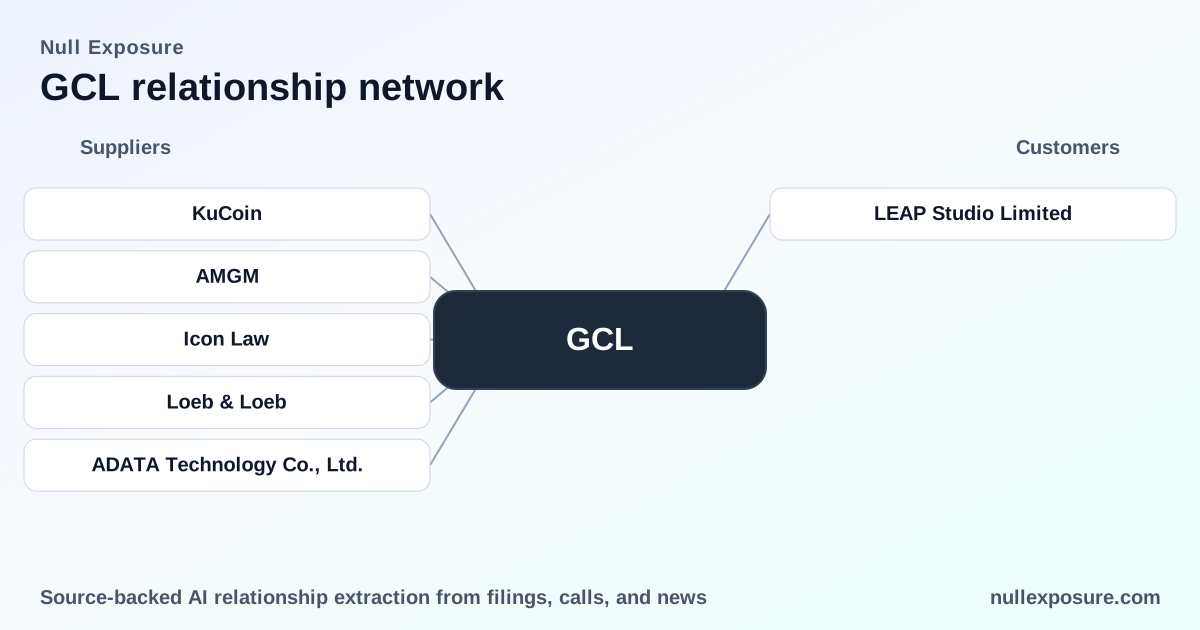
GCL Global Holdings: distribution-led games company with publishing leverage and concentrated ownership
GCL Global Holdings operates as a game developer, publisher, retailer and distributor that monetizes through direct game sales, third‑party publishing agreements and distribution partnerships that place titles on major storefronts and through regional distributors. The company's go‑to‑market runs through its publishing arm 4Divinity and branded content unit Titan Digital Media, which together convert owned and partner intellectual property into monetized releases across platforms such as Steam and regional retail channels.
For investors evaluating customer relationships, focus on the strategic function of each partner: platform access (Steam), third‑party distribution (Syngrid), and upstream IP sourcing / co‑investment (LEAP). These relationships shape revenue visibility and distribution reach more than they change GCL’s capital structure. If you want a consolidated feed of uncovered partner signals, see the team at https://nullexposure.com/ for ongoing monitoring and collection.
Quick investor snapshot: what the company’s financials and ownership say
GCL is a small‑cap, niche publisher with market capitalization around $62.6 million and trailing revenue of $189.9 million (TTM). Gross profit totaled $25.1 million with a slim net profit margin of 0.53% while operating margin is negative at -6.71%, signaling current operating drag despite positive top‑line scale. Trailing P/E is ~51x on a very small EPS base; EV/Revenue of 0.536 and EV/EBITDA of 13.86 reflect modest valuation relative to peers in the indie publishing space.
Ownership is highly concentrated: insiders control roughly 74.5% of shares while institutional ownership is negligible at 0.3%, which translates into tight control, limited free float and low analyst coverage. These structural facts drive both governance dynamics and trading liquidity for investors.
How GCL structures commercial relationships — operating model signals
GCL’s commercial posture is publisher‑led and partnership‑centric. The company signs time‑defined publishing/distribution agreements (multi‑year where appropriate) and pursues minority equity stakes in studios to secure exclusive publishing rights. That operating model implies:
- Contracting posture: preferential use of exclusive publishing terms and multi‑year distribution agreements that lock content flow and provide revenue share predictability.
- Concentration and criticality: single platform placements (for example, a Steam launch) and exclusive publisher arrangements increase the commercial importance of each partner, making each relationship strategically material to near‑term revenue potential.
- Maturity and scale: GCL is executing an acquisition/partnership playbook typical of early‑growth publishers—aggressive on exclusive rights and small‑equity stakes rather than large studio M&A—so portfolio diversification is incremental rather than immediate.
These company‑level signals inform how investors should size exposure: expect episodic revenue boosts tied to discrete releases, and control risk from concentrated share ownership.
The three relationships that shape near‑term distribution and publishing
Syngrid Technology HK Limited — regional distribution agreement
GCL’s publishing arm 4Divinity signed a three‑year distribution agreement with Syngrid that grants Syngrid rights to distribute titles from 4Divinity’s library and enables customer activation through official websites or client platforms. This is a classic regional distribution play that extends GCL’s reach into Syngrid’s channels. (Source: FinancialContent report on the Syngrid partnership, reported March 2026.)
LEAP Studio Limited — equity stake and exclusive global publishing rights
GCL negotiated a term sheet to take a potential 20% equity stake in LEAP, alongside an arrangement for LEAP to appoint 4Divinity as exclusive global publisher for its upcoming title "Realm of Ink" (墨境). This represents a vertical move: a minority investment to secure exclusive publishing rights and upstream IP flow into GCL’s publishing pipeline. (Source: GlobeNewswire release, March 2025, describing the term sheet and proposed partnership.)
Steam — primary PC platform distribution for titles
GCL’s subsidiary 4Divinity and Titan Digital Media executed a PC release on Steam for the title “Island of Hearts,” listing the game at a consumer price point with a limited‑time launch discount. Placement on Steam provides immediate global storefront access and is the distribution backbone for GCL’s PC revenue stream. (Source: GlobeNewswire announcement, March 2026, detailing the Steam launch.)
What these relationships collectively indicate about commercialization
Taken together, the three relationships illustrate a deliberate funnel strategy: secure IP through equity and exclusive publishing (LEAP), distribute regionally through local partners (Syngrid) and monetize globally through platform releases (Steam). That funnel supports predictable release‑driven cash flow while keeping capital commitments modest by using equity positions and partner networks rather than large outright studio acquisitions.
- Revenue concentration risk: single title launches on Steam and a limited slate of published games create episodic revenue patterns. Investors should anticipate volatility tied to release cadence.
- Distribution leverage: regional distribution agreements expand market access with low incremental cost, improving margin potential on established titles.
- IP control without heavy capex: minority equity stakes in studios create upside participation in hit titles without the cash drain of full acquisitions.
Risks, fragilities and strategic levers for investors
Key risk factors are release execution, platform dependency, and limited liquidity. A failed launch or weaker-than-expected uptake on Steam materially reduces near‑term throughput because GCL relies on a small number of monetization events per fiscal period. High insider ownership reduces takeover risk but also constrains market float and institutional participation.
Strategic levers that improve the risk/return profile are clear: broaden the publishing slate to reduce single‑title volatility, deepen non‑platform revenue (direct activation channels and regional distribution), and increase disclosure to attract institutional investors and raise free‑float liquidity.
For ongoing monitoring of GCL’s partner signals and how contracts convert into revenue, visit https://nullexposure.com/ for the company’s relationship tracking and alerting service.
Bottom line for investors
GCL operates a capital‑efficient publishing and distribution model that leverages minority investments and third‑party distribution to scale reach. The company’s Steam placements, regional distribution partnership with Syngrid and the proposed LEAP stake together create a pipeline of publishable IP and distribution capacity—but they also concentrate revenue around discrete releases. Investors should value GCL as a small‑cap, release‑driven publisher with significant insider ownership and high operational leverage to execution on its publishing calendar.