GCM Grosvenor (GCMG) — customer relationships that drive revenue and risk
GCM Grosvenor runs a global alternatives investment platform that earns primarily from management and incentive fees by structuring customized separate accounts and specialized funds across private and public markets. The firm monetizes scale and bespoke solutions: large institutional commitments to multi-year private strategies produce predictable fee streams, while liquid absolute‑return strategies generate shorter‑duration fee and performance opportunities. For investors, the revenue profile is therefore a mix of highly recurring long‑dated contracts and select, annually evaluated products that amplify upside through incentive fees.
For a concise view of the company and related analytics, see the firm homepage: https://nullexposure.com/
How GCM Grosvenor’s operating model shapes customer economics
GCM Grosvenor’s commercial posture is concentrated and service‑oriented. The company structures relationships that are often multi‑year and bespoke, with customized separate accounts requiring significant minimum commitments and long expected durations. At the same time, the firm offers more liquid, short‑term absolute‑return strategies that produce annual performance‑fee opportunities and client liquidity options.
- Contracting posture: Private markets commitments typically involve a multi‑year invest‑in period (commonly three years) and long expected durations (seven years or more), underpinning recurring management fees; absolute‑return products provide shorter‑term cash flow and redemption flexibility, supporting fee variability.
- Counterparty mix and concentration: Clients span both large institutional investors and a growing individual investor base; the top 25 clients are material to the business and have historically been long‑standing relationships, contributing the bulk of new capital.
- Geographic footprint: The company is global, with business and exposures across North America, EMEA, APAC and Latin America, which introduces cross‑jurisdictional revenue sources and operational complexity.
- Role and maturity: GCM functions primarily as a service provider and manager, not a simple distributor — relationships are mature, often lasting decades, and many deliver recurring fee revenue tied to assets under management.
- Spend and scale: Customized separate accounts are generally targeted at large commitments (commonly $100 million or more), supporting a high‑value client base and fee density.
These are company‑level signals drawn from filings and investor materials; they explain why fee visibility is strong on private mandates and more variable in liquid strategies.
Key customer relationships: what investors should track
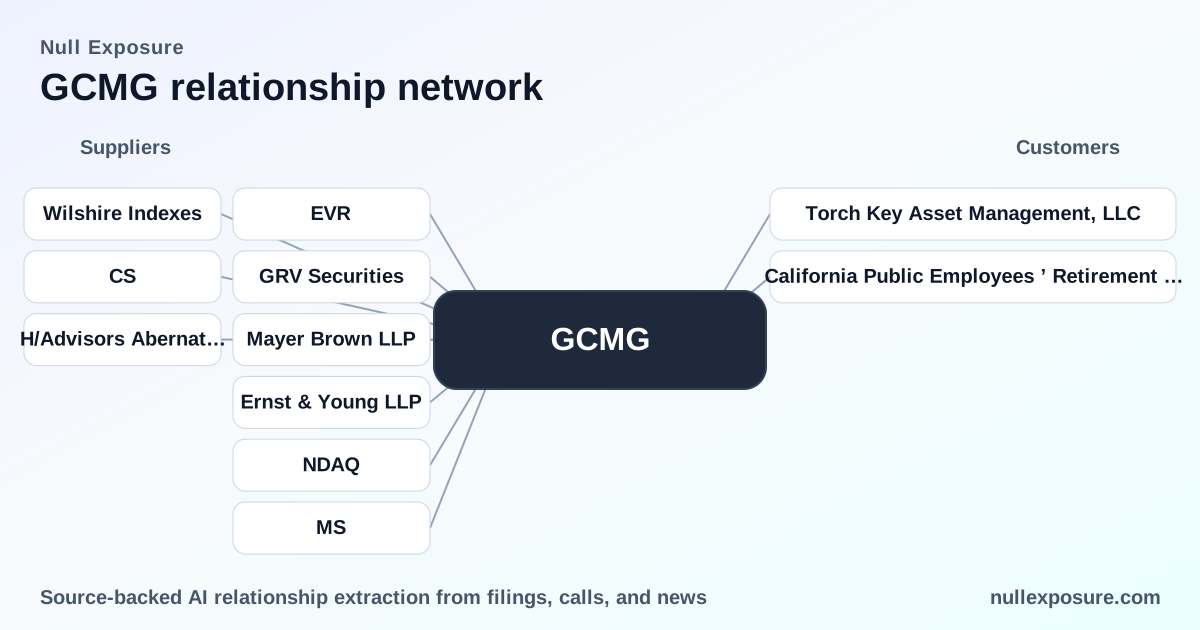
Torch Key Asset Management, LLC
Torch Key is publicly reported as a recipient of funding from GCM Grosvenor in multiple company news and investor materials in 2025–2026, indicating a capital relationship consistent with GCM’s seeding or strategic funding activity for emerging managers (see MarketScreener reports and the company’s investor‑day transcript, March–May 2026: https://www.marketscreener.com/news/gcm-grosvenor-posts-investor-day-presentation-and-announces-dividend-increase-ce7d5aded08ef623; https://www.marketscreener.com/news/transcript-gcm-grosvenor-inc-analyst-investor-day-ce7d5adfdd8df020).
California Public Employees’ Retirement System (CalPERS)
CalPERS is disclosed as a cornerstone investor in GCM Grosvenor’s Elevate fund, having launched the strategy with a $500 million commitment alongside other institutional investors—an explicit example of GCM’s ability to attract large public‑pension capital into debut seeding solutions (The Globe and Mail, March 2026 press release: https://www.theglobeandmail.com/investing/markets/stocks/GCMG/pressreleases/30574179/gcm-grosvenor-elevate-fund-holds-final-close-at-nearly-800-million-the-largest-debut-private-equity-seeding-fund-of-its-kind-signaling-strong-continued-support-for-small-and-emerging-firm-founders/).
Sumitomo Mitsui Trust Bank, Limited
GCM Grosvenor entered a Share Purchase Agreement with Sumitomo Mitsui Trust Bank, Limited, documented in the company’s SEC filing (Form 10‑K / 8‑K disclosures in 2025), reflecting a counterparty relationship that is contractual and material enough to be included in regulatory exhibits (GCM Grosvenor 2025 SEC filing, April 2025: https://www.sec.gov/Archives/edgar/data/1819796/000181979626000010/gcm-20251231.htm).
What these relationships imply for investors
- Seeding and strategic funding: The recurring references to Torch Key and the Elevate fund illustrate GCM’s active role in seeding and supporting emerging managers, which produces both potential carry upside and concentrated balance‑sheet exposures while enhancing long‑term fee pipelines.
- Institutional validation: A $500 million anchor commitment from CalPERS to an inaugural fund is an institutional endorsement that accelerates fundraising credibility for GCM’s seeding strategies and widens distribution to other pension and endowment clients.
- Counterparty and capital relationships documented in filings: The Sumitomo Mitsui Trust Bank agreement shows GCM’s engagement with large financial institutions at a transactional level, consistent with its global client and partner set.
Risk and opportunity — the investor checklist
- Concentration risk is real and material. The company discloses that its largest clients have been with GCM for long periods and contributed the majority of capital raised, which is a double‑edged sword: high fee visibility from existing mandates but meaningful sensitivity if a major client reallocates.
- Contract duration drives cash flow quality. Long private‑market commitments create predictable management fees but also lock up capital and concentrate operational risk on long investment horizons; shorter‑term products supply fee volatility tied to performance and redemptions.
- Scale and minimums favor large clients. Customized separate accounts, typically available for $100 million+ commitments, are a high‑margin engine but limit the pool of prospective buyers and concentrate counterparty exposure.
Bottom line: durable fee engine with concentrated client dynamics
GCM Grosvenor’s customer relationships combine durable, long‑dated private‑markets mandates with targeted shorter‑term products that amplify annual performance income. CalPERS’ large anchor commitment and documented funding activities with managers like Torch Key reflect the firm’s strategy to both provide capital and monetize fee streams across its platform, while regulatory exhibits such as the Sumitomo Mitsui agreement highlight transactional relationships with large financial institutions.
For investors and operators focused on revenue durability and client concentration risks, the critical metrics to monitor are client retention among the top cohorts, inflows into customized accounts versus liquid strategies, and the pace and scale of seeding activity that affect balance‑sheet exposure.
Explore these customer relationships and how they map to revenue risks and opportunities in greater depth at https://nullexposure.com/