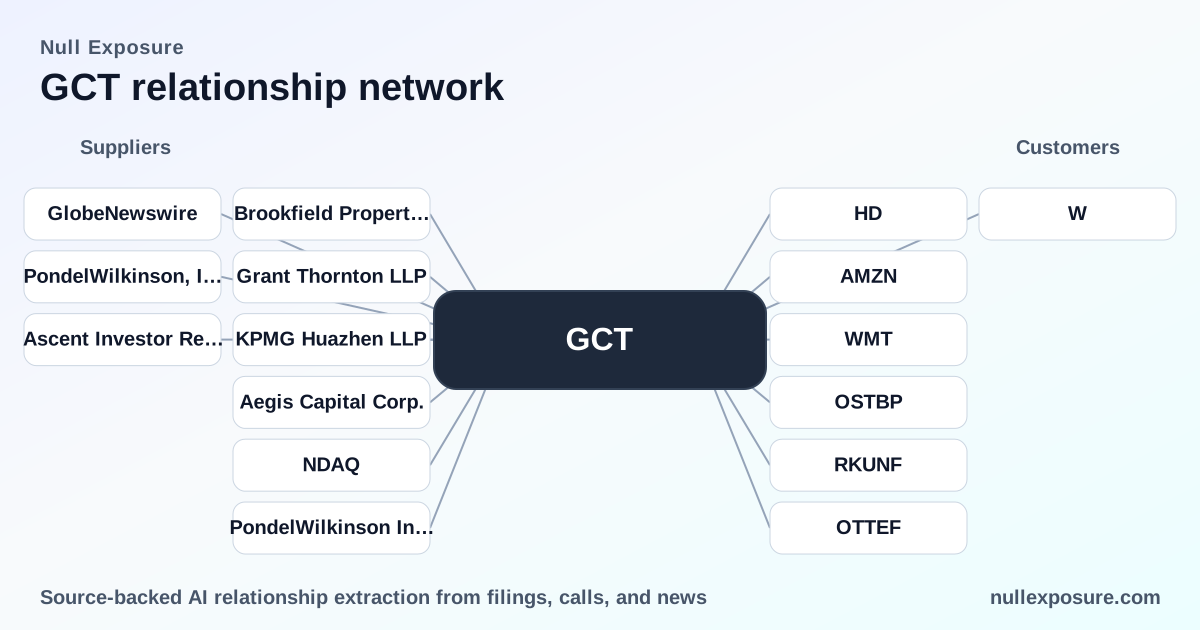
GigaCloud (GCT): Marketplace reach, fulfillment leverage, and where the revenue comes from
GigaCloud operates a global B2B e-commerce marketplace that connects primarily Asian manufacturers with resellers and end customers in North America, Europe and Asia, and monetizes through blended product sales (1P inventory) and service revenues (3P marketplace commissions, warehousing, transport and last‑mile fees). The company’s economics are driven by high take‑rates on logistics and fulfillment services, usage‑based storage and delivery fees, and growing buyer spend per account — the marketplace accounted for 64.7% of revenue in 2024 and demonstrates fast user and GMV scale. For readers evaluating customer relationships, the critical questions are concentration, contractual posture (usage‑based fees), geographic diversification and the degree to which large retail platforms are distribution channels versus strategic partners. Learn more at NullExposure.
How GigaCloud’s operating model shapes customer risk and upside
GigaCloud charges sellers storage fees by days and size, and buyers flat last‑mile delivery fees that vary by weight, which creates a usage‑based contracting posture tied directly to inventory turns and shipment volumes. The marketplace is material to overall revenue — more than half of sales — and has moved from early scale to a mature multi‑regional platform with active buyer and seller counts rising substantially in 2022–2024. Balance‑sheet concentration is notable: one customer represented over 10% of accounts receivable at year‑end 2024, which underscores counterparty credit and collection risk despite broad buyer numbers. Geographically, GigaCloud operates fulfillment centers across the U.S., Japan, the U.K., Germany and Canada and reports buyer bases in North America, APAC and EMEA, giving the company genuine global reach while exposing it to cross‑border logistics complexity.
- Contracting posture: Predominantly usage‑based fees for storage, warehousing and delivery; revenue scales with inventory days and shipment weight.
- Concentration: Platform revenue is material; a single customer exceeded 10% of AR in 2024 — a concentration risk to monitor.
- Criticality: Fulfillment and logistics services are core monetization levers and differentiate the platform from pure marketplace competitors.
- Maturity: Active 3P sellers increased to 1,111 in 2024 and buyers to 9,306, reflecting platform maturation and rising spend per buyer (~$144k).
If you want a concise view of customers and what they mean to GigaCloud’s revenue mix, visit NullExposure for structured relationship intelligence.
Customer relationships mentioned in the public record (each entry covered)
Below are every customer relationship referenced in the collection of public signals; each entry is summarized in plain language with the public source cited.
Otto Group
GigaCloud will leverage its supplier network and technology to expand Otto’s assortment on Otto’s platform under a collaboration announced in the press (initiative framed around assortment expansion). A news report from Investing.com documented this initiative in May 2026. (Investing.com, May 3, 2026)
Home Depot
GigaCloud lists Home Depot among off‑platform ecommerce channels through which it sells product, indicating Home Depot is a distribution channel for 1P or off‑platform sales. This is described in GigaCloud’s FY2024 Form 10‑K. (GigaCloud 2024 Form 10‑K, FY2024)
HD (repeat entry in 10‑K)
Home Depot is again referenced in the company’s 10‑K as an off‑platform ecommerce outlet, confirming the platform‑to‑retailer route for product sales. (GigaCloud 2024 Form 10‑K, FY2024)
Amazon
Amazon is identified as an off‑platform ecommerce website GigaCloud uses to reach end customers, positioning Amazon as a retail distribution channel rather than a strategic equity partner. (GigaCloud 2024 Form 10‑K, FY2024)
AMZN (repeat entry in 10‑K)
Amazon receives a second mention in the 10‑K in the same context, reinforcing its role as a channel for product sales to individual customers. (GigaCloud 2024 Form 10‑K, FY2024)
Walmart
Walmart is included among off‑platform ecommerce websites used to distribute GigaCloud inventory, indicating GigaCloud sells into mass retail channels in the U.S. (GigaCloud 2024 Form 10‑K, FY2024)
WMT (repeat entry in 10‑K)
Walmart is referenced again in the filing, reiterating the channel relationship cited elsewhere in the 10‑K. (GigaCloud 2024 Form 10‑K, FY2024)
Overstock
Overstock is listed as an off‑platform ecommerce partner where GigaCloud offers product, suggesting reach into online home‑goods retail channels. (GigaCloud 2024 Form 10‑K, FY2024)
OSTBP (repeat entry in 10‑K)
Overstock receives an additional mention in the same 10‑K passage, confirming the off‑platform relationship. (GigaCloud 2024 Form 10‑K, FY2024)
OTTEF (OTTO Germany)
The filing names OTTO (Germany) as a channel, and the company specifically calls out OTTO in a roster of off‑platform ecommerce websites, indicating European marketplace distribution. (GigaCloud 2024 Form 10‑K, FY2024)
OTTO (repeat entry in 10‑K)
OTTO is mentioned again in the 10‑K, completing the multiple references to Germany as an important market. (GigaCloud 2024 Form 10‑K, FY2024)
Rakuten
GigaCloud explicitly cites Rakuten in Japan as an off‑platform ecommerce channel for product sales to individual customers, which makes Rakuten a retail counterparty for consumer‑facing transactions. (GigaCloud 2024 Form 10‑K, FY2024)
RKUNF (repeat entry in 10‑K)
Rakuten is reiterated in the filing, confirming Japan‑focused distribution through local ecommerce marketplaces. (GigaCloud 2024 Form 10‑K, FY2024)
Wayfair
Wayfair is listed among U.S. off‑platform ecommerce partners, indicating that GigaCloud’s furniture and home categories leverage marketplace partners for end‑customer sales. (GigaCloud 2024 Form 10‑K, FY2024)
W (repeat entry in 10‑K)
Wayfair receives a second mention in the 10‑K excerpt, reinforcing its role as a distribution channel. (GigaCloud 2024 Form 10‑K, FY2024)
What these relationships imply for investors
- Distribution-first rather than exclusive partnerships: Most references are to off‑platform ecommerce channels (Amazon, Walmart, Home Depot, Rakuten, OTTO, Wayfair, Overstock) — these are distribution channels through which GigaCloud sells inventory or enables sellers, not equity partnerships. This pattern supports volume scale but limits strategic lock‑ins.
- Retail counterparty exposure: The 10‑K explicitly cites Rakuten, Amazon and OTTO as channels for product sales to individual customers, signaling that a portion of GigaCloud’s top line is retail‑facing and exposed to platform fee structures and fulfillment SLAs.
- Usage‑based revenue and logistics leverage: Public disclosures emphasize storage, warehousing and last‑mile delivery fees tied to inventory days and weight, producing volatility linked to inventory turns but also strong operational leverage when fill rates and turnover improve.
- Concentration and counterparty credit risk: The single‑customer AR concentration noted in the filing elevates receivables risk despite broad buyer counts; investors should monitor customer receivable aging and concentration trends in subsequent filings.
- Geographic diversification with execution complexity: Fulfillment centers in five countries and buyer bases across NA, EMEA and APAC reduce single‑market exposure but increase cross‑border logistics and regulatory complexity.
Final takeaway
GigaCloud’s customer map reads like a distribution network built around third‑party marketplaces and large online retailers: broad reach, usage‑based monetization, and revenue concentration risk that investors need to underwrite alongside impressive growth in active buyers and sellers. For analysts building a risk/reward view, prioritize monitoring receivables concentration, fee‑mix trend (1P vs. 3P services), and the pace of fulfillment center utilization. For a structured customer intelligence report and signal tracking, visit NullExposure.