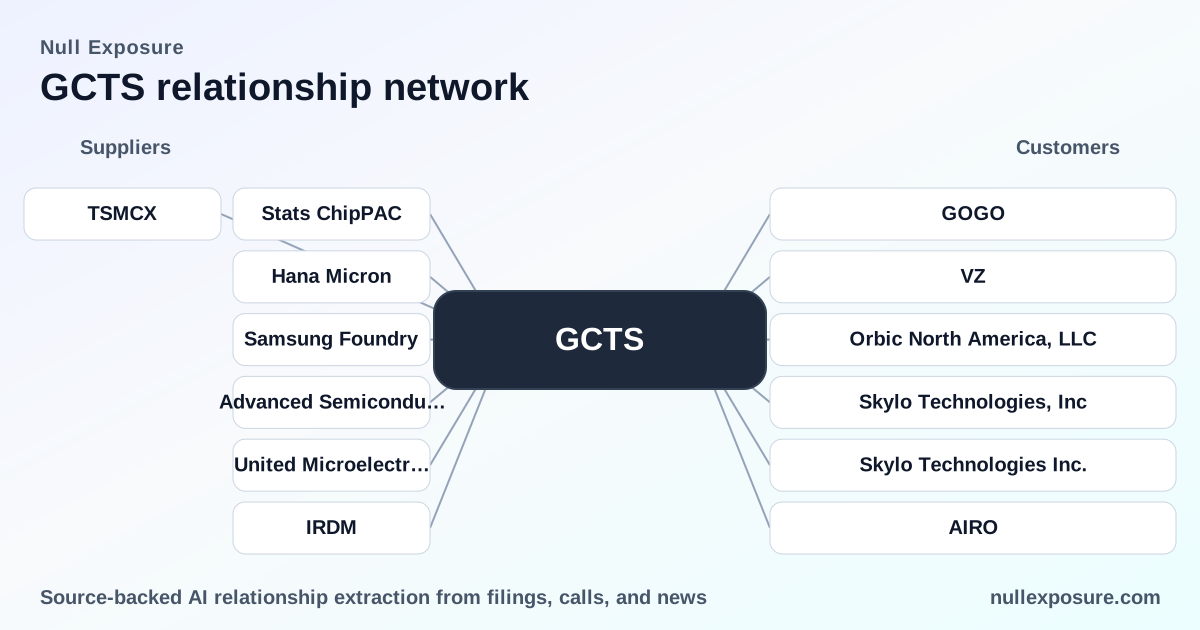
GCT Semiconductor (GCTS) — customer map and what it tells investors
GCT Semiconductor designs and sells 4G/5G chipsets and certified modules to wireless operators, OEMs/ODMs and device makers, monetizing primarily through unit sales of silicon and modules and related integration services. Recent press and filings show the company has moved into commercial shipments of a Verizon‑certified 5G module and is executing multiple go‑to‑market partnerships that position the company to convert engineering wins into recurring revenue from device and gateway manufacturers.
For a concise, interactive view of these relationships and updates on commercial milestones, visit https://nullexposure.com/.
Why the customer map matters now
GCT’s near‑term valuation depends on two dynamics: commercial adoption of its new 5G chipset and the company’s ability to translate qualification wins into volume purchase orders. The relationship set documented in public news and filings shows anchor customers across aviation connectivity, fixed wireless access (FWA), and satellite‑augmented IoT, plus a financing link that supports near‑term liquidity. These are the revenue levers investors must watch.
Key commercial partners and what each relationship means for revenue
Below I cover every relationship surfaced in the public results. Each entry is a plain‑English summary with the source noted.
-
Gogo (GoGo / GOGO) — GCT’s 5G chipset is integrated into Gogo’s air‑to‑ground (ATG) trials and commercial shipments; Gogo completed a 5G end‑to‑end phone call using GCT technology and is listed among lead customers receiving commercial shipments. According to Aviation Business News and iConnect007 reporting in FY2025–FY2026, GCT has delivered chipsets to support Gogo’s 5G ATG connectivity and announced commencement of commercial shipments to lead customers including Gogo (AviationBusinessNews, March 2026; iConnect007, March 2026).
-
Airspan (AIRO) — Airspan, a network deployment partner for Gogo, received GCT’s new 5G chipset in May as part of the aviation connectivity rollout, signaling a channel route for aircraft installations and ground network OEMs. Aviation Business News reported the delivery in FY2025 and subsequent analyst coverage referenced continued shipments to Airspan in FY2026 (AviationBusinessNews, March 2026; InsiderMonkey, May 2026).
-
Orbic / Orbic North America, LLC — GCT signed a letter of intent (LOI) with Orbic to co‑develop an Orbic‑branded mobile hotspot and FWA gateway that will use a Verizon‑certified 5G module based on GCT’s chipset, establishing a branded product channel and a potential route to carrier channels. The LOI was announced via PR Newswire in FY2025 (PR Newswire, March 2026).
-
Verizon (VZ) — While Verizon is not a direct contracting party in GCT’s disclosures, the Orbic LOI expressly frames the collaboration around supplying Verizon‑certified modules and includes terms related to volume purchases for supply to Verizon and other operators — a direct route into carrier volume if certifications and purchase commitments follow. This framework was outlined in the PR Newswire LOI announcement in FY2025 (PR Newswire, March 2026).
-
Skylo Technologies, Inc. (Skylo) — GCT is partnering with Skylo to integrate its 3GPP‑compliant silicon with Skylo’s satellite network to extend cellular‑grade coverage to satellite IoT use cases, positioning GCT for M2M and industrial IoT shipments beyond terrestrial networks. Multiple outlets reported the collaboration in FY2026, highlighting satellite augmentation of GCT’s silicon (IoTBusinessNews, CyprusShippingNews, EETAsia, Feb–Mar 2026).
-
Indigo Capital LP — Indigo Capital is a financing counterparty: GCT entered into a convertible promissory note purchase agreement with Indigo Capital, a capital injection that supports operations and commercialization activities but is not a product customer. The convertible note agreement was disclosed in FY2025 filings and reported on investing.com (Investing.com, May 2026).
What these relationships collectively reveal about GCT’s operating model
-
Contracting posture: short‑term, order‑by‑order sales. GCT’s public disclosures state the company does not have firm long‑term purchase commitments from most customers and executes predominantly on purchase orders; therefore revenue recognition will depend on the cadence of qualification and shipment approvals rather than long‑dated supply contracts. This is a company‑level signal rather than a relationship‑specific condition.
-
Geographic footprint: APAC supply base with global customers. The company relies on customers and suppliers primarily in the Asia‑Pacific region for manufacturing and supply, while its customer set and commercialization targets are global — carriers, aviation integrators and OEMs worldwide. The APAC concentration is a supplier and operational risk that coexists with an internationally distributed customer base.
-
Role orientation: primarily a seller of chipsets and modules. GCT’s disclosures characterize it as a supplier to wireless operators, ODMs and OEMs (seller role), with associated service and integration revenue recognized at times. The filings also show activity in service revenue and unbilled revenue categories, indicating some ancillary service contracts accompany product shipments.
-
Concentration and criticality. The customer map shows a small set of strategically important customers and partners (aviation, FWA hotspots, satellite IoT). That creates high upside if any partner converts to recurring buys, but also concentration risk until volume is diversified.
-
Maturity of commercial relationships. Several relationships are at the qualification/LOI/commercial shipment phase — a natural progression from engineering validation to revenue. Commercial shipments to lead customers (notably Gogo and Airspan) indicate the company has cleared product integration hurdles and is transitioning into volume fulfillment.
Investment implications and risk checklist
-
Upside: Certification wins (Verizon‑certified module), Orbic LOI and visible commercial shipments into aviation are concrete monetization pathways that should drive revenue growth if order flow scales. The Skylo partnership positions GCT to access a growing satellite‑enabled IoT addressable market.
-
Downside: Revenue remains dependent on purchase orders rather than long‑term contracts, and the supply chain reliance on APAC raises execution risk for scaling volumes. Investor focus should be on quarterly order flow, backlog disclosures and whether LOIs convert to firm volume commitments.
For a deeper, continuously updated map of these customer relationships and the underlying source documents, see the company page at https://nullexposure.com/.
Bottom line: what to watch next quarter
- Monitor firm purchase orders and backlog tied to the Orbic/Verizon channel and Gogo/Airspan aviation shipments.
- Watch whether the Skylo integration produces customer pilots that translate into module orders.
- Track financing activity and warrant/note terms (Indigo Capital) as liquidity events that affect cash runway.
Key takeaway: GCT has transitioned from engineering wins to initial commercial shipments across multiple vertical channels; the valuation hinge is now execution — converting LOIs and qualification wins into sustained purchase orders while managing APAC supply concentration and short‑term contracting dynamics.