GCTS-WS: Customer Relationships That Reveal a 5G Chipset Commercialization Path
Investor thesis — GCT Semiconductor (ticker reflected by warrant GCTS-WS) sells 5G and 4G chipsets to equipment manufacturers and network operators, monetizing through chipset licensing and product sales tied to gateway, hotspot and air-to-ground broadband solutions. The company is progressing from development-stage partnerships and letters of intent to first live network deployments, and the customer list published in corporate releases and press coverage shows a strategy focused on targeted OEM partnerships and select operator wins that validate product readiness. For more detailed signals on counterparties and go-to-market posture, visit https://nullexposure.com/.
What GCT sells and how the economics line up
GCT’s revenue model is straightforward: chipset unit sales and licensing to device OEMs and service providers, with additional commercial leverage from operator certifications and service launches that accelerate adoption. The customer relationships documented in public releases are concentrated and high-impact — a small number of agreements that, if converted to volume, can generate outsized revenue relative to the company’s current scale. GCT’s contracts are predominantly partnership- or LOI-driven, signaling a contracting posture focused on strategic integrations rather than broad-channel distribution.
- Key dynamic: GCT is building commercial credibility through software and certification milestones (e.g., Verizon-certified modules, live operator launches) rather than through a long tail of small customers.
Who’s on GCT’s customer roster — direct relationship notes
Below I cover every customer relationship that appears in the public results set, with concise, plain-English summaries and source references.
Gogo — first live network deployment powered by GCT chipsets
Gogo is a network operator that launched a new broadband air-to-ground service using GCT’s 5G chipset, representing the company’s first live operator deployment and an important commercial milestone. According to press coverage and the company’s earnings commentary in May 2026, the Gogo network launch used GCT’s chipset technology to enable in-flight broadband service (01net.it; The Globe and Mail / Motley Fool transcript, May 2026).
Orbic North America — LOI to co-develop 5G hotspot and FWA gateway
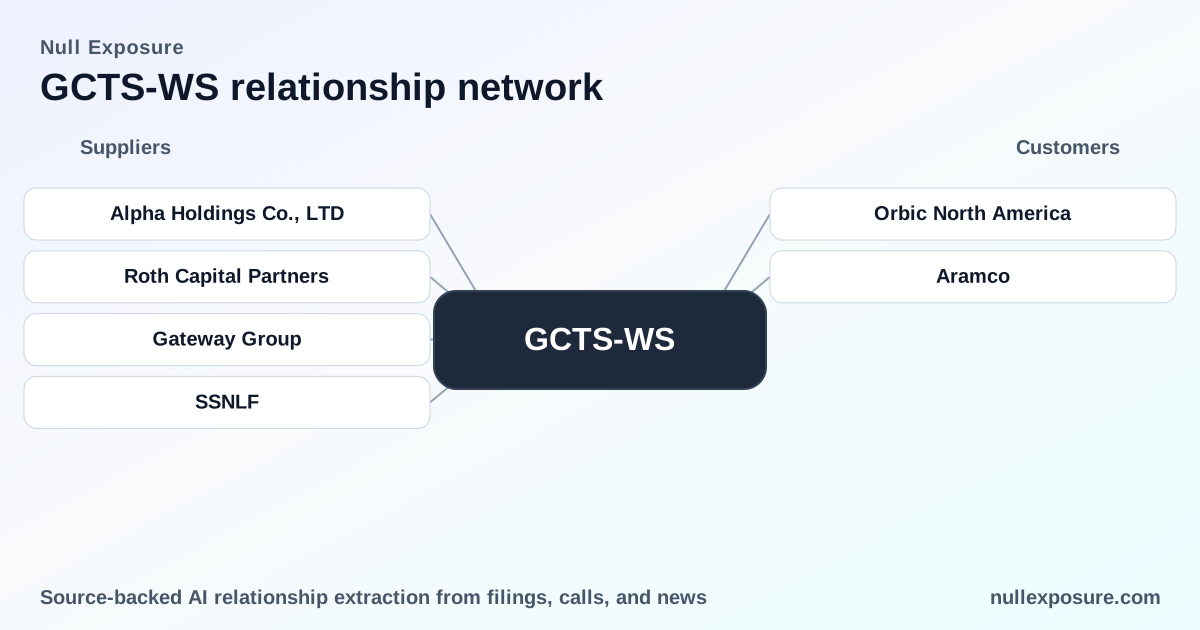
GCT signed a letter of intent with Orbic North America to jointly develop and supply a mobile hotspot and fixed wireless access (FWA) gateway that will use a Verizon-certified 5G module based on GCT’s new chipset, positioning Orbic as an OEM integrator for consumer and enterprise gateway products. This partnership was disclosed in a company business update (BizWire, May 14, 2025).
Orbit North America — media coverage references the same LOI in fundraising context
Media coverage of GCT’s capital raise noted a strategic partnership and LOI with Orbit North America to develop a mobile hotspot and gateway using the company’s new 5G chipset; the article tied the LOI to the company’s recent equity and warrant sale discussions. Investing.com reported on the transaction and referenced the partnership in coverage of the company’s financing (Investing.com, May 2026 coverage).
Aramco — strategic aspiration for regional chipset supply in Saudi Arabia
GCT has positioned itself to be a chipset supplier and partner to Aramco and its suppliers for the Saudi Arabian market and the broader region, with the company describing this as a longer-term goal while next steps were being defined. This strategic intent was articulated in GCT’s FY2024 financial update (BizWire, May 14, 2024).
What these relationships imply about GCT’s operating model and risk profile
The relationship set reveals a commercially focused, partnership-led go-to-market with several definable characteristics:
- Contracting posture: GCT operates primarily through letters of intent and strategic OEM partnerships rather than mass-market distribution deals, indicating an emphasis on engineered integrations and certification pathways (Verizon-certified modules, operator launches).
- Customer concentration: The disclosed relationships are limited in number but high in potential impact — a concentration risk that increases revenue volatility until the pipeline broadens beyond a few OEMs and operators.
- Criticality to customers: For partners like Gogo and Orbic/Orbit, GCT’s chipset is an enabler of service launches (air-to-ground broadband, FWA/hotspot products), making the product critical to those go-to-market plans and increasing the commercial value of successful integrations.
- Maturity and commercialization stage: The company has moved from development agreements to at least one live operator deployment, signaling product maturity for targeted use cases while still being early in broader market penetration.
No structured third-party constraints were reported in the available relationship records; the public mentions are dominated by LOIs, strategic intent and narrative confirmations of the Gogo deployment rather than long-term volume contracts or supply agreements.
Balance of risk and opportunity for investors
The current customer mix creates a classic early-commercialization risk/reward profile:
- Opportunity: Operator-level validation (Gogo) and OEM LOIs (Orbic/Orbit) create tangible proof points that unlock larger tender and certification processes. These relationships materially increase the probability of scaling revenue if GCT converts LOIs into volume orders.
- Risk: Concentration and dependency on certification milestones inject near-term revenue uncertainty; a small number of partners means results hinge on a few execution milestones and commercial agreements.
Key takeaways for investment due diligence
- GCT has moved to commercial reality: a live operator deployment with Gogo is a pivotal validation for the 5G chipset platform (press and earnings commentary, May 2026).
- OEM partnerships are strategic and selective: LOIs with Orbic/Orbit position GCT into gateway and hotspot product stacks that are Verizon-certified and operator-facing (BizWire, Investing.com).
- Geographic ambition includes the Middle East: GCT has publicly stated an ambition to serve Aramco and its suppliers for Saudi Arabia and the region, indicating a targeted international growth strategy (BizWire, FY2024 update).
- Concentrated book of business: convertibility of LOIs and pipeline expansion will determine revenue durability; investors should track order flow and commercial contracts beyond LOIs.
For a concise dashboard of counterparties and signals that affect capital markets positioning, review the company’s public statements and related coverage at https://nullexposure.com/. If you want a tailored briefing comparing GCT’s counterparty risk to peer chipset suppliers, reach out through our site for a customized analysis.