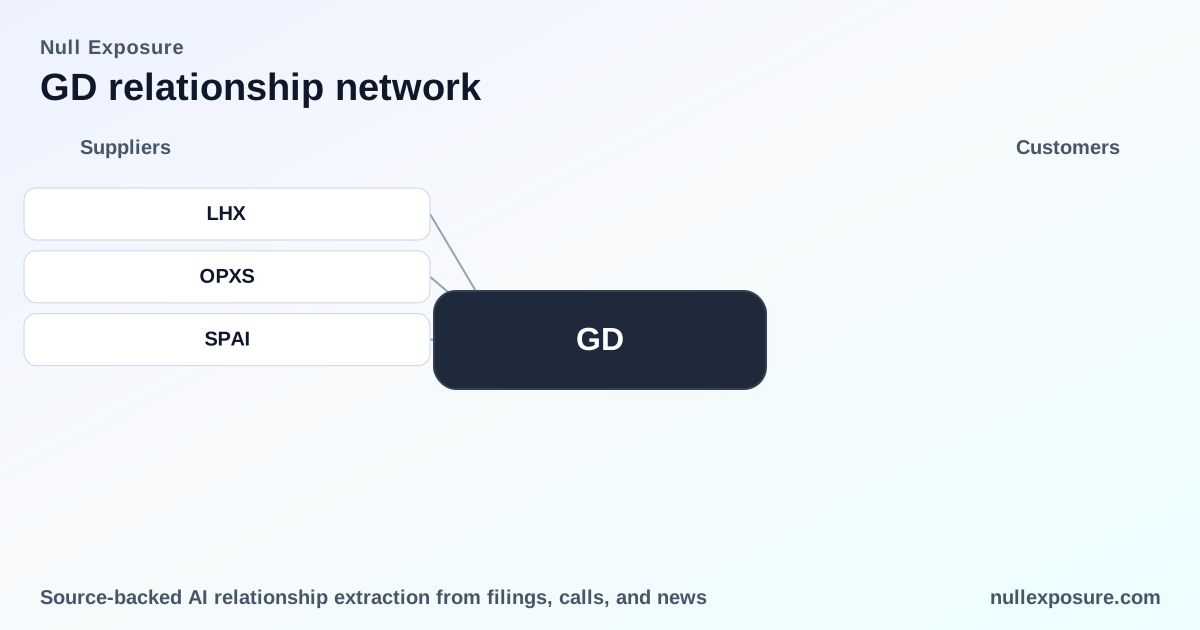
General Dynamics: monetizing scale in defense, platforms and services
General Dynamics operates as a diversified aerospace and defense contractor that monetizes through long-term, program-based contracts with governments and recurring commercial services (business aviation, ship repair, and technology systems). Its revenue mix is generated from multi-year platform builds and sustainment contracts backed by a substantial funded and unfunded backlog, plus commercial aviation and FBO services that capture aftermarket and operator economics. For investors, the company’s value rests on program stability, backlog conversion, and exposure to a concentrated set of large public-sector buyers. Learn more at https://nullexposure.com/.
How to read the customer relationships: what the map tells investors
General Dynamics’ customer relationships show a business that is structured around contract duration, scale, and counterparty concentration rather than spot transactions. From the available signals, the company demonstrates a strong contracting posture and program maturity:
- Contracting posture — long-term programs dominate. Management states the majority of revenue derives from long-term contracts that span multiple years, which produces predictable revenue recognition and phased delivery risk tied to program milestones.
- Concentration — heavy government reliance. The U.S. government represents a large portion of revenue (management cited 68% of consolidated revenue from the U.S. government in 2025), creating high concentration and direct linkage to U.S. defense budgets and procurement cadence.
- Criticality and scale — programs are strategic and large. Several programs are classified as national priorities (for example a large submarine program with multi-decade construction profiles), and the company reports a total backlog in excess of $100 billion, implying material future revenue streams.
- Global footprint and commercial channels. While the company is government-facing, it also operates global commercial services (FBOs and business aviation) and generates revenue from non-U.S. geographies—North America is dominant, but APAC, EMEA and LATAM exposures exist.
- Maturity and spend band. Backlog size, funded/unfunded program values, and references to multi-decade construction schedules position General Dynamics at the upper end of the vendor spend band (>$100m per program), favoring established prime contractors.
These are company-level signals derived from public excerpts and should be treated as structural characteristics of how General Dynamics manages customers and recognizes revenue.
Relationship-by-relationship: what matters to the P&L and risk profile
SOAR (Volato fractional program and Gulfstream G280 deliveries)
Volato (listed as SOAR) is referenced as taking deliveries of Gulfstream G280 aircraft under a fractional ownership program, indicating commercial aviation supply relationships that interact with General Dynamics’ business aviation operations. A Volato press release noted the fourth G280 delivery from its aircraft order in Q4 2025 and signaled continued demand for the premium jet (FinancialContent/BizWire, Nov 18, 2025; also reported via The Globe and Mail, Nov 18, 2025).
U.S. government (DoD and broader federal buyers)
The U.S. government is a principal counterparty, representing a majority share of consolidated revenue in 2025 and forming the backbone of large-program backlog and sustained revenue conversion. Commentary on defense contractors’ government exposure highlights General Dynamics receiving substantial contract obligations relative to peers and underscores the DoD’s central role in the company’s revenue mix (TradingView reporting citing FY2026 context, May 2026).
SPAI (Safe Pro Group demo with GeoSuite at Army event)
Safe Pro Group (SPAI) is cited for integrating an AI-powered navigation and detection capability into General Dynamics Mission Systems’ GeoSuite platform for demonstration at a U.S. Army event (Transforming in Contact 2.0, Fort Hood). This reflects GD’s role as a systems integrator and platform provider that partners with niche technology vendors for operational demonstrations and capability extensions (InvestorBrandNetwork/Digital Journal coverage, March 2026).
SOAR-WS (Volato SPAC/warrant context and fractional program)
A separate reference to SOAR-WS documents Volato’s SPAC merger and the launch of a Gulfstream G280 fractional program, reinforcing the commercial aviation tie-ins that intersect with General Dynamics’ business aviation services and FBO operations (PrivateJetCardComparisons, Dec 1, 2023).
What the relationship set implies for investors
- Revenue visibility is high but concentrated. The combination of long-duration contracts and a $100bn-plus backlog gives General Dynamics predictable top-line conversion, while the 68% U.S. government share concentrates political and budget execution risk.
- Program criticality elevates defensibility but raises political exposure. Being a supplier to strategic national programs increases contract stickiness and pricing leverage, but it also ties financial outcomes to government procurement cycles and appropriations.
- Commercial channels diversify cash flow modestly. Relationships with fractional aviation programs and FBO clients provide additional margins and aftermarket opportunities, but these are complementary to, not replacements for, core defense revenues.
- Partner ecosystem supports technology insertion. Demonstrations with technology vendors like Safe Pro Group illustrate how GD leverages third-party innovation to sustain relevance in battlefield and sensor systems—this is a growth vector for mission systems revenue.
Investor checklist: risks, levers, and catalysts
-
Key catalysts: backlog conversion timing (expected recognition schedule across 2026–2028), major program award progress, and commercial aviation demand recovery.
-
Key risks: U.S. defense budget shifts, program schedule slips on multiyear builds, and single-buyer concentration that amplifies procurement-driven volatility.
-
Operational levers: margin expansion through higher content in follow-on sustainment contracts, cross-selling mission systems into allied markets, and capturing aftermarket revenue from business aviation clients.
-
For quick reference, consider these focal points:
- Backlog size and burn-down schedule — critical to revenue cadence.
- Government funding and appropriations — drive majority of revenue.
- Program execution — schedule adherence is the primary short-term risk.
If you want a deeper relationship-level projection or a modeled sensitivity of backlog conversion to Defense budget scenarios, start with the company’s backlog and revenue recognition cadence at https://nullexposure.com/.
Bottom line
General Dynamics combines program-scale stability and government concentration with commercial services that smooth aftermarket revenue; this creates a predictable, capital-intensive earnings profile with asymmetric policy and program risk. Investors should value the company for backlog visibility and program criticality while monitoring defense budget execution and program delivery milestones as the core drivers of near-term performance.