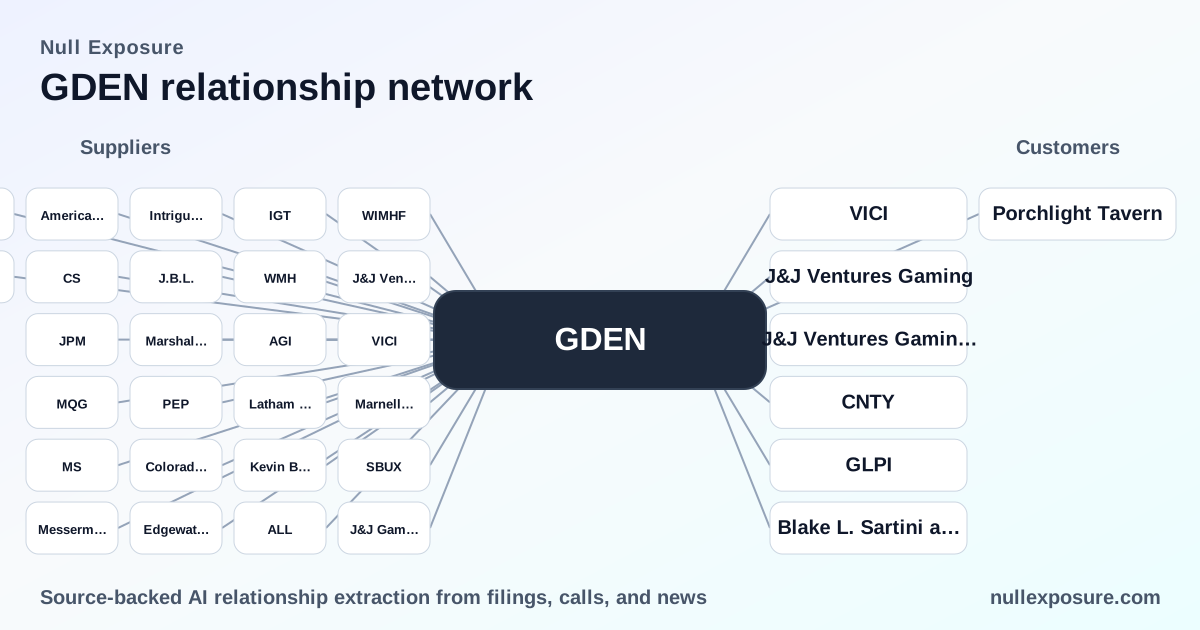
Golden Entertainment (GDEN): Transaction-heavy repositioning with landlord partners and route divestitures
Golden Entertainment operates a diversified gaming and hospitality platform that historically monetized through casino wagering, rooms, food & beverage, tavern operations and slot-route services. Over the past 18 months the company executed a strategic asset-sale and operational transition: Golden sold its Nevada and Montana slot-route businesses, agreed to sell operating assets to Blake L. Sartini and affiliates, and completed a sale‑leaseback of seven Nevada casino real estate assets to VICI Properties, converting asset value into liquidity and recurring lease income for new landlords. For investors, the company now looks less like an integrated operator and more like a seller-turned-operator under third‑party real estate arrangements. Learn more at https://nullexposure.com/.
Executive snapshot: what this restructuring means for revenue and risk
Golden’s recent transactions are definitive: the company monetized core real estate and distributed-gaming businesses while transferring long-term property ownership to REITs and private buyers, preserving operating cashflow through new contractual relationships. The $1.16 billion sale of seven Nevada properties to VICI Properties converts real estate into immediate capital, while the sale of slot-route operations to J&J Ventures Gaming removes a high-volume, lower-margin distributed gaming line and its associated operational complexity.
This repositioning changes Golden’s contracting posture and counterparty dynamics: gaming revenue is intrinsically usage‑based (wagers and patron activity drive top-line), the customer base is concentrated in local individual patrons across Nevada, and the company’s role in many relationships is that of a seller/operator transitioning to operator-under-lease. These features compress asset risk into landlord counterparty risk and operational execution under third‑party real estate ownership. Read deeper at https://nullexposure.com/.
Company-level operating signals investors should track
The public record and transaction disclosures produce a consistent set of operating signals for Golden:
- Contracting posture — usage-based: Golden’s core revenue historically derives from gaming transactions recorded daily based on wagers and patron activity; the company recognizes gaming revenue using residual approaches because per-wager selling price is not determinable. This implies revenue volatility tied directly to patron behavior and footfall patterns.
- Customer type — individual, local: Golden’s Nevada casino and tavern footprint is concentrated on local patrons (many properties target customers within ~5 miles), making consumer spending patterns and regional tourism cycles material to performance.
- Geography — concentrated in North America (Nevada): Operations and the branded tavern network are largely tied to the greater Las Vegas area and regional Nevada markets, raising exposure to Nevada-specific regulatory and tourism trends.
- Role and stage — seller and active operator: The company has been an active seller of both real estate and slot-route operations while retaining an operating presence; the business continues to engage actively with its ~600,000 player database to drive cross-marketing.
- Segment focus — services and hospitality: Golden’s revenue mix centers on services: casino operations, taverns, and hospitality, not long-term product contracts, which emphasizes operational execution and local market share.
These signals indicate operational maturity in hospitality execution but elevated exposure to local demand cycles and landlord counterparty performance.
Counterparty relationships that matter right now
Below are every counterparty relationship reflected in the public coverage of GDEN transactions, with plain-English summaries and source citations.
VICI Properties (VICI)
VICI acquired the land, buildings and improvements tied to seven Nevada casino properties from Golden for roughly $1.16 billion, and executed a triple‑net-style master lease with entities controlled by Blake Sartini, transforming Golden’s real estate into a landlord-tenant structure. According to VICI and press reports, the transaction closed around April 30, 2026. (Source: VICI acquisition coverage, iGamingBusiness / BettorsInsider / CityBiz, March–May 2026)
J&J Ventures Gaming, LLC (J&J Gaming)
J&J Ventures Gaming purchased Golden’s distributed‑gaming (slot-route) operations in Nevada and Montana in deals that totalled several hundred million dollars, exiting Golden from that route business and transferring route operations and purchased cash to the buyer. CDCGaming and industry reporting note completion of the Nevada and Montana slot-route sales in early 2026. (Source: CDCGaming reporting on slot-route sale, March 2026)
Blake L. Sartini and affiliates
Blake L. Sartini and affiliated entities agreed to acquire Golden’s operating assets, effectively taking the company private in a transaction announced November 2025; the structure paired Sartini’s ownership of operations with VICI’s ownership of the underlying real estate. Latham & Watkins and related filings describe Sartini’s acquisition of operating assets in the definitive agreement. (Source: Latham & Watkins client announcement, Nov 2025)
Century Casinos (CNTY)
Century Casinos is referenced in connection with past property transactions (Rocky Gap Casino Resort), as an acquirer of casino operations in other Golden-related transactions, where it paid roughly $56.1 million for casino operations in that deal; the coverage provides context for how Golden and its peers monetize assets via operation vs. real estate splits. (Source: Review-Journal / WTOP coverage of Rocky Gap sale, 2022 reporting cited in later industry summaries)
Gaming & Leisure Properties Inc. (GLPI)
GLPI was identified by shareholders and activist correspondence as a likely strategic buyer of Golden’s real estate during the sale process; industry commentaries pointed to the two dominant gaming REITs—VICI and GLPI—as motivated buyers capable of creating competitive tension in a real‑estate auction. (Source: Everbay Capital letter and PR Newswire, Mar 2026)
Porchlight Tavern
Porchlight Tavern is cited in local reporting as an illustrative tavern/property that was on Golden’s slot route and later converted to a PT’s branded location, showing how the company repositions micro-assets within its tavern and slot operations. The Review‑Journal covered this example in profile pieces on Golden’s slot-routing and tavern strategy. (Source: Las Vegas Review-Journal feature, Mar 2026)
What investors should monitor next
- Lease economics and counterparty credit: With real estate sold to VICI and leases running to Sartini-controlled operators, investors must track lease rates, escalation structures and VICI’s and GLPI’s ability to underwrite Nevada locals economics. VICI’s regulatory filings and REIT reports will reveal landlord-side cashflow assumptions.
- Post-sale operating cashflow and margins: Removal of slot-route revenues and real-estate ownership will reallocate margin contribution; watch reported operating margins, same‑store gaming trends and tavern-level profitability in quarterly disclosures.
- Customer engagement and demand elasticity: Golden’s concentration on local patrons means same-market footfall and regional tourism metrics will lead revenue direction; the company’s active player database is a key lever, but patron behavior is usage‑based and volatile.
- Regulatory and closing mechanics: The transactions required gaming regulatory approval; closing notices and regulatory filings can produce contingent liabilities or performance covenants that affect residual value extraction.
Bottom line: capitalized real estate, ongoing operational exposure
Golden Entertainment has materially reshaped its balance sheet by selling real estate and slot-route businesses while retaining operational control under new ownership structures. The company now operates with reduced real-estate ownership risk but sustained exposure to patron-driven, usage-based revenue and local market cycles; counterparty strength—particularly VICI and J&J—and lease economics will determine whether the restructuring enhances long‑term value or simply compresses upside. For a concise feed of events, filings and counterparty updates visit https://nullexposure.com/.
Key takeaway: the shift from owner-operator to operator-under-lease is transformative—monitor landlord cashflows, lease terms and local demand as the primary drivers of GDEN’s forward earnings profile.