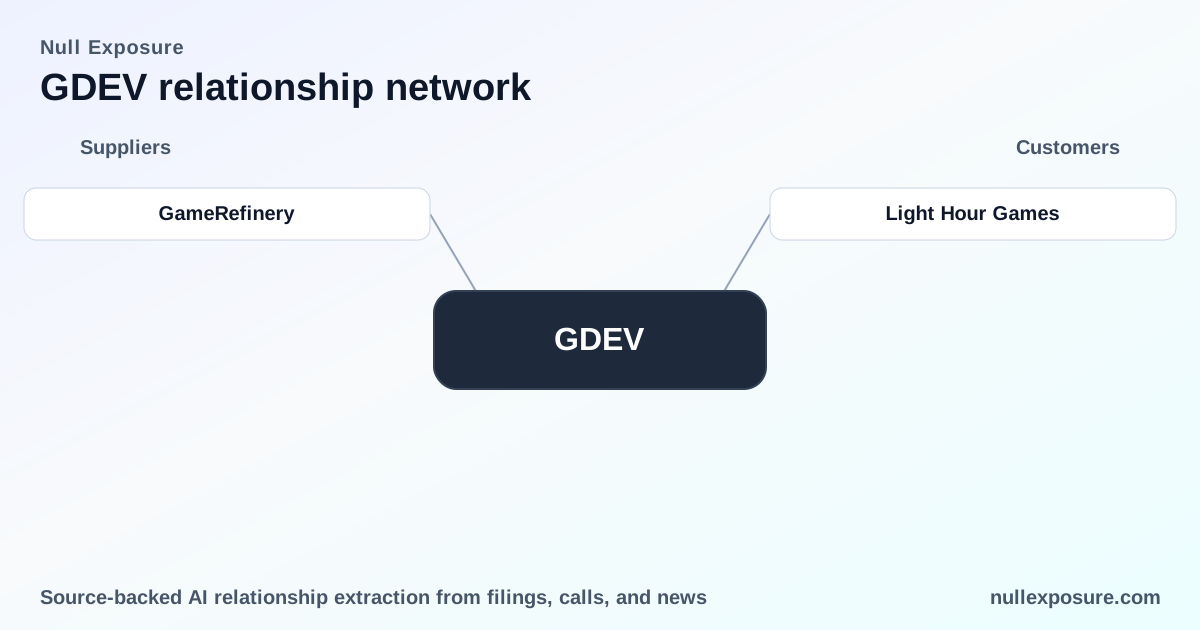
GDEV customer map: concentration, strategy, and the commercial levers investors should watch
GDEV operates as a capital-backed publisher and operator for mobile and casual game studios, monetizing through revenue-sharing publishing agreements, upfront funding and analytics-driven live-ops support that accelerate scale for partner studios. The company earns the bulk of its revenue from a very small set of partner studios while expanding its mobile footprint through acquisitions and full-funding arrangements — an operating model that trades concentrated top-line exposure for high-margin publishing economics when titles succeed. For a concise view of the relationships and what they imply for investors, visit the NullExposure homepage: https://nullexposure.com/
How GDEV’s commercial model works in practice
GDEV contracts with independent studios and provides three principal contributions: capital (upfront funding), publishing execution (user acquisition and monetization), and analytics/live-ops support. That contracting posture positions GDEV as both financier and commercial operator rather than a passive platform supplier, which increases both upside from hit games and downside from client-specific failures.
- Concentration is acute: reported FY2026 figures show a single partner accounting for the vast majority of sales, which creates outsized revenue volatility and counterparty risk at the company level.
- Contracts skew toward revenue-share and equity-like economics: the company funds studios and takes a share of game revenues while studios retain creative control, aligning incentives but embedding dependency on title performance.
- Criticality of relationships is high: a small number of studios drive commercial results, so relationship continuity and hit cadence determine financial stability.
- Maturity and consolidation: GDEV is actively consolidating its portfolio through acquisitions and full-funding deals that aim to convert creative IP into scaleable revenue streams.
Relationship-by-relationship breakdown — what the record shows
Below are all customer relationships listed in the available results, each with a short, plain-English summary and a source reference.
Light Hour Games
GDEV executed a full-funding agreement in which it provides capital, data, analytics and publishing support while the studio retains creative control and shares in its games; this is an acquisition-style deal intended to expand GDEV’s mobile portfolio. According to PocketGamer (March 2026), GDEV will fully fund Light Hour Games and deliver publishing services while preserving the studio’s creative autonomy.
Nexters Global Ltd
Nexters is the dominant revenue contributor to GDEV: it accounted for 96.7% of total sales, equal to $115.90 million in FY2026, indicating extreme top-line concentration with Nexters as the single material customer. This figure is reported in Intellectia’s FY2026 financials.
Cubic Games Ltd
Cubic Games is identified as an other significant revenue stream for GDEV alongside Gamegears, implying a secondary but materially smaller contribution to revenues compared with Nexters. Intellectia’s FY2026 financials list Cubic Games Ltd among other notable contributors.
Gamegears Ltd
Gamegears is likewise cited as a material but secondary revenue contributor; it forms part of the company’s diversified studio roster behind the dominant Nexters relationship. Intellectia’s FY2026 financials include Gamegears Ltd as one of the other significant revenue streams.
What these relationships imply for commercial strength and investor risk
The revenue mix and deal mechanics produce a clear set of strategic trade-offs for investors evaluating GDEV.
- Revenue concentration is the primary risk. With Nexters accounting for 96.7% of sales in FY2026, GDEV’s earnings and free cash flow are effectively tied to one counterparty’s title performance and contractual continuity. This concentration creates binary outcomes around retention and product hits.
- Contracting posture is capital-intense and operator-focused. GDEV’s model of full funding plus publishing and analytics support shifts risk onto the publisher’s balance sheet in exchange for outsized revenue shares when a title scales; that instrument structure accelerates growth but amplifies downside when titles underperform.
- Portfolio expansion aims to reduce one-name dependency, but it is execution-sensitive. The Light Hour Games deal demonstrates an active consolidation strategy: GDEV is willing to acquire or fully fund studios to broaden its IP pipeline. That reduces single-customer dependence over time if new titles reach scale, but returns are realization-dependent.
- Criticality of third parties is asymmetric. For studios, GDEV is a revenue and UA (user acquisition) partner; for GDEV, a handful of studios are mission-critical. This places outsized importance on contract terms, retention incentives, and performance-based milestones.
- Maturity is mixed. The presence of multi-year revenue relationships with established studios like Nexters suggests commercial traction, while recent deals (Light Hour Games) indicate an active growth phase that increases near-term execution risk.
For investors, monitor retention clauses, minimum-guarantee mechanics, and published revenue split disclosures in upcoming filings; these specifics determine how concentrated revenue converts to margin and free cash flow.
Tactical signals to watch next
- Quarterly disclosures and FY2027 filings for confirmation that Nexters’ revenue share has diversified below critical thresholds.
- Metrics from new-publish deals (Light Hour Games) — user acquisition efficiency and early monetization lifts — as indicators of successful portfolio scaling.
- Any change to contract structure: increased guarantees, minimum revenue commitments, or equity transfers would materially change the company’s risk profile.
If you want an ongoing, structured feed of customer-concentration and relationship intelligence for GDEV and peer publishers, explore how we surface counterparty exposure at NullExposure: https://nullexposure.com/
Bottom line
GDEV operates as a capitalized publisher that generates revenue primarily through a concentrated set of studio partnerships, with Nexters supplying the vast majority of FY2026 sales and other partners like Cubic Games and Gamegears contributing materially less. The company’s acquisition and full-funding strategy (evidenced by the Light Hour Games deal) is designed to broaden its portfolio, but near-term investor outcomes hinge on the company’s ability to reduce single-customer dependence and deliver repeatable hit titles. Investors should treat counterparty retention and early performance metrics from newly funded studios as the central drivers of valuation.