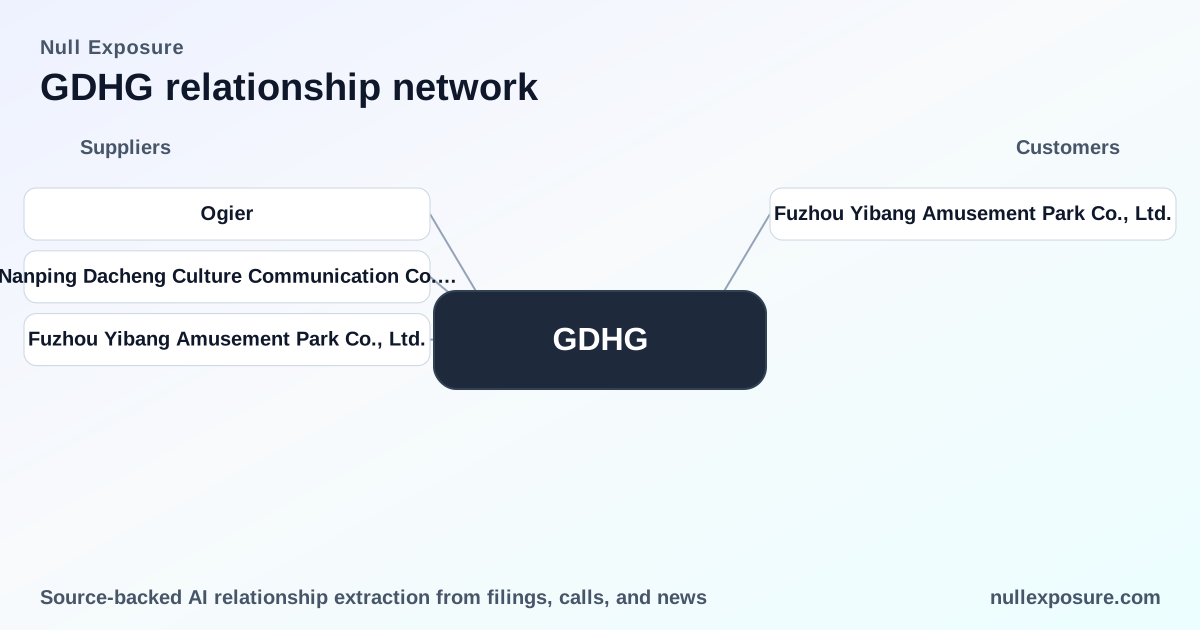
Golden Heaven Group Holdings (GDHG): Customer Relationships and What Investors Should Know
Golden Heaven Group Holdings operates and monetizes a portfolio of leisure assets in China—theme parks, cultural attractions and hospitality—by selling admissions, ancillary services, and partner services to local operators and developers. Revenue flows from gate receipts and service contracts for park development and operations, with incremental upside from branded hospitality and event programming. The company's cash generation depends on continued domestic tourism recovery, commercial partnerships with local operators, and the execution of service agreements that convert development work into recurring fees.
If you want ongoing monitoring of corporate relationships and contract-level signals, visit the Null Exposure homepage: https://nullexposure.com/
A concise take for investors: business model drivers and immediate signals
Golden Heaven is a leisure operator that converts physical assets and intellectual property into service fees and admissions revenue. The firm’s reported metrics show positive gross margin (RMB equivalent gross profit ~50% of reported revenue) but negative bottom-line profitability, driven by operating losses and a diluted EPS of -10.26. Market capitalization is modest (~$33.6 million) with a very concentrated insider ownership stake (87.7% insiders) and negligible institutional ownership (0.099%), which shapes governance and liquidity dynamics. Key investment drivers are domestic leisure demand, the company’s ability to secure and scale service contracts, and operational execution at its parks.
What contract disclosures tell us about customers
One discrete customer relationship is disclosed in public reporting and media: a service-fee agreement with a local amusement operator. Below is the public evidence and the implications for revenue quality and concentration.
Fuzhou Yibang Amusement Park Co., Ltd.
Fuzhou Yibang agreed to pay a service fee of RMB 15 million (approximately US$2.1 million) to Golden Heaven for services rendered in FY2025, according to an OpenPR news release dated March 9, 2026. This is a single-contract disclosure that contributes directly to FY2025 service revenue. This contract represents a material, one-off service payment at the company’s current reported revenue scale, and therefore has outsized impact on near-term top-line performance. (Source: OpenPR news release, March 9, 2026 — https://www.openpr.com/news/3877261/promising-new-investments-and-joint-venture-agreements)
How this relationship fits into Golden Heaven’s operating profile
The Fuzhou Yibang contract illustrates Golden Heaven’s real-world monetization pathway: the company signs service agreements with local park operators that produce upfront or discrete service fees for development, operational setup, or branded offerings. Given Golden Heaven’s TTM revenue of ~¥15.3 million (converted to reported USD-equivalents in filings), a single RMB 15M fee is material and underscores the firm’s current dependence on contract wins over scale-based revenue. The disclosed transaction is consistent with a hybrid leisure operator that blends recurring admissions revenue with project-style service income.
Company-level contract signals and what’s not reported
There are no explicit contract constraints or disclosure masks in the relationship dataset provided for customers; the constraints field returned no entries. As a company-level signal, the absence of reported constraints implies:
- Contracting posture: Golden Heaven publicly discloses individual sizable service agreements, indicating a posture that highlights commercial wins as growth proof points rather than bundling or obfuscating contract terms.
- Concentration: Given the relative magnitude of the disclosed RMB 15M service fee versus reported trailing revenue, the business currently shows customer concentration risk: individual contracts can materially move reported revenue.
- Criticality: Service agreements with local operators are strategically critical to revenue expansion; discrete contracts convert into measurable service fees and are key to demonstrating monetization beyond admissions.
- Maturity: The mix of project-style service revenue signals a business still in growth and commercialization phase rather than a mature, recurring-revenue leisure chain with broad, predictable cash flows.
These are company-level signals and not tied to any specific undisclosed customer.
Financial context that intensifies the relationship impact
Golden Heaven’s trailing revenue is $15.3 million with gross profit of $7.67 million, yet EBITDA and net income metrics are negative (EBITDA -3.56 million; EPS -10.26). A single RMB 15M (~US$2.1M) service fee therefore represents material incremental revenue and can compress reported losses if converted to cash and recognized in the same fiscal year. Market multiples are thin; price-to-sales is ~2.2 while price-to-book is 0.196, and the stock trades with a wide historical range (52-week high/low: 109.88 / 1.41), reflecting illiquidity and volatility. Insider dominance of shares outstanding and a tiny public float (2.4 million float vs. 19.96 million shares outstanding reported) further amplifies share-price sensitivity to contract announcements.
Investment implications and risk checklist
- Revenue concentration: The Fuzhou Yibang fee is a concrete example of dependence on large, discrete service agreements; investors should treat future earnings guidance and quarter-to-quarter revenue swings with this concentration in mind.
- Execution risk: Converting service contracts into repeatable, scalable revenue requires operational capability at multiple sites; the company currently blends one-off and recurring revenue, increasing execution complexity.
- Governance and liquidity: High insider ownership and low institutional participation create governance tailwinds for insiders but reduce trade liquidity and raise takeover or related-party risk.
- Valuation asymmetry: With negative margins and high operating leverage, meaningful contract wins can disproportionately improve near-term profitability; conversely, failure to secure new contracts creates downside.
Key actions for investors: monitor contract announcements and timing of cash receipts, and track admissions trends at company-owned parks to separate recurring revenue from project-based service income. Additional monitoring and relationship-tracking are available through Null Exposure—visit https://nullexposure.com/ for ongoing signals and contract-level coverage.
Final read: what to watch next
The Fuzhou Yibang contract confirms that Golden Heaven’s commercial model leverages service agreements as an important revenue stream alongside admissions. For investors, the most consequential metrics are contract cadence, collections, and the company’s ability to translate project fees into longer-term recurring operations. Given current financials and ownership structure, short-term share movements will react to new service contract disclosures and park attendance metrics more than to steady-state operational performance.
Bold focus on contract wins and follow-through will determine whether Golden Heaven transitions from a project-oriented revenue profile to a more stable, scalable leisure operator.