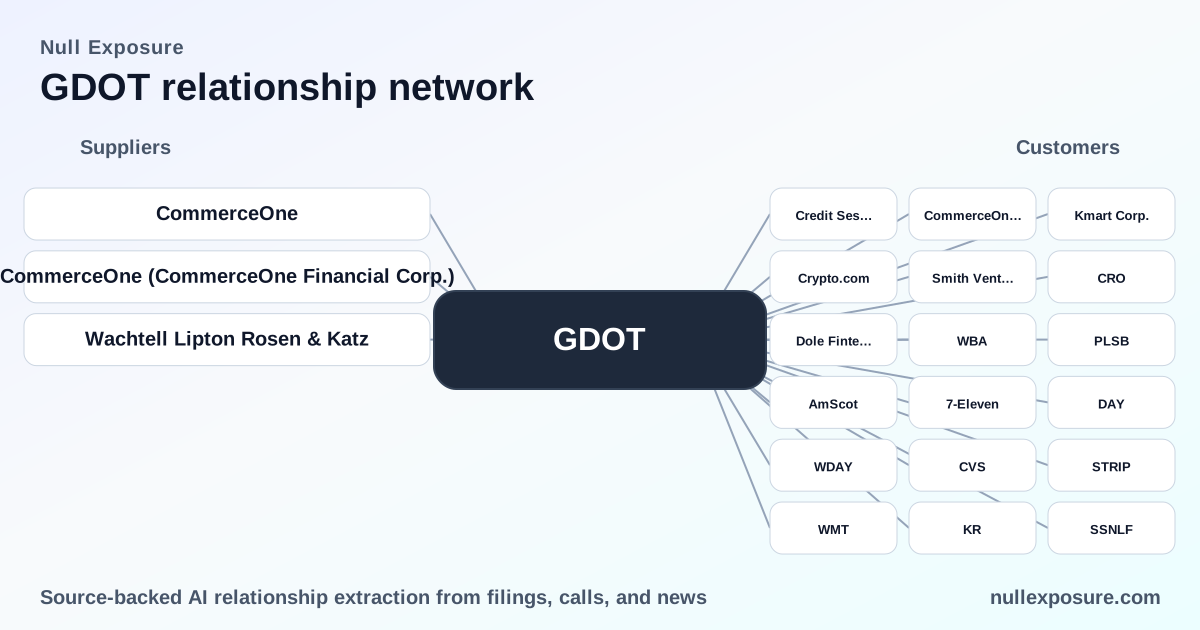
Green Dot (GDOT) — Customer Map and Commercial Implications
Green Dot operates as a banking-as-a-service (BaaS) and payments platform that monetizes through partner fees, product processing volumes, deposit and fee revenues from consumer accounts, and embedded banking services for fintechs and retailers. The company's revenue mix is concentrated (notably a single BaaS partner generating a majority of operating revenue in FY2024), while growth is being driven by new BaaS wins and embedded-payments integrations announced across 2025–2026. For more detailed signals and partner tracking, visit https://nullexposure.com/.
Quick read: what this partnership map tells an investor
Green Dot runs a hybrid model: a regulated bank arm (Green Dot Bank) supporting deposit, identity and compliance needs, and a technology/service arm that packages accounts, cards, and money-movement rails to third parties. That posture positions Green Dot as a service provider to large retail and fintech customers, with a contracting posture that is partner-dependent and operationally critical for customers who offload account issuance and payment rails. The business shows both maturity (legacy program wind-down) and active product-level expansion (EWA, real-time payments, crypto offerings)—a transition profile that investors should value as both opportunity and concentration risk.
Key operating constraints and company-level signals
- Geographic focus: domestic U.S. — Green Dot’s products and services are offered within the United States and certain U.S. territories, indicating regulatory and market focus on North America. (Company disclosures, FY2024 10‑K.)
- Service-provider posture — The company describes the “Green Dot Network” as a service provider for Consumer Services and B2B clients, which frames the commercial relationship as B2B2C supply of banking infrastructure. (Company filings.)
- Customer concentration — Approximately 55% of operating revenue in FY2024 derived from a single BaaS partner, a material concentration that defines principal downside risk if that partnership contracts. (FY2024 10‑K, Dec 31, 2024.)
- Business mix shifting — Management has disclosed the deliberate wind-down of legacy accountholder programs while growing third‑party cash transfer volumes and new BaaS partnerships, signaling transition risk from legacy revenue to newer, partner-driven revenue streams. (Investor calls and filings.)
Counterparty roll call: every relationship identified and what it implies
-
Walmart (WMT) — Green Dot generated roughly 10% of operating revenues from products sold at Walmart locations and disclosed that a single BaaS partner accounted for ~55% of total operating revenues; management discussed transitioning the Walmart MoneyCard off Green Dot’s legacy platform to enable better product development. (FY2024 10‑K; 2025 Q2 earnings call.)
-
Credit Sesame — Management announced a new partnership and subsequent launch activity with Credit Sesame, positioning Credit Sesame as a prospective major BaaS brand partner once fully implemented. (GDOT 2025 Q2 & Q3 earnings calls.)
-
Crypto.com (CRO) — Crypto.com was named among new partners accelerating growth, and Green Dot referenced launching Crypto.com’s “cash earned” products during the quarter, reflecting expansion into crypto-linked savings/payments features. (GDOT 2025 Q2 & Q3 earnings calls.)
-
Dole Fintech — Management signaled an expected launch of Dole Fintech’s banking product, indicating a new white-label/BaaS client conversion. (GDOT 2025 Q3 earnings call.)
-
AmScot — Green Dot announced a new partnership with AmScot in the Financial Service Center (FSC) channel, underscoring continued distribution through neighborhood financial services. (GDOT 2025 Q3 earnings call.)
-
Workday (WDAY) — Management announced a partnership with Workday to deliver Earned Wage Access (EWA), reflecting Green Dot’s expansion into employer-payroll adjacent fintech services. (GDOT 2025 Q3 earnings call.)
-
Stripe — Green Dot announced a new partnership with Stripe, signaling broader payments and merchant-facing integrations to extend API-driven payouts and payout rails. (GDOT 2025 Q3 earnings call.)
-
Dayforce (DAY) — Green Dot launched real‑time payments with Dayforce, consistent with the company’s push into payroll-related money movement and employer services. (GDOT 2025 Q3 earnings call.)
-
Samsung (SSNLF) — Green Dot partnered with Samsung to launch a Tap-to-Transfer feature, an example of device-level payments innovation and a distribution/UX channel partnership. (GDOT 2025 Q2 earnings call.)
-
PLS (PLSB) — Management referenced “our relationship with PLS,” indicating an ongoing commercial collaboration; the reference was captured in the 2025 Q3 call. (GDOT 2025 Q3 earnings call.)
-
Wealthfront (WLTH) — Wealthfront has used Green Dot Bank for checking features and identity verification for cash accounts in previous years, illustrating Green Dot’s role as the behind-the-scenes bank for digital investment platforms. (Wealthfront press releases, FY2020–FY2021 coverage.)
-
7‑Eleven — Historical news coverage cited a 2013 lawsuit naming retailers including 7‑Eleven for selling Green Dot’s MoneyPak product, a legacy compliance and distribution touchpoint. (CSP Daily News, FY2013.)
-
CVS / CVS Caremark Corp. — Coverage of the MoneyPak litigation named CVS among retailers tied to distribution of Green Dot prepaid products, showing long-standing retail partnerships in card distribution. (CSP Daily News, FY2013.)
-
Kroger Co. (KR) — Kroger was named in the MoneyPak-era litigation, evidencing multi-retailer distribution channels for Green Dot’s prepaid products in historical context. (CSP Daily News, FY2013.)
-
Walgreens Co. (WBA) — Walgreens was also identified in historical MoneyPak litigation as a distribution partner for Green Dot’s prepaid offerings. (CSP Daily News, FY2013.)
-
Kmart Corp. — Kmart appeared in the same 2013 coverage related to MoneyPak distribution, another piece of legacy retail distribution evidence. (CSP Daily News, FY2013.)
-
CommerceOne Financial Corporation — News coverage and press releases in early 2026 document an acquisition agreement announced Nov 24, 2025, under which CommerceOne would acquire Green Dot Bank and related assets in the announced sale to Smith Ventures and CommerceOne. (GlobeNewswire; SahmCapital; FinViz, FY2026 coverage.)
-
Smith Ventures — Public filings and press announcements indicate Smith Ventures will acquire and privatize Green Dot’s non-bank fintech assets as part of the acquisition agreement announced Nov 24, 2025. (GlobeNewswire; AccessNewswire; SahmCapital, FY2026 coverage.)
-
Other ticker aliases (CRO, STRIP, PLSB, DAY, SSNLF, WLTH) — These entries in corporate materials correspond to the parties above (Crypto.com, Stripe, PLS, Dayforce, Samsung, Wealthfront) and confirm the same partner set referenced in earnings and news coverage. (GDOT 2025 earnings calls and related press.)
Investment implications: growth vectors versus concentration and transition risk
- Growth drivers: New BaaS partnerships (Crypto.com, Credit Sesame, Wealthfront), EWA and payroll rails (Workday, Dayforce), and merchant/device integrations (Stripe, Samsung) create multiple product levers for fee and volume growth. These wins indicate diversification by product type and vertical even as retail distribution remains relevant.
- Concentration risk: A single BaaS partner contributed approximately 55% of operating revenue in FY2024, creating significant downside if that partner reduces engagement or re-shores services. (FY2024 10‑K.)
- Transition dynamics: Management is actively winding down legacy accountholder programs while onboarding new partners; this produces execution risk (migration costs, customer retention) and timing risk for revenue replacement.
- Regulatory and geographic bound: Operating primarily in the U.S. concentrates regulatory risk and constrains international expansion optionality.
For actionable partner-level tracking and continuous signal capture, explore Green Dot’s partner map and monitoring tools at https://nullexposure.com/.
Bottom line
Green Dot combines regulated banking capabilities with a platform distribution model that generates concentrated but high-margin BaaS revenue today, and diversified product-led growth opportunities tomorrow. The investment case hinges on the company’s ability to replace legacy revenue while scaling newer BaaS relationships without operational disruption—a profile that rewards close monitoring of partner renewals, migration progress (notably Walmart), and the integration cadence of new wins like Crypto.com, Stripe, and Workday.