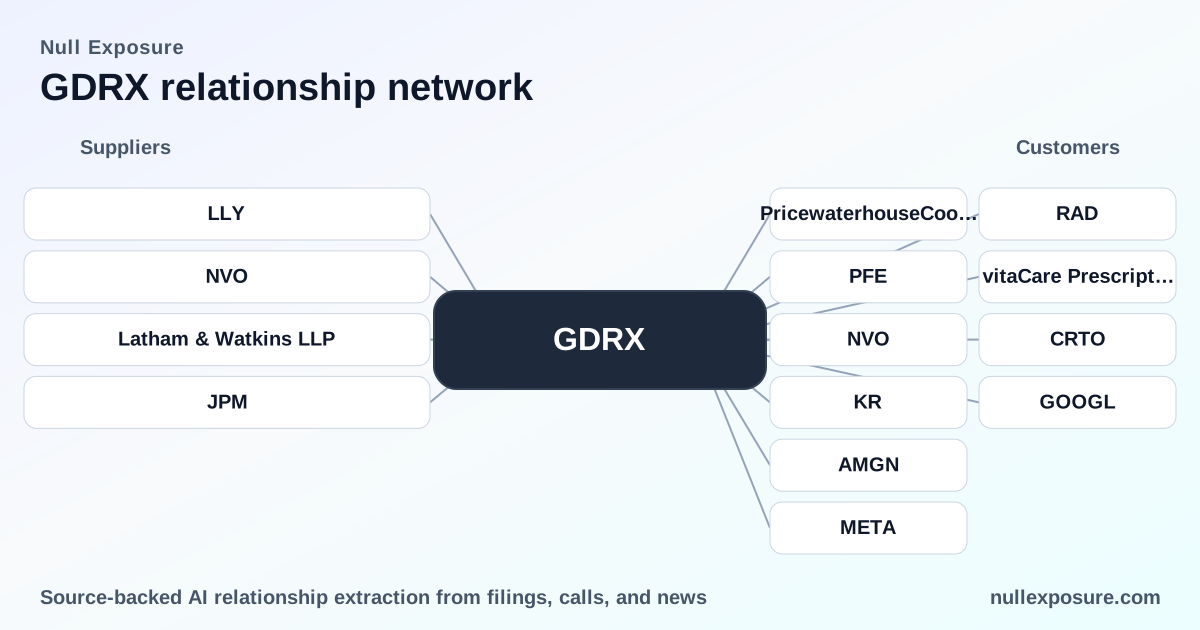
GoodRx (GDRX) customers and commercial footprint: what investors need to know
GoodRx operates a consumer-facing prescription savings platform that monetizes through a mix of subscription fees (GoodRx Gold and co-branded programs), per‑transaction fees tied to prescription fills, manufacturer partnerships that embed affordability offers, and advertising/placement relationships. The company’s revenue profile is driven by a blend of recurring subscription income and variable, volume‑sensitive transaction fees, with strategic partnerships—retail chains and pharma manufacturers—serving as the commercial backbone. For a closer look at counterparties and operating constraints, see an overview at https://nullexposure.com/.
Why the counterparty map matters for valuation and risk
GoodRx’s business is a two‑sided commercial model: it sells predictability (subscriptions) to consumers and distribution and price transparency to manufacturers, pharmacies and employers. That structure produces concentration and volume exposure (large retail partners and integrated manufacturer launches), regulatory and privacy sensitivity, and revenue that is part recurring, part usage‑based, making growth and margin forecasts sensitive to retail or pharmacy network changes.
Explore more company relationships and forensic signals at https://nullexposure.com/ to inform model adjustments and scenario analysis.
Relationship-by-relationship: what the evidence shows
PricewaterhouseCoopers LLP
PwC has served as GoodRx’s external auditor since 2018, providing the company’s statutory audit and related financial statement attestation in the FY2024 10‑K. According to GoodRx’s FY2024 10‑K filing, PwC has been the auditor since 2018.
Novo Nordisk (NVO)
GoodRx collaborated on the rollout of Novo Nordisk’s Wegovy pill, offering the lowest available self‑pay price at launch and thereby integrating manufacturer launch pricing into GoodRx’s consumer offering, per comments on the company’s 2025 Q4 earnings call.
Pfizer (PFE)
GoodRx acted as an integrated pricing source for Pfizer at launch, covering pricing for more than 30 core Pfizer brand medications across multiple therapeutic areas, according to the 2025 Q4 earnings call where management highlighted launch integrations with Pfizer.
Eli Lilly (LLY)
Industry reporting on employer programs (Mar 2026) lists GoodRx among administrators already on the platform for obesity‑drug coverage initiatives, indicating GoodRx’s role in employer/plan administrator ecosystems (CNBC, March 2026).
Amgen (AMGN)
GoodRx expanded access and affordability programs with Amgen as part of its manufacturer partnerships, according to investor reporting on GoodRx’s Q3/Q4 results (Yahoo Finance summary, Mar 2026).
The Kroger Co. / Kroger Pharmacies / Kroger Savings Club (KR)
Kroger has been a material commercial partner: GoodRx operated a Kroger Rx Savings Club subscription product and launched the RX Smart Saver solution at Kroger Pharmacies nationwide, but the Kroger relationship also surfaced as a revenue concentration point in litigation filings that allege Kroger accounted for a disproportionate share of prescription transaction revenue in past periods (company releases and class‑action disclosures, FY2024–FY2025).
Rite Aid (RAD)
GoodRx reported revenue impact from Rite Aid store closures and bankruptcy dynamics, and guided that integrated savings program volume reductions tied to Rite Aid would result in estimated revenue losses in 2025, per trading and earnings summaries (Q2/Q3 results commentary, FY2025).
Phathom Pharmaceuticals (PHAT)
Phathom noted in an earnings call that, beginning in November (period reported in company commentary), it enabled an offering through GoodRx to provide an alternative cash‑pay option for retail pharmacy fills of VOQUEZNA, illustrating GoodRx’s role in expanding retail visibility for smaller manufacturers (company earnings transcript, FY2026 context).
60 Degrees Pharmaceuticals (SXTP / SXTPW)
60 Degrees announced a partnership to offer up to 30% savings on ARAKODA® via GoodRx, expanding point‑of‑sale visibility into 70,000+ pharmacies and broadening the product’s retail footprint (company press releases, Feb–Mar 2026).
Harrow (HROW)
Harrow’s program for expanded access and price cuts explicitly identified a strategic partnership with GoodRx, demonstrating GoodRx’s use as a channel for ophthalmology and other specialty product access programs (industry press, Nov 2024 release referenced in FY2024 reporting).
Veru (VERU)
Veru reported partnering with GoodRx to reach consumer and provider audiences and to offer cash pricing visibility for a newly approved product, underscoring GoodRx’s marketing and retail access role for biopharma launches (company press release referenced in FY2021 materials).
vitaCare Prescription Services, Inc.
GoodRx disclosed that vitaCare contributed revenue historically but was de‑prioritized during restructuring, with a $2.5 million decrease in revenue contribution referenced in company Q3 2024 reporting, illustrating product/service portfolio rebalancing (GoodRx press release, FY2024).
TherapeuticsMD (TXMD)
TherapeuticsMD noted that variable costs of vitaCare services, under GoodRx ownership, were included in its expense management — a signal that GoodRx’s vitaCare capabilities were formerly being integrated into partner cost structures (company earnings call transcript, FY2022 filing history).
Meta / Facebook (META)
A proposed class‑action settlement resolved allegations that GoodRx shared user information with Meta; the settlement totaled $25 million to resolve claims about data sharing between 2017 and 2020, per legal reporting (ClassAction.org and media summaries, FY2026).
Google (GOOGL)
Google is identified in the same litigation and settlement narrative, with reporting stating GoodRx agreed to pay $25 million to resolve claims regarding sharing user data with Google and other advertising partners (consumer and class‑action reporting, FY2025–FY2026).
Criteo (CRTO / Criteo Corp.)
Criteo is likewise named among advertisers in the settlement reporting, and consumer‑facing articles summarized GoodRx’s agreement to resolve claims tied to third‑party ad partners (consumer press and class‑action summaries, FY2025–FY2026).
What the contract and operating constraints imply for investors
- Contract mix and monetization posture: GoodRx runs a hybrid subscription + usage‑based revenue model. The company’s disclosures note revenue from subscriptions (GoodRx Gold, Kroger co‑branded club) recognized on a time‑basis, and variable per‑transaction fees recognized at fill‑time. This structure produces a base of recurring revenue with sensitivity to prescription fill volumes and retail acceptance behavior.
- Geographic concentration: All revenue is U.S.‑based, so macro and regulatory shifts in the U.S. market will directly affect results rather than being diluted by international diversification.
- Counterparty mix and criticality: Primary customers include PBMs, pharmacies, pharma manufacturers and individual consumers; manufacturers use GoodRx to integrate affordability offers at launch (Pfizer, Novo Nordisk), while large retail partners (Kroger, Rite Aid historically) create concentration and strategic dependency.
- Contract maturity and operating leverage: Many arrangements are operationally mature—audited financials and recurring programs exist—but reliance on launch integrations and transactional volume introduces variable margin pressure during retailer churn or industry disruptions.
- Privacy and legal risk: Public reporting of a settlement related to third‑party data sharing establishes non‑trivial privacy/legal exposure that can affect costs and reputation.
Bottom line for investors and operators
GoodRx’s commercial model delivers valuable distribution and price transparency to manufacturers and consumers while exposing revenue to retail concentration, transaction volume swings, and privacy/regulatory risk. Investors should model mixed recurring/variable revenue, incorporate potential downside from retail partner churn, and assign a non‑zero compliance/legal cost premium to near‑term forecasts.
For an evidence‑driven view of counterparty relationships and to incorporate partner signals into financial models, review the full set of relationship records and filings at https://nullexposure.com/.