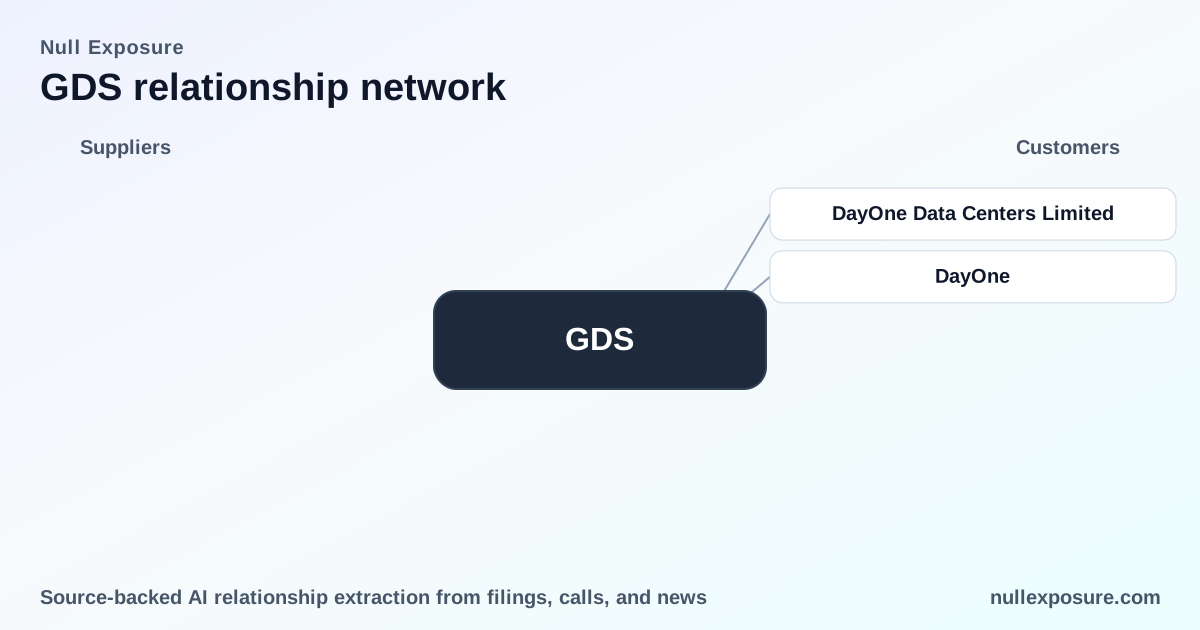
GDS customer map: what recent transactions tell investors about monetization and risk
GDS operates and monetizes large-scale, carrier-neutral data centers primarily in China by selling colocation, power and ancillary services to hyperscalers and enterprise customers, while increasingly recycling capital through minority investments, asset transfers and REIT-style structures. Revenue mixes combine stable, contract-backed colocation cashflows with episodic gains or losses tied to asset sales, deconsolidations and minority stake transactions. For a concise overview of GDS’s customer relationships and transactional posture, see https://nullexposure.com/.
Executive snapshot: business model drivers and why customer relationships matter
GDS’s core commercial engine is long-term capacity commitments from large customers that drive predictable utilization, but its corporate cash profile is materially influenced by capital-management actions—spinoffs, stake sales and REIT transfers—that convert hard assets into liquidity or one-off accounting items. Investors should treat operating cash generation and asset-recycling events as distinct levers: one sustains recurring EBITDA, the other reshapes balance-sheet and reported earnings volatility.
Key company-level operating signals:
- Contracting posture: GDS combines traditional long-duration colocation contracts with project-level capital deployment; commercial contracts underpin base cashflows while project sales and disposals provide episodic capital returns.
- Concentration and counterparty profile: The customer base is skewed toward hyperscalers and large enterprises, producing high-value, mission-critical tenancy but exposing the company to a concentrated revenue mix.
- Criticality of service: Data-center colocation is mission-critical for tenants, supporting high switching costs once facilities and connectivity are integrated.
- Maturity and capital cycle: GDS operates a capital-intensive, mid-to-late-cycle business that increasingly uses structured capital transactions (minority investments, REIT transfers, deconsolidations) to manage leverage and fund expansion.
What happened: the customer-relationship roll call (FY2026 coverage)
Below are the relationships surfaced in recent reporting, each with a concise plain-English summary and a source citation.
DayOne Data Centers Limited (FY2026)
GDS agreed to sell ordinary shares worth USD 385 million back to DayOne, reflecting a transactional reduction of GDS’s minority stake in the Singapore-based hyperscale platform and a near-term liquidity conversion. According to a March 2026 market note, the definitive repurchase agreement was announced on January 13 and recorded as a material minority-stake repurchase. (News report, Futunn, March 2026: https://news.futunn.com/en/post/67419452/gds-holdings-stock-price-rose-recovering-approximately-95-of-the)
C-REIT (FY2026)
GDS reported impairment losses and deconsolidation impacts tied to data center project companies that were sold to C-REIT, indicating that asset transfers into a REIT structure generated both disposals and non-cash writedowns in 2025. DatacenterDynamics covered the company disclosure that Q4 2025 included impairment charges and losses from selling project entities into the C-REIT vehicle. (Company reporting covered by DatacenterDynamics, May 2026: https://www.datacenterdynamics.com/en/news/gds-holdings-hits-16-billion-in-revenue-for-2025/)
DayOne (FY2026) — alternate coverage
Independent reporting confirmed DayOne’s $385 million repurchase of shares from GDS, describing the transaction as DayOne buying back GDS’s minority stake and further reducing GDS’s interest in its offshore spinoff. Mingtiandi’s March 2026 coverage framed the action as a consolidation of DayOne’s ownership base and a liquidity event for GDS. (Mingtiandi report, March 2026: https://www.mingtiandi.com/real-estate/data-centres/data-centre-operator-dayone-buying-back-385m-in-shares-from-gds/)
How these relationships change the investor equation
These transactions crystallize several strategic dynamics that investors must track closely.
- Asset recycling is an explicit capital-management lever. GDS converts equity stakes in project platforms into cash proceeds; that reduces ownership in growth platforms but improves liquidity and reduces on-balance-sheet capital exposure.
- Reported earnings will remain lumpy. Expect recurring colocation revenue to be steady while impairments, deconsolidation losses and gains from asset sales swing headline profitability across reporting periods.
- Governance and control evolve as stakes change. Minority-stake sell-downs shift alignment between operating entity managers and GDS shareholders and can reduce GDS’s ability to consolidate or direct platform strategy.
- REIT transfers are both a monetization channel and a reporting risk. Moving projects into a C-REIT unlocks value and liquidity but generates one-time accounting events (impairments, deconsolidations) and potential yield/occupancy mismatches in early stages.
If you want a practical mapping of counterparties and how these flows affect cash and reported metrics, visit https://nullexposure.com/ for the full coverage.
Practical risk checklist for operators and investors
- Liquidity vs. equity retention: Selling minority stakes raises cash but reduces future upside; model scenarios with and without retained ownership.
- Earnings volatility: Treat impairment and deconsolidation items as non-recurring for cash-flow analysis but material for equity valuation and debt covenants.
- Counterparty concentration: Monitor the tenant mix and large-customer exposures; losing a hyperscaler lease would have outsized revenue impact.
- Capital allocation discipline: Repeated use of asset recycling signals a capital-light pivot; validate that returns on redeployed capital exceed the yield from retained data-center ownership.
Bottom line
GDS’s customer relationships and recent actions—largely centering on a USD 385 million repurchase by DayOne and asset transfers into a C-REIT—tell a coherent story: the firm is monetizing physical assets and minority stakes to manage balance-sheet intensity while retaining a core of contract-backed colocation revenue. Investors must price the business as a hybrid of stable operational cashflows and episodic balance-sheet transactions that drive reported earnings volatility.
For a deeper read on counterparty linkages and to track unfolding transaction-level detail, explore the coverage at https://nullexposure.com/.