GDTC — What investor-grade customer relationships reveal about CytoMed’s commercialization path
CytoMed Therapeutics Limited (NASDAQ: GDTC) develops gamma delta T-cell immunotherapies and monetizes through clinical partnerships, licensing of proprietary cell-engineering technology, and ancillary service support such as immune cell banking. The company is transitioning from pre-clinical to early clinical activity and is generating modest revenue today through collaboration and service arrangements rather than product sales. For a concise corporate snapshot and related signals, visit https://nullexposure.com/.
The commercial picture in one line
CytoMed’s monetization today is partner-driven: clinical trial sites and cell-banking partners provide operational scale and near-term revenue opportunities, while the company’s long-term value depends on successful Phase I execution and subsequent commercialization or licensing of CAR-engineered gamma delta T therapies.
Customer relationships that define the near-term runway
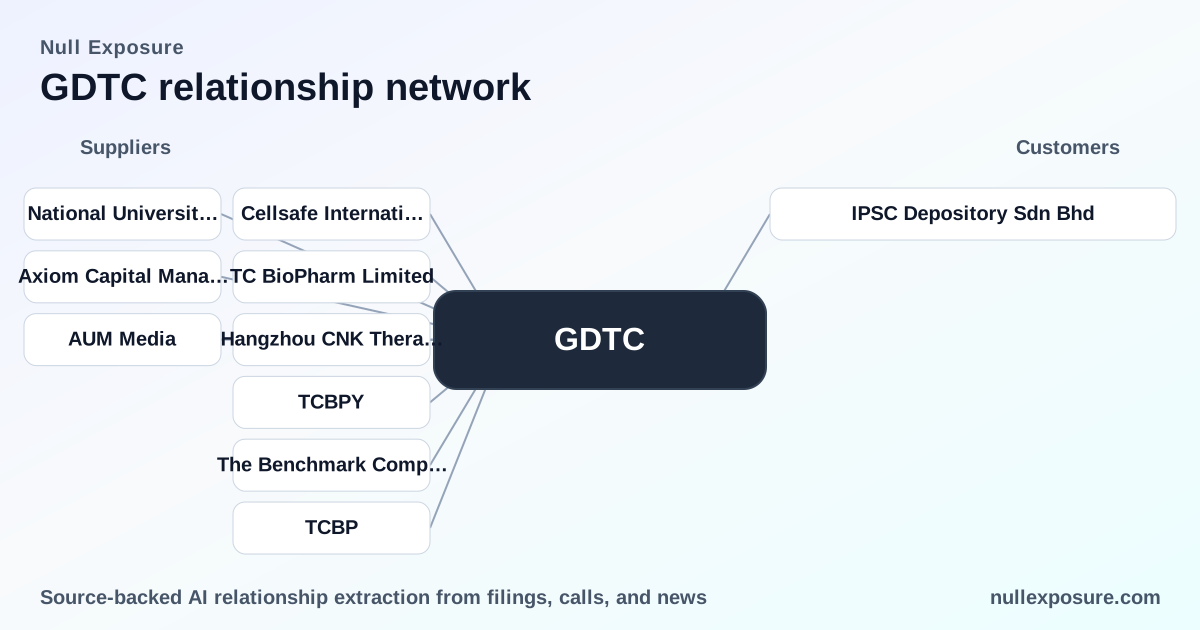
IPSC Depository Sdn Bhd — expanding into immune cell banking with CytoMed technology
IPSC Depository will relaunch its cord blood banking business and add immune cell banking offerings supported by resources and technologies from CytoMed, leveraging an installed base of more than 2,600 returning members. According to coverage from BioInformant (reported March 9, 2026) and echoed in a March 9, 2026 Yahoo Finance piece, this arrangement positions CytoMed as a technology and service supplier to a regional cell-storage operator.
Universiti Malaya Medical Centre (UMMC) — MoU to establish a multi-site Phase I trial in Malaysia
CytoMed signed a Memorandum of Understanding with UMMC to establish a multi-site, first-in-human Phase I clinical trial in Malaysia, formalizing a clinical trial pathway and local trial infrastructure. An Investing.com report on May 3, 2026 described the MoU as the vehicle to expand the company’s clinical footprint outside Singapore into Malaysia.
National University Hospital Singapore (NUH) — existing Phase I trial site for engineered gamma delta CAR-T
CytoMed’s ongoing Phase I trial at National University Hospital Singapore uses gamma delta T cells engineered with a proprietary CAR to target multiple cancers, and NUH remains an active clinical partner in the company’s current trial program. Investing.com noted on May 3, 2026 that the Malaysian MoU complements CytoMed’s ongoing NUH-led Phase I work in Singapore.
What these relationships imply about CytoMed’s operating model and business model characteristics
- Contracting posture — collaborative and research-oriented. The company contracts with academic and hospital partners under MoUs and clinical-trial agreements that emphasize shared operational responsibilities: CytoMed supplies engineered cells and proprietary technology, while hospital partners supply patient access, facilities, and clinical execution. This is a partnership-heavy commercialization path that trades capital intensity for clinical breadth.
- Concentration — small number of strategically important partners. The customer topology today is concentrated across a handful of high-value relationships (NUH, UMMC, IPSC), which means single-partner execution risk is material but each relationship is strategically meaningful to trial progression or service revenue.
- Criticality — high for clinical advancement, moderate for near-term revenue. Clinical partners such as NUH and UMMC are critical to trial timelines and regulatory validation; IPSC provides a complementary commercial channel for immune cell banking that can generate early recurring revenue and technology validation.
- Maturity — early clinical and commercial pilot stage. Corporate financials (Revenue TTM: $860,850; negative EBITDA and EPS) confirm that CytoMed is in transition from pre-clinical to early clinical monetization. Partnerships reflect pilot commercialization rather than broad market adoption.
Note: the relationship extraction returned no additional contractual constraints to analyze, which itself is a signal of limited public disclosure around customer contract terms.
Financial and governance signals that matter to partners and investors
- Small-cap, early-revenue profile. Market capitalization is roughly $11.8 million against TTM revenue of $860,850, indicating that the company’s current valuation is priced on clinical upside rather than near-term cash generation.
- High insider ownership, low institutional presence. Insiders hold ~67.8% of shares while institutional ownership stands at 0.49%, which produces tight control by founders/insiders and limited public float, increasing volatility and complicating external governance influence.
- Capital efficiency and leverage of partnerships. CytoMed’s strategy leverages clinical partners and a cell-banking operator to extend operational reach without proportional increases in fixed infrastructure, which conserves cash but concentrates execution risk in partner performance.
Key financial ratios: Price-to-Sales ~13.7, Price-to-Book ~2.3, and an EV/Revenue multiple elevated at ~41.4, reflecting the market’s valuation of future clinical success rather than current revenue streams.
Where the upside and the risks live
- Upside: successful Phase I data and execution of multi-site trials (UMMC + NUH) will materially de-risk therapeutic claims and open licensing or partnership monetization pathways, while IPSC’s immune cell bank can seed a recurring revenue channel and technical validation.
- Risks: execution dependencies on a small set of partners, concentrated insider ownership affecting liquidity, and the classic early-biotech risk that clinical outcomes determine valuation swings. Operational delays at NUH or UMMC would directly impact the company’s timeline and valuation.
Practical next steps for business and research due diligence
- Review the press releases and clinical trial registries connected to the NUH Phase I protocol and the UMMC MoU to verify enrollment timelines and trial scope. Investing.com coverage from May 3, 2026 is a starting pointer.
- Validate the commercial terms of the IPSC collaboration—ask whether technology transfer is fee-for-service, revenue-share, or equity-based; the BioInformant and Yahoo Finance notes from March 9, 2026 describe the operational link but not the economics.
- Monitor cash runway relative to projected trial costs and partnership milestones; with negative EBITDA and limited revenue today, funding cadence and potential dilution are primary investor concerns.
For an investor-focused dashboard and deeper relationship tracing that feeds into diligence workflows, see the company overview at https://nullexposure.com/.
Bottom line
CytoMed’s customer map is compact but strategically structured: clinical partners (NUH, UMMC) provide the pathway to de-risking the therapeutic hypothesis, while IPSC offers an early commercial node around immune cell banking. The company’s near-term value is partnership-dependent; investors should focus diligence on trial execution metrics, contract economics with IPSC, and the company’s funding plan to sustain multi-site trials.