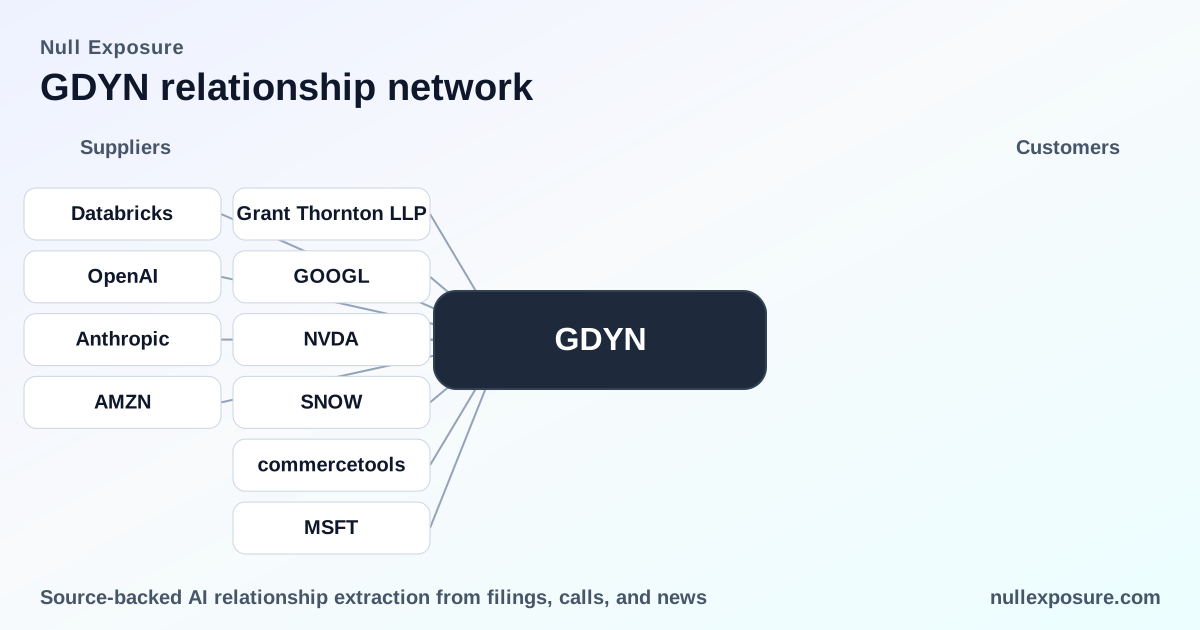
Grid Dynamics (GDYN) — customer relationships that drive a services-first growth story
Grid Dynamics is a services-led digital transformation firm that monetizes through long-form professional services, platform engineering and hosting contracts with large enterprises. Revenue comes primarily from project-based engagements scoped under master services agreements and statements of work, supplemented by hosting/subscription contracts recognized ratably; the company’s client mix and contract structure produce meaningful revenue concentration among a small set of large customers. For investors assessing customer risk and growth runway, the key lenses are contracting posture (framework MSAs + SOWs), enterprise concentration, and the balance between repeat project work and true recurring hosting revenue. For deeper research, visit https://nullexposure.com/.
What recent customer mentions reveal — a quick read for portfolio teams
Grid Dynamics continues to win high-profile enterprise engagements across retail and industrial automation verticals. Recent press mentions confirm active, value-driving work with Galeries Lafayette (retail personalization) and SmartRay (robotic inspection), signaling continued demand for engineered AI and automation services. These are consistent with the company’s stated client profile of Fortune 1000 customers and with its mixed revenue model of project work plus hosting. Below are the specific relationship signals pulled from public reports.
SmartRay — robotics inspection automation (FY2025)
Grid Dynamics supported SmartRay in transforming robotic programming workflows to create an AI-driven robotic inspection platform, accelerating automation and reducing time-to-market for weld seam inspection solutions. According to a press release published May 3, 2026, Grid Dynamics collaborated on an AI robotic inspection platform for SmartRay in partnership with Wandelbots. (Source: komunikasjon.ntb.no press release, May 3, 2026 — https://kommunikasjon.ntb.no/pressemelding/18600079/grid-dynamics-helps-smartray-create-an-ai-robotic-inspection-platform-in-collaboration-with-wandelbots?publisherId=90063&lang=en)
Galeries Lafayette — hyper-personalization for retail (FY2026) [source A]
Grid Dynamics is scaling hyper-personalization capabilities for Galeries Lafayette, applying platform and analytics engineering to customer experience initiatives at a major European retailer. MarketScreener reported the engagement in a company announcement dated April 20, 2026. (Source: MarketScreener news, Apr. 20, 2026 — https://www.marketscreener.com/news/grid-dynamics-to-announce-first-quarter-2026-financial-results-on-april-30th-ce7e51dddd89f42c)
Galeries Lafayette — hyper-personalization for retail (FY2026) [source B]
A second MarketScreener notice reiterates Grid Dynamics’ role in scaling personalization for Galeries Lafayette as part of FY2026 commentary, reflecting company communications distributed during the quarterly results cadence. (Source: MarketScreener company release, reported Apr. 20, 2026 — https://www.marketscreener.com/news/grid-dynamics-to-announce-fourth-quarter-and-full-year-2025-financial-results-on-march-5th-ce7e5ad8d988fe2c)
How Grid Dynamics structures customer relationships — practical implications
Grid Dynamics’ public disclosures and recent reporting establish a clear operating model that investors and operators must interpret as an integrated set of signals:
- Contracting posture — framework MSAs with SOWs. The company uses master services agreements to create a recurring legal framework, then executes discrete SOWs for individual projects. This produces predictable legal coverage without guaranteeing fully recurring revenue for every client.
- Recurring vs. project revenue mix. Hosting is sold as a subscription and recognized ratably, creating a layer of recurring revenue; however, the majority of engagements are project-based engineering work that is repeated but contractually singular in scope.
- Customer concentration is material and stable. Company filings state approximately 55.7% and 56.1% of revenue came from the top 10 clients in 2024 and 2023, and a single customer represented ~16% of revenue in those periods — a structural concentration investors must price into valuation and downside scenarios.
- Client profile — large enterprises, North America-focused. Grid Dynamics primarily serves Fortune 1000 corporations, with North America the principal sales market; this concentrates geopolitical and macro exposure to US enterprise IT spend cycles.
- Engagement stage and criticality. Most business is defined as repeated project work rather than long-term managed services, which makes relationships important and recurring but not always mission-critical subscription lock-ins.
- Spend band signal. The firm reports customer spend that places top clients in the $10M–$100M band (company-reported top customer figures included in filings), indicating meaningful program-size engagements when work is multi-year.
These operational signals together define a services-first growth model with pockets of subscription, where revenue visibility is driven by repeat engagements and a small number of large accounts.
For more context on how these customer dynamics affect valuation and credit-style risk, see additional coverage at https://nullexposure.com/.
Why the customer mix matters for valuation and operations
Grid Dynamics’ trailing twelve-month revenue of roughly $415.5M and gross profit near $141.6M come from a concentrated, services-driven book of business. That structure creates three concrete investment implications:
- Upside is client-driven: Large enterprise wins like Galeries Lafayette or industrial automation projects like SmartRay can move top-line growth materially because engagements land in the mid-to-high single-digit millions and scale system capabilities into new product lines.
- Downside is concentrated: With over 50% of revenue tied to the top 10 clients, the loss of one large contract or a protracted pause in spending by a marquee customer would pressure growth and near-term margins.
- Margin profile is variable: Project-based engineering yields step-changes in utilization and margin depending on bench management and offshore delivery efficiency; subscription hosting smooths revenue recognition but is not yet dominant.
Operators should prioritize converting successful SOWs into longer-term hosting or platform arrangements to increase recurring revenue share; investors should price a premium for growth potential balanced against concentration risk.
Bottom line — clear customer traction, concentrated risk
Grid Dynamics demonstrates clearly marketable capabilities in AI-driven automation and retail personalization, with public client citations at SmartRay and Galeries Lafayette confirming productized engineering outcomes. At the same time, material customer concentration and a services-heavy engagement model create asymmetry in the company’s revenue resilience. Investors should underwrite revenue scenarios with an explicit concentration premium, and operators should target contractual moves that increase subscription-like economics.
If you want a concise client-risk scorecard or a briefing slide for investment committees, NullExposure provides investor-ready relationship intelligence and synthesis tailored to these exact trade-offs: https://nullexposure.com/.