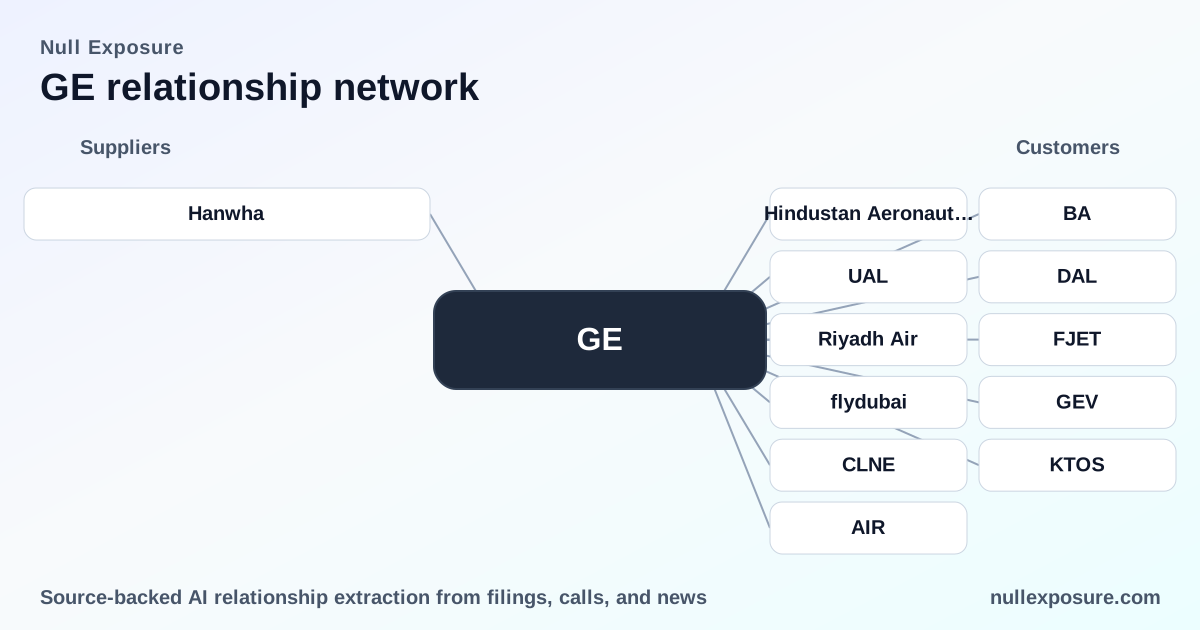
GE Aerospace: the customer map investors need
Thesis — GE Aerospace operates as a combined hardware-and-services engine OEM: it sells engines and large capital equipment at point-of-sale and then monetizes recurring, long‑duration services, spare parts and licensing agreements that generate the majority of Commercial Engines & Services (CES) margins. Investors should value GE on both engine backlog and the annuity-like services stream that follows installations.
For a quick overview of GE’s customer footprint, visit https://nullexposure.com/.
How GE’s commercial posture drives revenue and risk
GE’s operating model is dual‑mode: capital equipment sales (engines, turbines, power plant equipment) followed by long‑term maintenance, repair and overhaul (MRO) commitments. GE discloses that services contracts commonly run 10–25 years, and the CES segment accounted for roughly 73% of GE Aerospace revenue in 2025 with services representing 75% of CES — an explicit services-heavy monetization profile. GE also licenses MRO technology and sells spare parts, giving it a recurring revenue base and customer lock‑in through installed fleets.
This structure produces several investor-relevant characteristics:
- Contracting posture: long-term, high‑commitment service contracts that create annuity-like revenues but also expose GE to multi-year performance obligations.
- Concentration / counterparty profile: substantial exposure to large enterprises and governments — the U.S. government accounted for double‑digit percent of sales recently — which stabilizes demand but ties GE to defense and policy cycles.
- Criticality: engines and turbines are mission‑critical assets; performance or design issues with a program can force costly retrofits and reputational damage.
- Global reach and maturity: GE serves customers in ~120 countries, with meaningful revenue in NA, EMEA and APAC, making it sensitive to regional economic and regulatory shifts.
Customer relationships and what they mean for investors
Below I cover every customer relationship noted in the source results, with a concise plain‑English takeaway and the source cited naturally.
Aerospace customers and airline OEM relationships
- Hindustan Aeronautics (HAL) — GE reported a $1.6 billion order for F404‑GE‑IN20 engines from HAL in its FY2025 filing, illustrating GE’s continued traction in defense and regional military markets (GE 2025 10‑K).
- United Airlines (UAL / United Airlines) — GE secured a large commercial order to supply GEnx engines for United’s 787 fleet, reinforcing recurring services revenue tied to widebody operations (SimplyWall St / InsiderMonkey, March 2026).
- Delta Air Lines (DAL) — Delta selected GE’s NX engine to power and service a specified 787 order, reflecting fleet replacement demand and after‑sales service upside (GE Q4 2025 earnings call).
- American Airlines (AAL) — American reaffirmed its long history with CFM/GE powerplants as it selected CFM engines for A321neo operations, preserving GE’s installed base and spare‑parts demand (American Airlines press release / ASDNews, 2026).
- United / UAL (repeat coverage) — Multiple outlets reported the GEnx supply deal with United, underscoring its materiality to GE’s commercial backlog (SimplyWall St, March 2026).
- Ryanair (RYAAY) — Ryanair committed to long‑term materials and engine arrangements covering both LEAP‑1A and legacy CFM56 fleets, extending consumables and services revenues (TradingView / Zacks, May 2026).
- flydubai — Reported engine wins for GEnx at the Dubai Airshow help demonstrate GE’s regional commercial momentum in the Middle East (TradingView, March 2026).
- Riyadh Air — Included among the Dubai Airshow order wins, Riyadh Air’s LEAP‑1A commitment supports GE’s Middle East commercial growth (Bitget / TradingView, March 2026).
OEMs, integrators and program partners
- Boeing (BA) — Boeing is both a platform partner and a risk source: GE supplies engines for key Boeing platforms (777X, 787) while Boeing program issues (e.g., an identified 777X engine seal durability concern) can create retrofit costs and service work for GE (Boeing earnings calls; TradingKey coverage, March 2026).
- Airbus — GE, via CFM International, powers Airbus narrowbodies with LEAP engines; that installed base is a major source of recurring MRO and parts sales (InsiderMonkey analysis, March 2026).
- Embraer (EMBJ) — Regional jets such as the E175 run GE CF34 family engines, maintaining GE’s footprint in regional airline aftercare (DefenseMirror, 2026).
- CFM partners / Aercap (AER) — Lessor and engine‑leasing partners expanded partnerships with GE to support the GE9X engine, a sign that fleet operators and lessors are locking in maintenance and support (Aercap earnings / The Globe and Mail, Q4 2025).
Defense, space and advanced propulsion partners
- Kratos Defense & Security (KTOS) — GE Aerospace is in a joint development contract with the U.S. Air Force and Kratos to develop next‑gen military jet engines, reflecting GE’s defense R&D and prime‑supplier role (SimplyWall St, March 2026).
- Starfighters Space, Inc. / FJET — GE’s Innoveering division provided engineering and surface work for Starfighters’ STARLAUNCH test article, signalling GE’s move into space and propulsion engineering partnerships (BayStreet / GlobeNewswire, March–May 2026).
- FTAIM (FTAI Aviation) — FTAI signed a multiyear parts and upgrade agreement with GE Aerospace to support CFM56 engines, extending MRO demand into the late 2020s (Intellectia.ai coverage, March 2026).
Technology partners and smaller strategic investments
- BETA Technologies (BETA) — GE and BETA are collaborating on a turbogenerator that combines GE engine heritage with BETA’s electric propulsion expertise, showcasing GE’s approach to electrified propulsion and adjacent product innovation (Yahoo Finance / MyNBC5, March 2026).
- Hyliion Holdings (HYLN) — Hyliion acquired a 3D‑printed hydrogen/fuel‑agnostic generator from GE Additive, demonstrating GE’s additive manufacturing commercialization with transportation OEMs (TCTMagazine, August 2022; republished 2026).
- StandardAero / SARO — StandardAero referenced expanded licensing and long‑term contracts with GE to support platform maintenance, underscoring the aftermarket licensing channel (Standardaero earnings transcript, May 2026).
Energy, utilities and industrial customers
- Central Puerto (CEPU) — GE extended a multiyear maintenance services agreement to support a 760 MW combined‑cycle power plant in Argentina, a classic example of long‑term energy services revenue (GE press release, 2016; cited in coverage).
- Kenon / OPC Energy (KEN) — Kenon’s OPC Energy signed with GE Vernova to supply core equipment and maintenance for Hadera 2 gas‑fired power plant, showing GE’s pipeline in independent power projects (TipRanks, May 2026).
- Duke Energy (DUK) — Duke’s framework agreement with GE Vernova on turbine procurement illustrates GE’s role as a preferred OEM for utility turbine procurement (Duke Q4 2025 earnings call).
Consumer and commercial OEM mentions (appliances, retail)
- Conn’s HomePlus (CONN) and K. Hovnanian Homes (HOV) — Retail and homebuilder listings referencing General Electric appliances indicate ongoing OEM relationships in consumer markets, a modest but persistent revenue stream (local news archives, 2017–2025).
- FRT‑P‑C (FRT‑P‑C) — Local real‑estate listings referencing GE appliances highlight continued brand presence in residential channels (Patch.com, 2026).
Financial, legacy and other relationships
- Genworth (GNW) — Historical policy transfers from GE life insurance affiliates to Genworth are referenced in litigation notices, a legacy contractual exposure rather than current product revenue (TopClassActions, 2020).
- Plexus (PLXS) — GE Vernova presented Plexus with a Supplier Innovation Award, signalling supplier and procurement relationships in the gas power supply chain (Plexus earnings call mention).
Investment implications and risk checklist
- Positive: a large installed base and a services‑heavy CES segment create recurring, high‑margin revenue and strong aftermarket visibility. Commercial engine wins (United, Ryanair, flydubai, Riyadh Air) translate to multi‑year parts and MRO revenue.
- Negative: program execution risk (e.g., Boeing 777X seal issue), concentration with large OEMs and government customers, and global exposure to regional demand cycles create downside scenarios. Long‑term service commitments are lucrative but lock GE into performance obligations for up to 25 years.
For practitioners mapping counterparties or underwriting supplier exposure, GE’s profile — long‑term contracts, global footprint, heavy services mix and critical installed assets — should be modeled explicitly.
Explore a visual customer map and deeper relationship signals at https://nullexposure.com/.