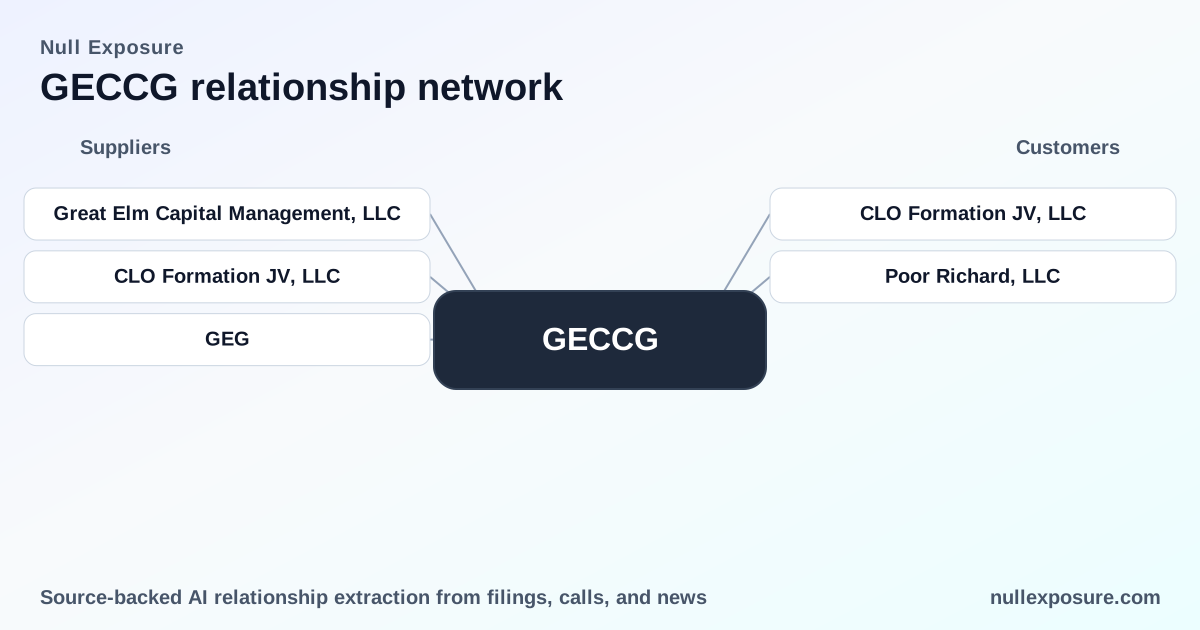
GECCG: Who Great Elm Capital Collects From and Why it Matters to Investors
Great Elm Capital (represented here via the GECCG 7.75% notes due 2030) operates as a middle‑market credit investor that monetizes through interest income, loan repayments, equity upside and structured finance distributions, while opportunistically raising capital via equity programs and unsecured note issuances to fund its portfolio. For investors and operators assessing counterparty risk, the observable relationships show a portfolio built from secured loans, syndicated credits and structured vehicles — with targeted middle‑market counterparties and a tilt toward specialty finance and services. Explore a concise counterparty mapping at https://nullexposure.com/.
How Great Elm’s operating model translates into measurable business behavior
Great Elm’s public filings and transcripts portray a company that contracts predominantly as a creditor: secured loans with warrants, syndicated loan positions, and ownership stakes in structured finance vehicles generate the firm’s cash flow. This contracting posture produces identifiable characteristics:
- Concentration: The firm holds concentrated positions in named credits — the company discloses allocations that can exceed 5% to single borrowers, which elevates idiosyncratic credit risk relative to a broadly diversified fund.
- Criticality: Counterparties function as the primary cash‑producers for GECC; distributions from structured vehicles and coupon/repayment streams are critical to noteholder returns.
- Maturity and funding linkage: GECCG bonds are a fixed‑coupon funding instrument due in 2030, and the company has actively raised equity and unsecured debt (including 7.75% notes and ATM/private placements) to manage liquidity and support the portfolio.
- Segment focus and reliance: Company disclosures define counterparties as middle‑market enterprises (enterprise values roughly $100m–$2bn) and indicate a focus on specialty finance/services, implying a reliance on borrower management teams for performance and workout outcomes.
These operating signals construct a straightforward investment thesis: returns are driven by credit selection and active funding management, while downside is concentrated in a small set of borrowers and structured investments.
Counterparty roll call: the relationships investors should price in now
CLO Formation JV, LLC
Great Elm reported receiving $4.3 million of cash distributions in Q4 2025 from its CLO Formation JV, up from $1.5 million in the prior quarter, indicating the JV is an active cash generator for the period ending December 31, 2025. According to a March 2, 2026 GlobeNewswire release, that distribution jump reflects realized cash flows from the structured vehicle.
Poor Richard, LLC
Poor Richard provided direct capital to GECC through a $14 million private placement in August 2025 (roughly 1.3 million shares), and company commentary in 2026 lists the same private placement alongside a separate $13 million ATM and $57.5 million of unsecured note issuance as part of the firm’s recent funding mix. QuiverQuant reported the private placement detail for FY2025, and an Investing.com recap of FY2026 funding activity confirms Poor Richard’s role in that financing tranche.
NicePak
Great Elm funded a secured loan with warrants to NicePak, a wet‑wipes producer, in 2022, positioning the company as a lender with equity kickers on a specialty consumer manufacturing borrower. The arrangement is summarized in an earnings call transcript published by Investing.com during discussion of Q3 2025 results.
First Brands
GECC has maintained syndicated loan exposure to First Brands since 2020, with portfolio allocations above 5% since 2023, making First Brands a material single‑name exposure within the portfolio. This concentration and timeline were disclosed in company commentary summarized in an Investing.com earnings call transcript for FY2025.
Maverick Gaming
Maverick Gaming was listed among non‑accrual positions as of September 30, 2025, contributing to the company’s reported non‑accrual bucket that totaled 1.5% of portfolio fair value at that cut‑off date. The Q3 2025 earnings transcript on Investing.com documents Maverick Gaming’s non‑accrual status.
Del Monte (DMPLF)
Del Monte also featured in the non‑accrual group as of September 30, 2025, and is counted in the same 1.5% portfolio fair‑value non‑accrual disclosure. The company’s Q3 2025 earnings call transcript (Investing.com) lists Del Monte alongside other non‑accruals.
What these relationships imply for credit and liquidity risk
- Concentrated credit exposure is a defining risk: a single issuer allocation above 5% (First Brands) and a small set of non‑accruals compress the margin for error; recoveries on large, stressed positions will disproportionately influence NAV and distributable earnings.
- Funding profile is active and multi‑sourced: GECC demonstrated willingness to supplement portfolio liquidity with ATM programs, private placements and unsecured note issuances, including the 7.75% notes that trade under GECCG. That behavior signals disciplined but dynamic liability management rather than passive funding.
- Counterparty complexity increases workout dependency: investments in structured vehicles (CLO JV) and specialty finance/services borrowers mean operational reliance on third‑party managers and borrower sponsors. Performance is therefore sensitive to sponsor capability and operational execution.
- Non‑accruals are present but contained: the reported 1.5% non‑accrual position as of September 30, 2025 indicates impairment exists but, by that metric, is currently a limited drag on portfolio fair value — nevertheless, material single‑name allocations could expand losses if recovery trajectories deteriorate.
Bottom line for investors and operators
Great Elm’s counterparty map is unequivocally middle‑market, credit‑centric and funding‑aggressive, with visible reliance on a handful of material borrowers and structured investments for cash flow. Key monitoring priorities are single‑name concentrations (notably First Brands), trajectory of non‑accrual recoveries (Del Monte, Maverick Gaming), and the firm’s ongoing use of equity and high‑coupon unsecured debt to manage liquidity. For an organized, observable view into these counterparty dynamics, see https://nullexposure.com/.
If you’re evaluating exposure to GECCG instruments, prioritize diligence on borrower workout plans, recovery assumptions and the near‑term funding calendar — those are the levers that will determine whether coupon receipts and portfolio realizations sustain noteholder returns.