Great Elm Capital (GECCI) — Customer Relationships That Underpin an 8.50% Note
Great Elm Capital Corp. issues 8.50% notes due 2029 and operates as an investment company that monetizes by generating income and capital appreciation across private equity, debt securities and real estate investments; the vehicle earns interest, fees and distributable income from its portfolio while using capital markets funding such as these notes to finance assets. For investors and operators, the named counterparties in GECCI’s filings — a commercial bank counterparty and a trustee for the indenture — are core pieces of its capital and servicing plumbing and deserve focused due diligence. Learn more at https://nullexposure.com/.
What the filings disclose about counterparties — two relationships, clear roles
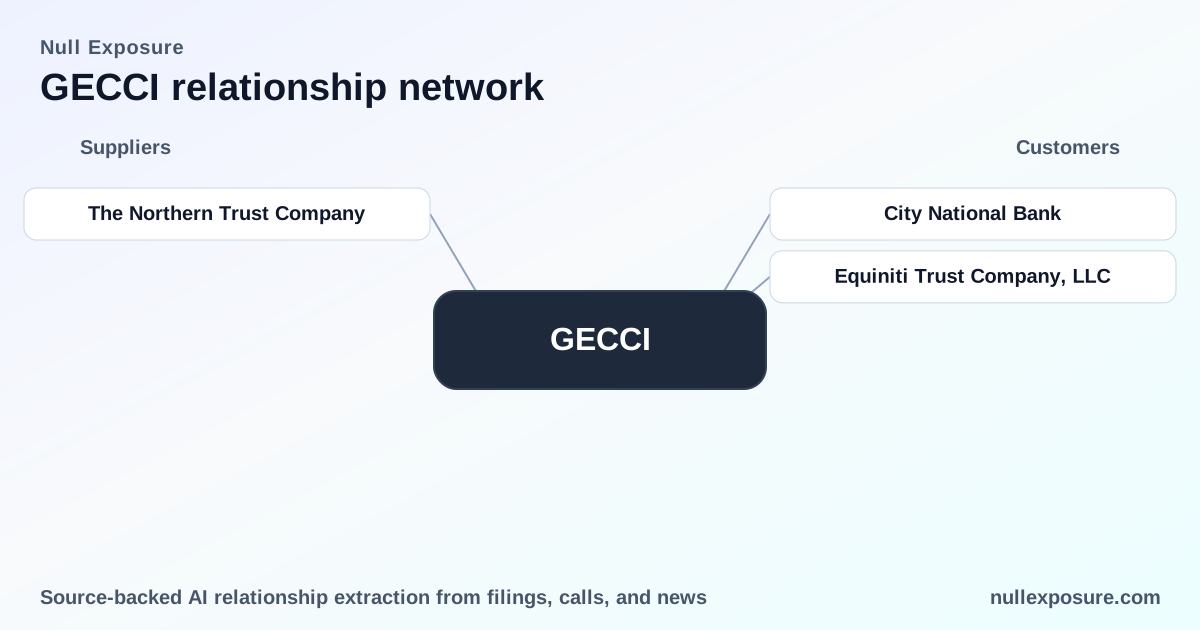
GECCI’s FY2024 Form 10‑K discloses two explicit external counterparties relevant to creditors and portfolio monitoring. These are not a long tail of vendors; they are institutional counterparties that structurally support financing and the note issuance.
City National Bank — the lending counterparty
GECCI has a Loan, Guarantee and Security Agreement dated May 5, 2021 with City National Bank, placing this bank in the role of creditor and secured-party under documented loan terms. According to GECCI’s FY2024 10‑K, this agreement establishes a formal lending relationship between the registrant and City National Bank. (Source: GECCI Form 10‑K, FY2024.)
Equiniti Trust Company, LLC — the indenture trustee
The indenture governing the notes names Equiniti Trust Company, LLC (formerly American Stock Transfer & Trust Company, LLC) as trustee under an indenture dated September 18, 2017. The FY2024 10‑K identifies Equiniti as the trustee responsible for administering the indenture for GECCI’s securities. (Source: GECCI Form 10‑K, FY2024.)
Operating-model signals you need to fold into valuation and covenant analysis
Beyond the two named counterparties, GECCI’s filings and model inferences surface company-level signals that shape how those relationships function and how risky they are for noteholders.
- Middle‑market investment focus (confidence 0.80). The company’s strategy targets middle‑market borrowers and assets — the filing defines middle market as enterprise values between $100 million and $2 billion and describes a “continuum of lending” that includes receivables factoring and asset‑based lending. This focus implies credit underwriting and covenant structures tailored to privately-held, growth‑stage businesses rather than large investment‑grade corporates. (Evidence from GECCI disclosure, FY2024.)
- Active managerial role consistent with a BDC/service provider posture (confidence 0.80). GECCI, operating as a business development company in its corporate family, provides managerial assistance to certain portfolio companies — monitoring operations, participating in board meetings and offering organizational guidance — which signals operational engagement beyond passive creditor behavior. This shapes counterparty risk: counterparties can be both borrowers and recipients of hands‑on oversight. (Evidence from GECCI disclosure, FY2024.)
- Single reporting segment — investment management. The company reports one operating segment and reporting unit, labeled investment management, so revenue and risk are concentrated in investment activity rather than diversified product lines. (Evidence from GECCI disclosure, FY2024.)
- Model‑inferred spend band and direct commitment datapoint. Automated constraint inference flags a $10M–$100M spend band (confidence 0.90) for unfunded commitments at the company level; the filing text reports “As of December 31, 2024, the Company had approximately $14,580 in unfunded commitments to provide financing to certain of its portfolio companies.” Treat the inference as a company‑level signal to probe in diligence — reconcile the model band with the explicit number disclosed in the filing. (Evidence excerpt and FY2024 filing text.)
How each relationship affects creditors and operators
City National Bank and Equiniti play distinct roles; both are structurally material for noteholders, but in different ways.
- City National Bank (lender): As a secured lender under the Loan, Guarantee and Security Agreement, City National Bank is a counterparty that can control collateral enforcement, borrowing base mechanics and default remedies. Operators should review the loan agreement for covenants that could accelerate or restrict the firm’s flexibility when market stress hits. (Source: GECCI Form 10‑K, FY2024.)
- Equiniti Trust Company, LLC (trustee): As indenture trustee, Equiniti administers obligations to noteholders and enforces trustee remedies; trustee duties are administrative but critical for formal acceleration, notice and creditor coordination under the bond documents. Confirm the trustee’s powers, fee mechanics and any delegated servant clauses in the indenture. (Source: GECCI Form 10‑K, FY2024.)
Risk and concentration checklist for investors and operators
Investors and risk officers should fold these relationship facts into a short checklist when assessing GECCI’s notes or counterpart exposures:
- Liquidity and covenant exposure to City National Bank: Review borrowing base triggers, permitted liens, and any cross‑default language that links the bank facility to the 8.50% notes.
- Trustee mechanics under Equiniti: Confirm the procedural pathways for enforcement and noteholder communication — the trustee is the conduit for remedies, so its administrative rights and restrictions matter materially.
- Portfolio concentration and active management: GECCI’s middle‑market focus and managerial assistance role mean credit performance will reflect private‑company cycles and idiosyncratic operating execution, not just macro credit spreads.
- Unfunded commitments and funding cadence: Reconcile the filing’s stated unfunded commitment figure with model inferences flagged in disclosure review; determine whether any material near‑term funding obligations could stress liquidity.
Explore institutional‑grade diligence frameworks and counterparty scoring at https://nullexposure.com/ for structured, repeatable analysis.
Bottom line — what investors should take away
- Both named counterparties are functionally essential: City National Bank underwrites secured lending relationships that affect liquidity and leverage, while Equiniti administrates the indenture that governs noteholder remedies. (Source: GECCI Form 10‑K, FY2024.)
- Company‑level signals point to concentrated, hands‑on investing in the middle market. That posture raises idiosyncratic credit risk but can also generate elevated yield capture if underwriting and portfolio supervision perform as intended. (Evidence: GECCI disclosure, FY2024.)
- Actionable next steps: Obtain the full loan agreement and indenture schedules, review covenant cross‑referencing between the bank facility and the notes, and reconcile unfunded commitment figures for nearer‑term liquidity planning.
For practitioners building a counterparty risk memo or covenant map tailored to GECCI’s notes, the two documents named in the FY2024 filing are the primary source material to request and analyze. Further tools and templates are available at https://nullexposure.com/.