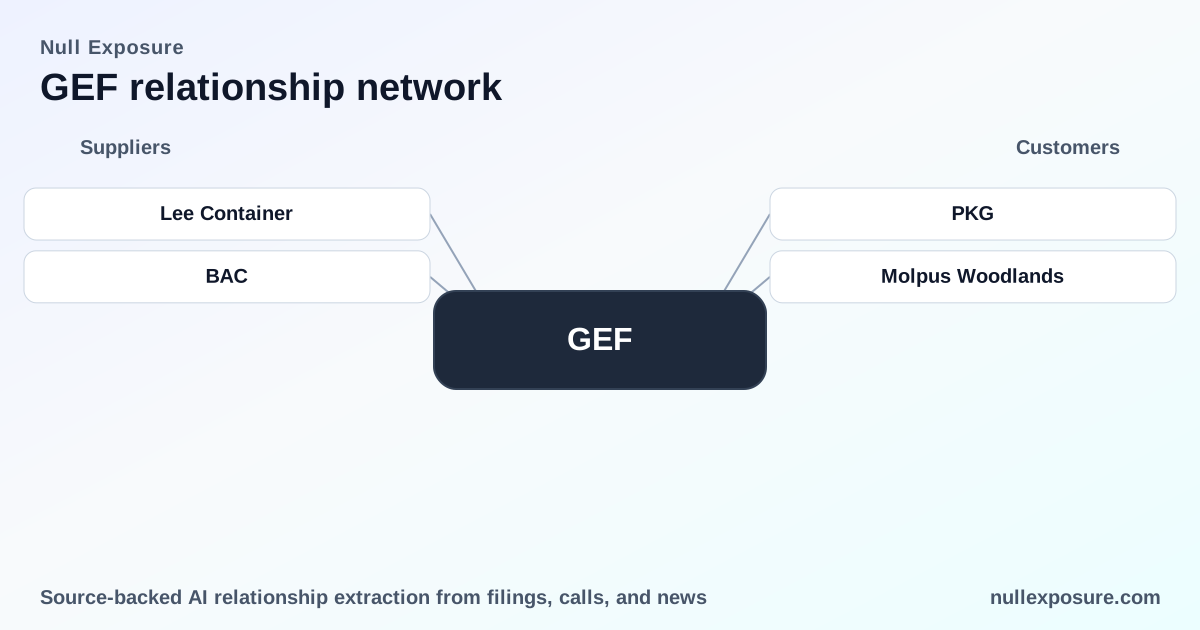
Greif (GEF): How customer relationships and disposals reshape the packaging franchise
Greif monetizes a global industrial-packaging franchise by manufacturing rigid containers and selling complementary logistics and lifecycle services, collecting revenue through a mix of framework purchase agreements for repeat industrial buyers and spot deliveries to smaller or one-off customers. Recent corporate disclosures and market commentary show Greif actively reshaping its asset mix—most notably divesting containerboard and timberland assets—while preserving a diversified customer base that supports recurring manufacturing and services revenue. For investors focused on revenue durability and counterparty risk, the interaction between long‑term master supply agreements and ongoing spot sales is the key operating dynamic. For deeper mapping of counterparty exposure and document-level evidence, visit https://nullexposure.com/.
What investors need to know up front
Greif generates margin from two interlocking businesses: core manufactured packaging (drums, IBCs, closures) and value-added services (container life cycle management, warehousing, logistics). This model produces mixed cash flow characteristics—manufacturing yields scale economics and steady gross profit, while services increase customer stickiness and recurring revenue. Customer concentration is low, geographic reach is global with a North American tilt, and contract types are mixed between master agreements and significant spot activity. Recent divestitures convert operating complexity into liquidity while reducing exposure to commodity corrugated markets.
How the public record documents specific counterparties
Below I document every relationship entry in the source set with a short, plain-English summary and the human-readable source. Each entry corresponds to a separate record surfaced in company and market coverage.
Packaging Corporation of America — Greif FY2025 press release (GlobeNewswire, Nov 5, 2025)
Greif disclosed that on June 30, 2025 it entered a definitive agreement to divest its containerboard business, including the CorrChoice sheet feeder system, in an all‑cash transaction of $1.8 billion to Packaging Corporation of America. This transaction reduces Greif’s exposure to the containerboard and corrugated sheet commodity cycle while monetizing assets for redeployment. (Source: Greif FY2025 results press release, GlobeNewswire, Nov 5, 2025.)
PKG — same Greif FY2025 press release (GlobeNewswire, Nov 5, 2025)
The same press release recorded the counterparty as PKG (Packaging Corporation of America) and reiterated the $1.8 billion all‑cash purchase of Greif’s containerboard business, confirming buyer identity and transaction economics for investors. (Source: Greif FY2025 results press release, GlobeNewswire, Nov 5, 2025.)
Packaging Corporation of America — Greif FY2026 results press release (GlobeNewswire, Jan 27, 2026)
Greif referenced the June 30, 2025 divestiture to Packaging Corporation of America again in its FY2026 reporting, underscoring the transaction’s continuity into the new fiscal year and its impact on segment composition. This restatement in FY2026 materials helps reconcile year‑over‑year revenue and margin metrics for modelers. (Source: Greif FY2026 results press release, GlobeNewswire, Jan 27, 2026.)
PKG — Manila Times reprint of FY2026 press release (Apr 29, 2026)
A reprint of Greif’s fiscal Q2 2026 results highlighted the same containerboard sale to Packaging Corporation of America, reflecting how the divestiture was communicated broadly to capital markets and syndicated news outlets. Syndicated coverage accelerates market digestion of the strategic shift away from containerboard. (Source: Manila Times (GlobeNewswire reprint), Apr 29, 2026.)
PKG — Packaging Corporation of America 2025 Q4 earnings call (transcript)
Packaging Corporation of America referenced acquisition- and integration‑related costs tied to the purchase of Greif’s containerboard business during its 2025 Q4 earnings call, indicating an active integration process and near‑term cost line items for the buyer. This is useful for investors modeling synergies and one‑time expenses on PKG’s side. (Source: PKG 2025 Q4 earnings call transcript, March 2026.)
Molpus Woodlands — coverage in The Globe and Mail (Mar 2026)
Media reporting confirmed Greif completed the sale of its timberlands business to Molpus Woodlands, evidencing further portfolio rationalization and reduction of non‑core forestry assets. The timberland sale converts operating landholdings into capital and narrows Greif’s exposure to timber‑derived commodity volatility. (Source: The Globe and Mail (press release coverage), March 2026.)
What these relationships imply about Greif’s operating model and constraints
The record of transactions and disclosures yields a clear set of company-level signals about how Greif structures customer relationships and runs operations:
- Contracting posture is mixed: Greif balances framework agreements—master supply agreements and recurring purchase orders that underpin the majority of revenues—with spot deliveries that serve immediate or smaller buyers and support volume flexibility. This balance delivers both predictable baseline revenue and opportunistic upside. (Company-level evidence from sales and contract descriptions in filings.)
- Counterparty mix is broad: Greif serves an ecosystem that includes Fortune 500 customers, mid‑market buyers, and small businesses, indicating low single‑customer concentration and diversified demand drivers across industries such as chemicals, food & beverage, automotive, and building products. This multi‑tier customer base reduces counterparty concentration risk. (Company-level evidence from customer base descriptions.)
- Geographic footprint has a North American bias with global reach: Reporting emphasizes North American sales and operations in Paper Packaging & Services, but Greif sells industrial packaging globally across NA, EMEA and APAC, implying currency and regional demand diversification. (Company-level evidence from segment reporting.)
- Materiality and concentration are low: Management explicitly states no single customer is principal to total operations, signaling revenue diversification and reducing counterparty credit risk. This is a structural strength for lending or premium finance counterparties. (Company-level evidence from customer disclosures.)
- Operating segments are manufacturing plus services: The business combines rigid packaging manufacturing with service offerings (container lifecycle management, warehousing, logistics), enabling higher customer stickiness and cross‑sell potential—useful for long‑tenor revenue forecasts. (Company-level evidence from segment descriptions.)
- Relationship dynamics are active: Weekly orders and spot deliveries indicate an operational cadence that requires robust distribution and fulfillment; this operational tempo supports recurring short‑cycle cash receipts while exposing supply chain to near‑term volatility. (Company-level evidence from order cadence disclosures.)
Investment implications and risk checklist
- Positive: diversified revenue base and service stickiness reduce counterparty concentration and improve predictability for premium finance arrangements.
- Neutral/Structural: mixed contract types imply models must capture both recurring master‑agreement volumes and volatile spot flows—use blended forecasting.
- Negative: disposal of containerboard and timberland removes commodity exposure but also shrinks bulk revenue lines, meaning near‑term EPS and margin comparisons require careful pro forma adjustments.
- Operational: integration costs at PKG for the acquired containerboard assets could produce short‑term noise in industry comparables and buying‑side working capital demands.
For a consolidated view of these customer relationships and the underlying document evidence, explore our coverage at https://nullexposure.com/.
Bottom line
Greif operates a resilient, low‑concentration industrial packaging franchise monetized through a combination of manufacturing scale and recurring service contracts, while actively monetizing non‑core commodity assets to simplify the business. The recent containerboard and timberland sales materially change the company’s balance of commodity exposure versus service‑led revenue—an essential adjustment for investors and counterparties modeling future cash flows and counterparty risk.