Greif Inc (GEF-B): Customer relationships, strategic divestitures and what they signal for investors
Greif is a global industrial packaging manufacturer and services provider that monetizes through the sale of rigid packaging products (steel, fibre and plastic drums, IBCs, closures) and ancillary services (container life‑cycle management, logistics and warehousing). The company operates a diversified, geography‑balanced sales base and supplements operating cash flow with periodic portfolio actions — most prominently the sale of its containerboard business for $1.8 billion — that reshape capital allocation and leverage. For an investor, Greif’s commercial profile combines durable manufacturing cash flow with service revenues and recurring spot/short‑term trading relationships across industrial end markets; the recent divestitures materially change the firm’s product mix and capital intensity.
If you want a concise, actionable map of Greif’s customer and counterparty moves, visit https://nullexposure.com/ for structured intelligence and transaction histories.
Big transaction you need to price in: the Packaging Corporation of America deal
Greif completed a major disposition of its containerboard operations to Packaging Corporation of America (PKG) in a transaction that closed in late 2025 for $1.8 billion in cash. According to Greif’s public filings and press releases, the company entered into the definitive agreement on June 30, 2025 and announced completion on September 2, 2025; the deal and subsequent quarterly reports reiterate the sale and its cash nature (Greif press releases, GlobeNewswire/Globe and Mail, 2025–2026). This transaction materially reduces Greif’s exposure to containerboard manufacturing while boosting liquidity and enabling faster deleveraging (Greif FY2026 results commentary, GlobeNewswire, Jan 2026).
- Greif announced the definitive agreement with Packaging Corporation of America on June 30, 2025 and reported closing the sale on September 2, 2025; the company reiterated the terms in its FY2026 reporting (Greif press releases and company statements, GlobeNewswire/Globe and Mail, 2025–2026).
Other divestitures and asset sales that matter for capital allocation
Greif’s historical asset sales show a pattern of shedding non‑core or land-intensive businesses to focus on core industrial packaging and services.
- Molpus Woodlands Group, LLC acquired Greif’s Soterra land management business for approximately $460 million in a transaction reported in the company’s historical disclosures (Simply Wall St summary of FY2017 transactions). This sale reduced Greif’s timberland exposure and shifted cash into the operating business (Simply Wall St company history, FY2017).
- PSC Group LLC acquired Delta Petroleum Company, Inc. from Greif as part of prior portfolio rationalization steps disclosed in company history summaries (Simply Wall St, FY2017).
Each of these transactions is documented in Greif’s public history and third‑party reporting and reflects an active capital‑reallocation posture that investors should incorporate into valuation and leverage assessments (Simply Wall St, historical filings).
Full roster of counterparties mentioned in public coverage
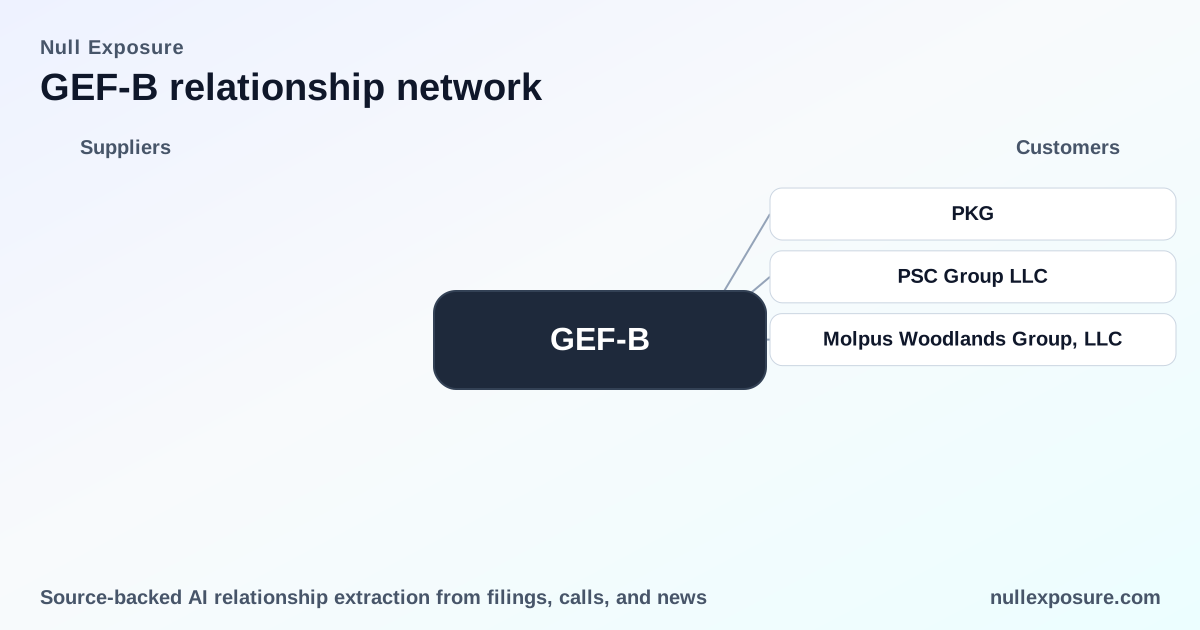
Below are the counterparties that appear in Greif’s public customer/transaction reporting in the period covered by aggregated sources. Each entry is accompanied by a one‑line summary and the source cited naturally.
- Packaging Corporation of America (PKG): Greif sold its containerboard business, including the CorrChoice sheet feeder system, to PKG in an all‑cash transaction for $1.8 billion, announced in mid‑2025 and closed on September 2, 2025; referenced in Greif’s FY2026 and FY2025 press releases (GlobeNewswire; The Globe and Mail; company FY2026 reporting, 2025–2026).
- Molpus Woodlands Group, LLC: Molpus agreed to acquire Greif’s Soterra land management business for roughly $460 million, a transaction recorded in Greif’s disposition history (Simply Wall St company summary, FY2017).
- PSC Group LLC: PSC Group acquired Delta Petroleum Company, Inc. from Greif as part of earlier restructuring moves described in archival company summaries (Simply Wall St, FY2017).
These counterparties are the public face of Greif’s recent portfolio reshaping; the PKG sale is the most consequential for near‑term cash, leverage and segment composition (Greif press coverage, 2025–2026).
How Greif sells — commercial posture and what that means for revenue stability
Greif’s customer contract profile and sales mechanics are an operational signal for investors. These are company‑level characteristics derived from Greif’s disclosures:
- Greif uses a mix of framework agreements (master supply agreements) combined with purchase orders for the bulk of transactions, which enables predictable baseline volumes while preserving flexibility in pricing and delivery.
- The company also conducts spot and day‑to‑day deliveries across a wide set of industrial end markets (chemicals, food & beverage, petroleum, pharmaceuticals, etc.), which introduces cyclical volume sensitivity tied to industrial production.
- Typical customer payment and contract durations are short (payment terms typically less than one year), removing significant financing component adjustments but increasing sensitivity to working capital swings.
- Customer base is broad and non‑concentrated: Greif serves Fortune 500 firms as well as mid‑market and small businesses globally; no single customer is deemed principal to total operations.
- Geography is diversified: North America, EMEA and Asia‑Pacific are all material to net sales, with North America and EMEA particularly sizeable in recent reporting.
- Commercial role is both seller of goods and provider of services (container lifecycle, logistics), blending manufacturing margins with recurring services revenue.
These features mean revenue is diversified but exposed to cyclical industrial demand and working‑capital variation; the company’s contracting posture supports margin capture during stable demand yet leaves downside risk in broad industrial slowdowns.
Investment implications and risk drivers
- Balance‑sheet reset through divestitures. The $1.8 billion sale to PKG and earlier asset sales demonstrate an explicit strategy to reduce capital intensity and leverage while focusing on higher‑return core products and services (company press releases, 2025–2026).
- Diversified customer base reduces single‑counterparty risk. No single customer dominates revenue, which is a structural credit and revenue stability positive.
- Cyclicality remains a core risk. The continued mix of spot and short‑term contracts ties revenue to industrial production cycles; services revenue cushions but does not eliminate cyclicality.
- Geographic reach supports volume resilience but raises operational complexity. Material sales across North America, EMEA and APAC diversify demand exposures but increase execution and supply‑chain complexity.
Key takeaway: Greif’s transaction activity materially improves liquidity and lowers capital intensity, while its commercial model keeps the company exposed to industrial cycles; investors should price the business as a diversified, manufacturing‑led operator with an improving balance sheet but cyclical top‑line sensitivity.
For a structured view of counterparties and transaction histories that complement this narrative, consult our platform: https://nullexposure.com/.
Authoritative data sources referenced include Greif’s FY2025–FY2026 press releases and shareholder communications (GlobeNewswire, The Globe and Mail) and archival transaction summaries (Simply Wall St).