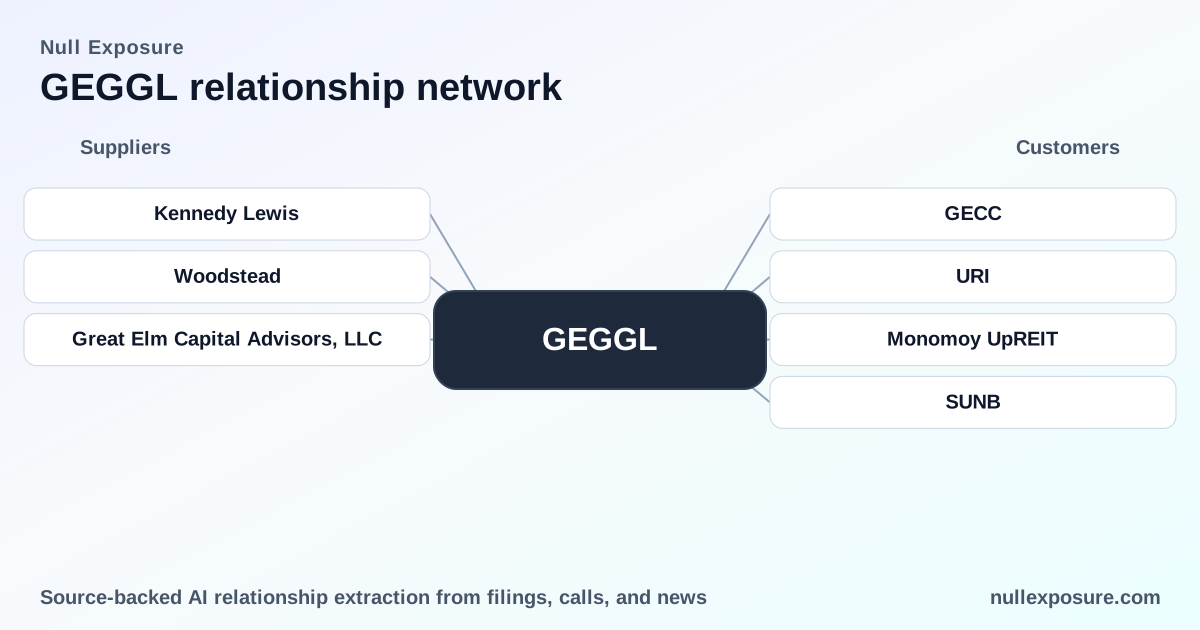
Great Elm Group (GEGGL): Customer Map and What It Means for Credit Investors
Great Elm Group operates as a diversified holding and asset-management platform that monetizes primarily through investment management, property management, incentive and administration fees collected from externally managed vehicles and real-estate portfolios. The company’s 7.25% Notes due 2027 sit above an operating model that generates recurring fee income from sponsored vehicles (notably Great Elm Capital Corp. and Monomoy UpREIT) and generates tenant cashflows from real-estate assets concentrated in the equipment rental sector. For fixed-income investors, the structural questions are revenue concentration, contract enforceability and how incentive-driven fee volatility translates into cash available for debt service. Learn more at https://nullexposure.com/.
How the customer relationships actually work — operating model signals that matter
Great Elm functions primarily as a service provider: its subsidiaries (GECM and MCRE) manage externally sponsored investment vehicles and property portfolios and earn fees on management, property operations, incentives and administration. The company recognizes revenue under agreements that are cancellable by either party, which creates a short-term contracting posture in legal terms even as management treats some of these relationships as long-lived economic assets (the firm records an intangible for IMAs amortized over 15 years). The combination produces two structural characteristics:
- Concentration and criticality: Revenues are materially concentrated in a small number of managed vehicles—GECC and Monomoy UpREIT are the primary sources of continuing revenues—so client loss or fee compression would have outsized impact on cashflow.
- Contracting nuance: Contracts are legally cancellable (short-term posture) but are economically treated as long-duration (amortized IMAs), creating revenue sensitivity to performance and incentive-fee cycles rather than pure multi-year guaranteed cashflow.
These signals position Great Elm as a fee-revenue business with operational leverage to investment returns (through incentive fees) but concentration and cancellability risk that investors must price into the notes.
Customer relationships — who pays Great Elm and what they pay for
Great Elm Capital Corp. (GECC / Great Elm Capital Corp.)
Great Elm is the external manager for Great Elm Capital Corp., and management and incentive fees from GECC are a material and active source of revenue—the company reported $1.2 million of management fees for the quarter ended December 31, 2025 and recorded $4.1 million of incentive fees for the year ended June 30, 2025. According to a company filing summarized on TradingView (FY2025), GECM provides investment management services and earns management, property management, incentive and administration fees from GECC (TradingView, Mar 2026: https://www.tradingview.com/news/tradingview:b362565774483:0-great-elm-group-inc-sec-10-k-report/). Quarterly reporting also corroborates the $1.2M management fee in Q2 FY2026 (FutuNN news, Mar 2026: https://news.futunn.com/en/post/68441047/great-elm-group-reports-fiscal-2026-second-quarter-financial-results).
Monomoy UpREIT
Monomoy UpREIT is another sponsored vehicle for which Great Elm’s MCRE subsidiary performs management and property-related services; Monomoy is identified as a primary revenue contributor alongside GECC, creating the concentration cited in the firm’s disclosures. This relationship is explicitly described in the FY2025 SEC summary and underpins the company’s property-management fee stream (TradingView, Mar 2026: https://www.tradingview.com/news/tradingview:b362565774483:0-great-elm-group-inc-sec-10-k-report/).
United Rentals (URI)
United Rentals is identified by management as the largest tenant in Great Elm’s equipment-rental-focused real-estate portfolio, a point discussed on Great Elm’s Q1 FY2026 earnings call. This tenant relationship concentrates cashflow exposure to the equipment rental sector and links property cashflows to the performance and credit of a small number of large operators (earnings transcript, Investing.com, May 2026: https://www.investing.com/news/transcripts/earnings-call-transcript-great-elm-group-posts-q1-2026-loss-misses-eps-forecast-93CH-4355614).
Sunbelt Rentals
Sunbelt Rentals is cited as the second-largest tenant in the equipment-rental space within Great Elm’s portfolio, reinforcing sector concentration in that tenant cohort and suggesting correlated occupancy and rent risk with United Rentals (earnings transcript and investor coverage, InsiderMonkey & Investing.com, Mar–May 2026: https://www.insidermonkey.com/blog/great-elm-group-inc-nasdaqgeg-q1-2026-earnings-call-transcript-1645492/ and https://www.investing.com/news/transcripts/earnings-call-transcript-great-elm-group-posts-q1-2026-loss-misses-eps-forecast-93CH-4355614).
What the relationship map implies for credit and equity investors
Great Elm’s revenue profile is fee-driven with incentive upside and tenant cashflow exposure concentrated in a narrow industrial segment. Key investor implications:
- Revenue concentration and counterparty risk are primary credit levers. GECC and Monomoy UpREIT account for a large share of continuing revenues; loss of either relationship or a sharp fee decline compresses operating cashflow and stress-tests the 7.25% notes due 2027.
- Contract cancellability reduces structural cashflow certainty even where management treats IMAs as long-lived. Legal cancellation rights create downside optionality for counterparties; however, the amortization of IMAs over 15 years signals the company views these relationships as economically durable.
- Incentive fees produce volatility and upside but are cyclical. The recent surge in GECC fees (253% year-over-year increase in fees reported in FY2025 coverage) demonstrates upside elasticity, but incentive fees reverse with portfolio performance and can be lumpy (analysis summary, ValueTheMarkets, Mar 2026: https://www.valuethemarkets.com/analysis/great-elm-group-stock-geg-strategic-growth-initiatives).
- Tenant concentration to United Rentals and Sunbelt links property cashflow to sector health. A downturn in equipment rental demand or idiosyncratic stress at either tenant would materially affect property NOI and distributions to the sponsor.
Key takeaways for investors
- Primary revenue sources are management and incentive fees from GECC and property-management fees from Monomoy UpREIT — both are material (company filings and summaries, FY2025–FY2026).
- Contracts are legally cancellable but economically treated as long-duration, creating asymmetric risk where fee upside can drive earnings but downside is less protected.
- Tenant concentration (United Rentals, Sunbelt Rentals) introduces correlated real-estate risk to the asset-management revenue stream.
- Notes holders should underwrite both fee-cycle volatility and counterparty concentration when evaluating the 7.25% notes due 2027.
For a focused credit and customer-risk briefing that maps contractual language to cashflow risk and counterparty exposures, visit https://nullexposure.com/ for tailored analysis and model-ready summaries.
Conclusion: Great Elm’s structure delivers fee upside and operational leverage, but the same structure concentrates downside through cancellable contracts and a small set of economically critical customers and tenants. Investors in the 7.25% notes must price both the incentive fee volatility and the concentrated counterparty exposure into current yields.