GE HealthCare: customer relationships that drive recurring, mission‑critical revenue
GE HealthCare generates revenue by selling and servicing advanced imaging, diagnostics and AI-enabled software to hospitals, health systems, government agencies and device OEMs. The company monetizes through equipment sales, long‑term maintenance and warranty contracts, consumables, lease arrangements, and subscription software (SaaS) for cloud and AI services, creating a mix of upfront capital revenue and high‑margin recurring service streams that underpin profitability. For investors, the customer book combines global scale, government exposure, and embedded clinical criticality—a profile that supports steady service revenues and pricing leverage.
Explore the company profile and relationship analytics at https://nullexposure.com/.
How GE HealthCare wins business and locks in customers
GE HealthCare is a classic med‑tech organizer: it sells hardware, backs that hardware with long‑term service and SaaS agreements, and captures recurring cash through consumables and cloud services. The company’s go‑to‑market posture emphasizes bundled deals—equipment plus maintenance plus upgrades—that convert one‑time capital sales into multi‑year revenue streams. GEHC’s global footprint (operations in 160+ countries) and broad counterparty mix (hospitals, universities, government agencies) produce diverse but clinically concentrated demand: imaging and diagnostic supply disruptions are operationally critical for customers, which sustains service contract take‑rates and pricing resilience.
Key operating signals from company disclosures:
- Contracting posture: Sales force cross‑sells equipment with long‑term maintenance and SaaS agreements, indicating a deliberate push toward subscription and recurring revenue models.
- Counterparty mix: Customers include hospitals, academic centers and government entities, reflecting both commercial and public contracting channels.
- Global reach and scale: Revenues reported across the U.S., China and all other geographies highlight international diversification.
- Criticality and maturity: Diagnostic supplies and imaging systems are mission‑critical for clinical workflows; GEHC is a mature incumbent with a nearly 130‑year legacy that supports entrenched customer relationships.
- Revenue mix: Hardware, services, consumables and software all contribute—services growth is a visible driver of recurring revenue expansion.
These characteristics underpin the investment case: recurring margins from services and software plus scale across public and private healthcare systems.
Relationship roll call: every customer tie the coverage found
Below are the customer relationships surfaced in recent reporting and news, each summarized in plain English with source attribution.
ENDRA (NDRA) — commercialization support for TAEUS
GE HealthCare agreed to support ENDRA by providing equipment, technical advice, and introductions to GEHC clinical ultrasound customers to commercialize ENDRA’s TAEUS technology for fatty‑liver applications (press release describing the partnership). (PR Newswire: https://www.prnewswire.com/news-releases/endra-announces-partnership-to-accelerate-development-of-endras-clinical-ultrasound-capabilities-300272745.html)
Medtronic (MDT) — intraoperative ultrasound integrated into surgical system
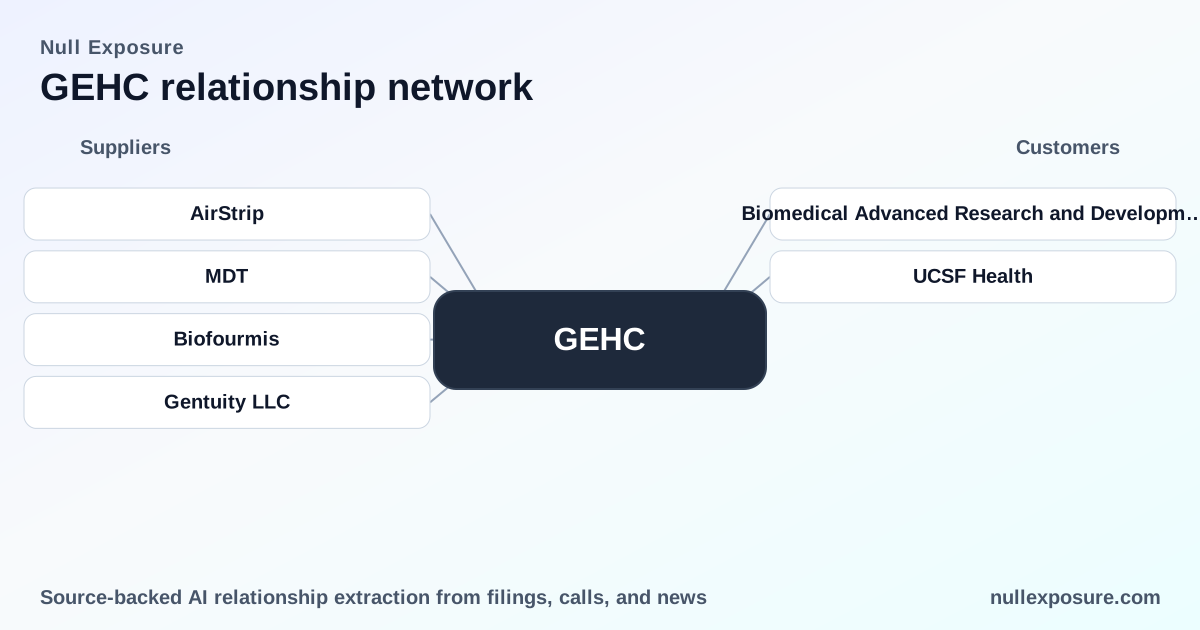
GE HealthCare integrated its intraoperative ultrasound technology into Medtronic’s Stealth Axis surgical system to provide real‑time imaging that helps surgical teams respond to intra‑procedure anatomical changes, signaling an OEM integration where GEHC supplies imaging capability to another med‑tech vendor. (MedTech Dive: https://www.medtechdive.com/news/medtronic-secures-ce-mark-for-stealth-axis-surgical-system/818784/)
Check‑Cap (CHEK) — manufacturing transfer and production by GE HealthCare
GE HealthCare completed the implementation and qualification of a manufacturing line transfer to operate the C‑Scan® system for Check‑Cap, indicating GEHC provides contract manufacturing and operational support for diagnostic device production. (Finviz/PR Newswire archive: https://finviz.com/quote.ashx?t=MBAI)
Medtronic (duplicate result) — integration noted in multiple outlets
A second result reiterates that GE HealthCare’s intraoperative ultrasound is embedded in Medtronic’s surgical platform to enhance real‑time imaging during operations, confirming the OEM integration across reporting sources. (MedTech Dive: https://www.medtechdive.com/news/medtronic-secures-ce-mark-for-stealth-axis-surgical-system/818784/)
UCSF Health — 10‑year alliance to deploy imaging across clinical settings
UCSF Health will deploy GEHC imaging technologies across multiple clinical environments under a 10‑year collaboration that supports clinical translation and care delivery, representing a long‑term health‑system partnership that amplifies device penetration and services revenue. (TradingView / Zacks reporting: https://www.tradingview.com/news/zacks:4f05f40f6094b:0-gehc-ucsf-form-10-year-alliance-to-advance-imaging-care-delivery/)
BARDA — expanded government contract for preparedness and supply
GE HealthCare announced a $35 million expansion of its contract with the Biomedical Advanced Research and Development Authority (BARDA), reflecting direct government contracting and programmatic funding for medical countermeasures and diagnostic readiness. (TradingView / Zacks reporting: https://www.tradingview.com/news/zacks:4f05f40f6094b:0-gehc-ucsf-form-10-year-alliance-to-advance-imaging-care-delivery/)
HCA Healthcare — AI for perinatal monitoring launched jointly
HCA and GE HealthCare launched “CareIntellect for Perinatal,” an AI tool that detects fetal distress earlier than traditional monitors, demonstrating GEHC’s strategy to monetize software and AI through clinical partnerships with large hospital systems. (FinancialContent / Markets reporting: https://markets.financialcontent.com/wral/article/finterra-2026-2-17-deep-dive-hca-healthcare-navigates-policy-shifts-and-market-volatility)
What these relationships imply for investors
The relationship set reveals three durable monetization patterns:
- OEM and partner integrations (Medtronic, ENDRA, Check‑Cap) show GEHC sells or licenses imaging modules and provides manufacturing/integration services, creating pockets of high-margin, non‑recurring revenue plus follow‑on service opportunities.
- Large system and government deals (UCSF, HCA, BARDA) deliver multi‑year, strategic commitments that drive recurring service, software subscriptions and consumable flows—critical for revenue visibility.
- Software and AI monetization (HCA) validates that GEHC is converting device installs into platformed, subscription revenue.
Collectively, these ties reinforce GEHC’s role as seller, manufacturer and service provider—a vertically integrated supplier where equipment sales seed long‑term contracts for maintenance, consumables and SaaS.
Risk considerations framed by relationship dynamics
- Concentration of critical workflows: Imaging and diagnostics are mission‑critical; supply or service disruption would materially impact customers and could increase churn or contract penalties.
- Contract structure exposure: The company’s push to bundle equipment with long‑term maintenance and SaaS increases recurring revenue but also raises expectations on multi‑year delivery and software performance.
- Government contracting nuances: BARDA and other public customers introduce procurement complexity and program‑specific performance risk, while also offering stable funding streams.
- OEM dependence: Integrations with device OEMs (Medtronic) reduce direct pricing control in some channels but expand end‑market reach.
Bottom line and next steps for research
GE HealthCare’s customer map demonstrates a deliberate strategy to convert capital equipment into recurring revenue through services and software, supported by global scale and government relationships that stabilize cash flow. For portfolio managers and operators evaluating counterparty risk or revenue durability, focus due diligence on service attachment rates, SaaS adoption curves, and contract tenure across large system deals.
For a deeper look at relationship analytics and tailored exposure reporting, visit https://nullexposure.com/ for enterprise‑grade profiles and tracking.
Bold takeaway: GE HealthCare leverages equipment sales to lock in multi‑year service and software revenue, positioning customer relationships as the primary engine for durable margins and predictable cash flow.