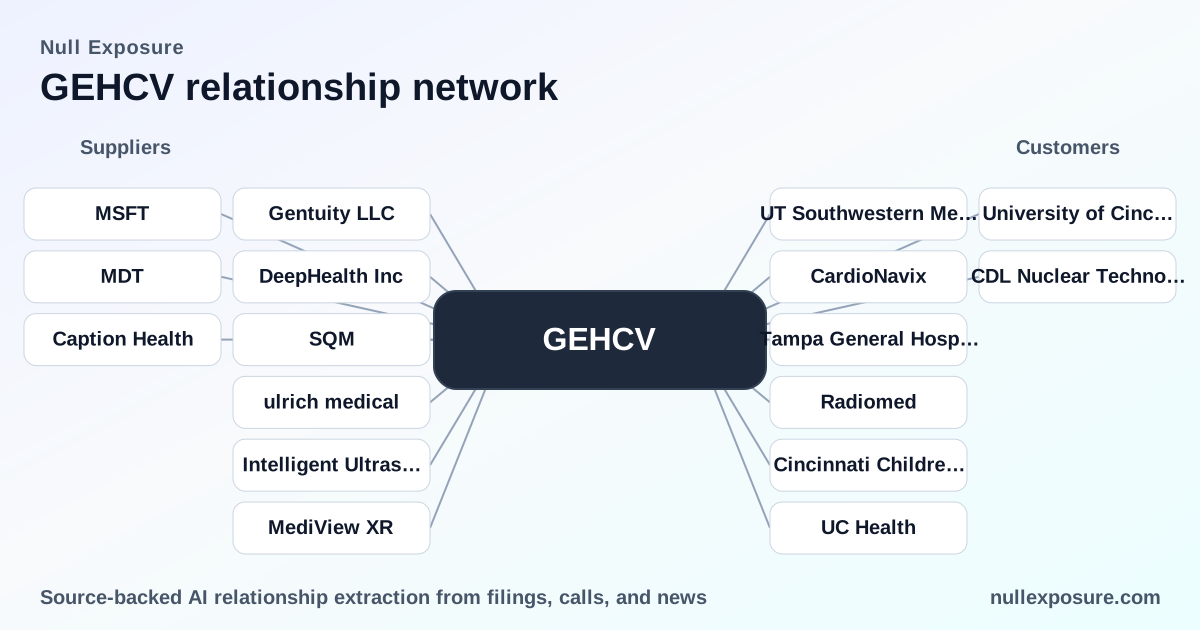
GE HealthCare (GEHCV) — customer map and commercial signal for investors
GE HealthCare monetizes through three intertwined channels: capital equipment sales (CT/CT, MRI, PET), software and AI-enabled applications, and recurring services/distribution agreements that lock customers into multi-year maintenance and upgrade flows. The customer relationships in this feed reinforce a strategy that mixes direct enterprise deals with health systems, research partnerships for product validation, and channel distribution to broaden reach — a commercial model that drives both one-time system revenue and annuity-like service income. Learn more about how coverage like this can inform portfolio decisions at https://nullexposure.com/.
What the customer list tells you about strategy and reach
GE HealthCare’s named customers fall into three practical buckets: early evaluators and academic partners, health system adopters, and distribution/service partners. Each relationship is evidence of market adoption for specific product lines — AI oncology tools, cardiac PET/CT solutions, and next‑generation CT/MRI systems — and collectively they indicate GEHCV’s emphasis on cross-selling hardware with software and service contracts.
UT Southwestern Medical Center — early evaluator for oncology AI
UT Southwestern agreed to serve as an early evaluator for GE HealthCare’s CareIntellect for Oncology, signaling clinical validation efforts and customer-led product refinement in oncology workflows. According to MassDevice (March 2026), UT Southwestern is a named early evaluator in GE HealthCare’s rollout of its oncology application (FY2024).
Tampa General Hospital — clinical early user for CareIntellect
Tampa General Hospital is also listed as an early evaluator of CareIntellect for Oncology alongside UT Southwestern, demonstrating GE’s targeted piloting with large regional health systems to accelerate adoption. MassDevice reported this arrangement in March 2026 (FY2024).
CardioNavix — channel partner distribution agreement for cardiac PET
GE HealthCare announced a Distribution and Services Agreement with CardioNavix, part of the CDL Nuclear Technologies group, to distribute cardiac PET imaging solutions — a sign GE is leveraging specialist distributors to scale PET offerings across outpatient and hospital settings. DiCardiology covered this distribution agreement in March 2026 (FY2025).
CDL Nuclear Technologies — strategic distribution group
CDL Nuclear Technologies is the services group under which CardioNavix operates; the DSA with this group extends GE’s commercial footprint in nuclear cardiology and reinforces a channel-led distribution posture for advanced imaging modalities. DiCardiology (March 2026) details the agreement and positioning (FY2025).
Radiomed — installed-base upgrade wins for CT capability
Radiomed reported tangible operational gains after adopting GE’s Revolution Vibe CT, including higher cardiac CTA capacity and reduced scan times, highlighting the revenue-side value proposition GE sells: more throughput and improved diagnostic confidence. A BioSpace press release (March 2026) quoted Radiomed’s managing partner on these workflow and quality improvements (FY2025).
University Hospitals (Cleveland) — first U.S. install for new technology
University Hospitals is the first U.S. healthcare system to install GE HealthCare’s cleared Aurora and Clarify DL technology, indicating priority placements of flagship products with major health systems to establish reference sites. ITN Online reported this milestone in May 2026 (FY2025).
University of Cincinnati, UC Health, and Cincinnati Children’s — an R&D collaboration cluster
GE HealthCare partnered with the University of Cincinnati, UC Health, and Cincinnati Children’s to create an MRI Research & Development Center, supported by a JobsOhio grant and incorporating GE’s SIGNA Premier 3T scanners and AI tools — a model of co‑development and academic validation for MRI innovations. MarketScale covered this collaboration in March 2026 (FY2024).
Operating-model constraints and commercial posture (company-level signals)
- Contracting posture: GE combines enterprise capital sales with targeted distribution and formal evaluation agreements. The presence of Distribution and Services Agreements alongside named early evaluator hospitals signals a dual approach: direct strategic installs plus delegated distribution for scale.
- Concentration and diversification: The customer list spans academic centers, large regional health systems, specialty imaging groups, and distributor networks, indicating diversified go-to-market channels that reduce single-customer concentration risk while preserving strategic reference accounts.
- Criticality: Imaging systems and associated AI are highly embedded in clinical workflows, making these relationships operationally critical to customers; installations at systems like University Hospitals and University of Cincinnati act as reference points that can accelerate enterprise procurement elsewhere.
- Maturity: The mix of early evaluators and commercial installs reflects both new product introduction phases and mature installed-base upgrades; GE is actively converting clinical validation into commercial adoption through service agreements and distributor partnerships.
No explicit contractual constraints (such as exclusivity clauses, concentration caps, or regulatory limitations) are disclosed in this feed; the signals above derive from deal types and customer roles rather than contractual text.
Investment implications: revenue quality, growth levers, and risk profile
Investors should treat these relationships as evidence of a balanced revenue engine: hardware sales drive upfront revenue and visible bookings, while software/AI and service contracts underpin recurring revenue. Key implications:
- High-value reference accounts (University Hospitals, University of Cincinnati, Cincinnati Children’s) accelerate enterprise adoption and shorten sales cycles for peers in the same systems.
- Distribution agreements with specialist groups (CardioNavix / CDL Nuclear Technologies) reduce direct sales friction and broaden market access for niche modalities like cardiac PET.
- Clinical validation via early evaluators (UT Southwestern, Tampa General) supports regulatory and payer conversations for AI applications, improving monetization potential for software subscriptions and performance-based contracts.
- Risks include execution on converting pilots to full deployments, the timing of service contract renewals, and competitive pressure in AI-enabled imaging from other vendors and in-house hospital solutions.
Primary near-term watch items for investors: pilot-to-deployment conversion rates, recurring service revenue growth from installed upgrades (e.g., Revolution Vibe CT), and penetration through distribution channels. Bold wins at reference hospitals materially de-risk broader commercial rollouts.
Bottom line for portfolio decisions
The customer relationships in this feed portray GE HealthCare as executing a pragmatic go-to-market that blends academic R&D partnerships, flagship system installs, and targeted distribution agreements — a combination that supports both near-term equipment revenue and longer-term annuity streams. For investors focused on revenue quality and TAM capture in advanced imaging and AI, these named relationships are positive commercial signals that validate product-market fit across oncology, cardiac PET, CT, and MRI domains.
For a deeper view across customer signals and how they translate into commercial exposure, explore detailed coverage at https://nullexposure.com/.
Bold takeaway: GEHCV’s customer footprint in this sample demonstrates multi-channel distribution and anchor installations that materially improve the company’s path to recurring software and service revenue, while conversion risk from early evaluators remains the primary gating factor for accelerated growth.