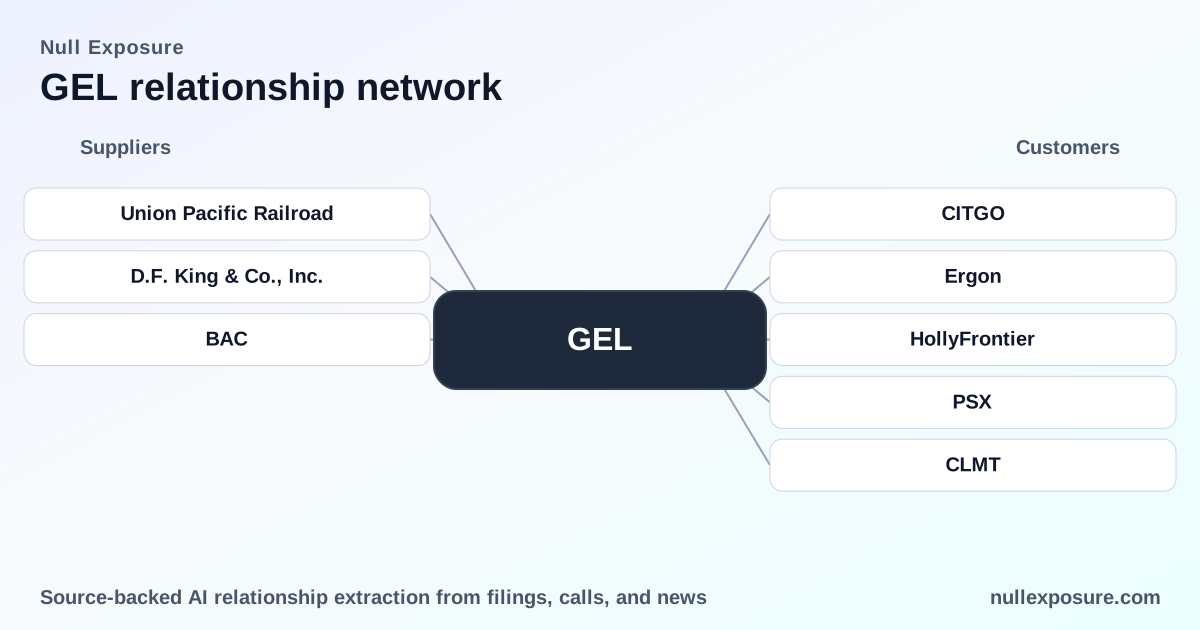
GEL’s customer map: refiner-heavy, contract-anchored, midstream economics
GEL operates as an integrated midstream and chemical supplier that monetizes through fee-based transportation, storage, processing and the sale of alkali products. The business captures stable cash flow by locking a large portion of marine and pipeline volumes into long‑term and life‑of‑lease contracts, while retaining spot exposure on a minority of tonnage and onshore shippers. For investors, the core investment thesis is straightforward: refiner-driven, contract-protected revenues with concentrated counterparty exposure that support predictable cash flows but create counterparty and commodity concentration risks. Learn more about GEL’s coverage and signals at https://nullexposure.com/.
How GEL makes money and where the leverage lives
GEL’s cash-generation model combines two revenue streams. First, fee-based midstream services—marine transportation, pipelines, terminals and related logistics—where the company receives fixed or term contract payments for capacity and transport. Second, until early 2025, GEL operated an Alkali Business that produced and sold sodium hydrosulfide (NaHS), caustic soda and soda ash; those product sales were both domestic and international. According to the FY2024 Form 10‑K, approximately 76% of marine transportation revenue was from term contracts and 24% from spot, and the company’s pipelines often operate under life‑of‑lease take‑or‑pay commitments that further stabilize cash flow.
Key business model characteristics to watch:
- Contracting posture: Predominantly long‑term contracts for marine and offshore pipeline volumes, with measurable spot exposure in marine and onshore pipeline shippers.
- Concentration: Revenue is highly concentrated with refiners—the company reports refiners accounted for roughly 95% of marine transportation revenue in 2024.
- Counterparty profile: Receivables are disproportionately obligations of large integrated refiners and producers, increasing single‑counterparty credit dependence.
- Geographic footprint: Operations are principally North American and Gulf Coast‑focused for midstream services, while alkali product sales have both domestic and international customers.
- Criticality and maturity: Many agreements are long‑dated or life‑of‑lease, producing predictable cash flows and supporting leverage metrics; however, concentrated counterparty risk and spot revenue volatility remain material.
What the 10‑K lists as GEL’s counterparty relationships
Below I summarize every counterparty mentioned in the FY2024 customer disclosures and provide an immediate source reference for each mention. These relationships are primarily referenced in the context of GEL’s alkali feedstock sourcing (NaHS) and its refinery customers.
-
CITGO — a refinery feed source for NaHS. The FY2024 Form 10‑K notes that a majority of the NaHS GEL receives is sourced from refineries owned and operated by large companies including CITGO, indicating an upstream sourcing relationship for alkali inputs. (Source: FY2024 Form 10‑K)
-
Ergon — listed among large refinery suppliers of NaHS. GEL’s 2024 disclosure groups Ergon with other large refiners that supply the NaHS used in its alkali operations, reflecting an input relationship rather than a retail customer. (Source: FY2024 Form 10‑K)
-
HollyFrontier — named supplier of NaHS. The company’s 10‑K explicitly lists HollyFrontier as one of the large refiners supplying NaHS to GEL’s alkali business. (Source: FY2024 Form 10‑K)
-
Phillips 66 (PSX) — a principal NaHS source named in filings. Phillips 66 is explicitly identified in the 2024 filing as a supplier of NaHS to GEL, and is represented in the filing both as “Phillips 66” and as ticker PSX in the company’s referenced counterparty list. (Source: FY2024 Form 10‑K, FY2024)
-
PSX — duplicate reference to Phillips 66 as a NaHS supplier. The filing also lists PSX (the market ticker for Phillips 66) separately in the same excerpt, reaffirming Phillips 66’s role in providing NaHS feedstock. The duplication in the disclosed list underscores PSX’s prominence among GEL’s large refinery suppliers. (Source: FY2024 Form 10‑K, FY2024)
-
Calumet (CLMT) — identified as a NaHS supplier. Calumet appears in the same supplier roster in the FY2024 10‑K indicating its role as a source of NaHS for GEL’s alkali operations. (Source: FY2024 Form 10‑K, FY2024)
Each of these mentions is drawn from the same FY2024 disclosure that lists several large refiners as sources of NaHS supplied to GEL’s alkali business. The filing frames these relationships as feedstock supply links that supported GEL’s alkali production prior to the business changes around early 2025.
Operational implications and investment risks
GEL’s operating model delivers stability via contracted cash flows but creates concentration risk that investors must price. The FY2024 disclosures highlight several constraints worth integrating into any investment model:
- Contract mix is defensive but not immune. With roughly three quarters of marine revenues under term contracts and many pipeline commitments structured as life‑of‑lease take‑or‑pay arrangements, GEL secures predictable receipts; however, 24% of marine revenue is spot, exposing the business to market rate cycles and operational disruptions.
- Counterparty concentration is material. Refiners provided about 95% of marine transportation revenue in 2024, which amplifies credit risk—loss or distress of a single large counterparty could materially reduce utilization and revenue.
- Geographic and product diversity is uneven. Midstream operations are concentrated in the Gulf and North America, while alkali sales had an international footprint; the company’s strategic shift after February 2025 alters that product mix and its exposure profile.
- Role variability across relationships. GEL acts both as a service provider (transportation, storage, processing) and as a seller of chemical products (NaHS, caustic), which creates a hybrid cash‑flow dynamic across segments.
What investors should watch next
- Monitor contract renewal schedules and the pace of term‑contract rolloffs that could shift revenue toward spot exposure.
- Track receivable composition and counterparty credit trends among major refiners, since a concentrated receivable base drives downside risk.
- Reassess post‑February 2025 revenue composition after the alkali business changes to understand how global soda‑ash/chemical sales influence the firm’s cash flow volatility.
For a compact, data‑driven view of GEL’s counterparty exposures and operating signals, visit https://nullexposure.com/. If you’re modeling midstream cash flow or counterparty concentration, GEL’s FY2024 disclosures are essential reading.
Bold takeaways: GEL’s revenue durability rests on long‑term contracts and life‑of‑lease commitments, but the business carries high refiner concentration and a modest spot revenue channel that amplify cyclical sensitivity.