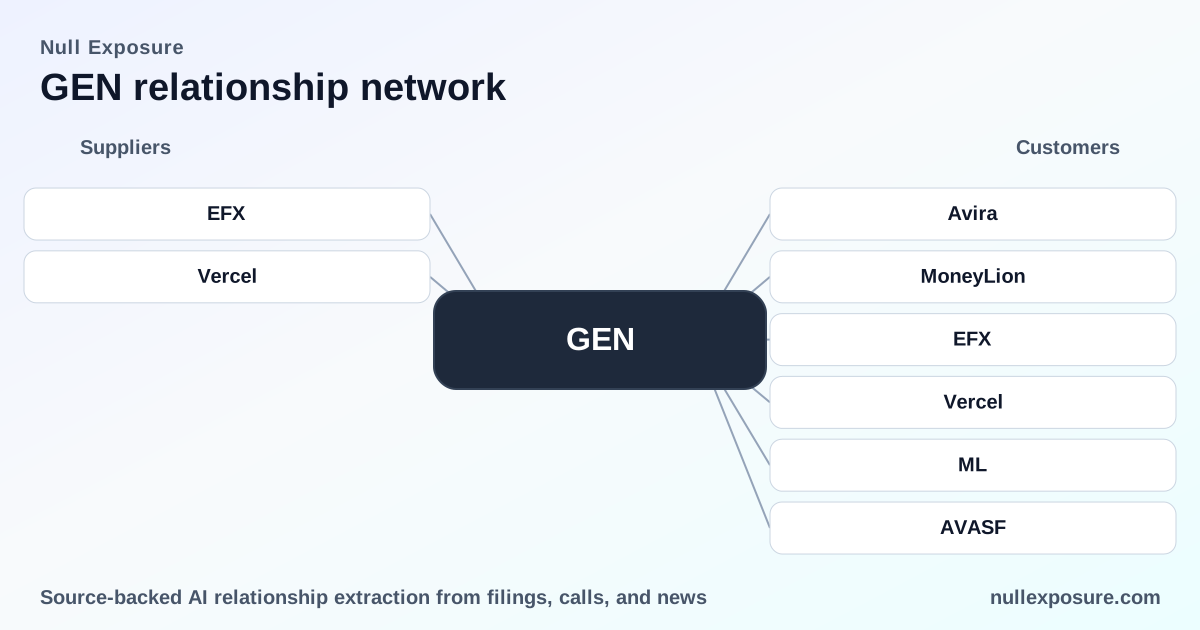
GEN: Customer relationships that drive product distribution and platform monetization
Gen Digital sells consumer cyber‑safety at scale: subscription revenue from direct billing and freemium conversion, white‑label and embedded integrations (Engine by Gen) that surface financial offers and identity protection inside third‑party platforms, and channel/reseller economics that extend reach into government and enterprise ecosystems. Investment value flows from recurring subscription economics plus platform licensing to partners that convert Gen’s security and identity signals into monetizable financial offers. Learn more at https://nullexposure.com/.
Why investors should track customer links, not just headlines
Gen’s commercial model balances two revenue pathways: high‑volume consumer subscriptions (direct and freemium funnels) and B2B platform integrations that embed Gen’s Engine and Agent Trust capabilities into partner products. That hybrid posture produces durable recurring cash flow but also concentrates operational risk around platform integrations, reseller channels, and government contracting exposure. Below I summarize the active customer and partner references surfaced across filings and media coverage and explain the operational constraints that matter for valuation and risk.
If you want a concise dataset and investor briefing for portfolio models, visit https://nullexposure.com/ for an integrated view of these relationships.
Operational constraints shaping monetization and risk
- Subscription-first contracting posture. Gen explicitly offers free and paid subscription plans, largely on annual terms with some monthly options; this supports predictable renewal economics and LTV‑driven acquisition decisions. (Gen FY2025 10‑K)
- Platform and framework exposures. The company runs integrations under framework arrangements including historical sales through a GSA Schedule contract, which the DOJ has reviewed; that dynamic introduces potential government claims and legacy financial exposure. (Gen FY2025 10‑K)
- Counterparty mix is broad and global. Gen serves individuals, families, small businesses and government channels across 150+ countries, creating scale but also regulatory and geographic complexity. (Gen FY2025 10‑K)
- Buyer and reseller roles coexist. The company reports ~65 million paid cyber‑safety customers and 40+ million direct billing relationships, while sales through reseller arrangements (including GSA resellers historically) increase distribution but can amplify compliance risk. (Gen FY2025 10‑K)
- Product mix is software plus services. Gen’s go‑to‑market integrates its software platform (Engine, Agent Trust Hub) with service capabilities around identity protection and financial wellness, enabling both subscription margins and partner licensing revenue. (Gen FY2025 10‑K)
Relationship-by-relationship scan (each item summarized with source)
Avira
Gen’s FY2025 10‑K highlights that many Avira users are freemium subscribers, underscoring the company’s funnel reliance on converting large free user bases into paid customers. Source: Gen FY2025 Form 10‑K (filed March 28, 2025).
EFX (Finviz coverage)
Finviz reported that Equifax will leverage Gen’s “Engine by Gen” to deliver personalized financial product recommendations to U.S. consumers on myEquifax, signaling a monetization path where Gen’s intelligence powers partner‑facing offers. Source: Finviz news (March 9, 2026).
Equifax (Finviz duplicate)
A second Finviz mention reiterates that Equifax integrates Engine by Gen into myEquifax to enrich consumer recommendations, confirming public media traction for the Engine partnership. Source: Finviz news (March 9, 2026).
MoneyLion (Finviz)
Finviz coverage describes a rollout in which MoneyLion embeds LifeLock’s scam and identity protection directly into its app, representing a classic partner distribution of Gen’s identity products. Source: Finviz news (March 2026).
Microsoft Corporation (MarketScreener)
MarketScreener reported Gen is integrating Engine by Gen into Microsoft products like Copilot, MSN and Bing, bringing trusted financial information and offers into Microsoft’s AI experiences — a strategic platform placement for distribution and offer monetization. Source: MarketScreener (May 3, 2026).
BMA (Banco Macro / Economis)
An Economis summary of Banco Macro’s FY2025 report notes Genneia supplies 100% of power to the Maipú data center, an operational fact about energy provisioning cited by Banco Macro’s annual report; the reference is to Genneia as the energy provider. Source: Economis article summarizing Banco Macro FY2025 reporting (March 2026).
Vercel (Bitget)
Bitget reported the partnership where Gen’s Agent Trust Hub will scan Skills.sh skills before installation, indicating Gen’s move to certify third‑party AI components and sell security verification into developer platforms. Source: Bitget news (March 2026).
EFX (CrowdfundInsider)
CrowdfundInsider covered the Equifax collaboration, noting that Equifax will harness Engine to enrich myEquifax for U.S. customers, reinforcing the partner licensing narrative. Source: CrowdfundInsider (February 2026).
Equifax (CrowdfundInsider)
CrowdfundInsider’s piece again highlights Equifax’s use of Engine to provide financial and security tools inside myEquifax, a repeated channel partner announcement. Source: CrowdfundInsider (February 2026).
EFX (InsiderMonkey transcript)
An earnings‑call transcript reported on InsiderMonkey underscores that Engine enables Equifax to surface more personalized financial offers on myEquifax, reflecting management’s articulation of the partnership on Gen’s call. Source: InsiderMonkey (March 2026 earnings call transcript).
Equifax (InsiderMonkey)
InsiderMonkey’s coverage repeats that Equifax will use Engine to power personalized offers on myEquifax, corroborating prior press with earnings‑call context. Source: InsiderMonkey (March 2026).
Vercel (PR / Morningstar)
A PR reported on Morningstar describes the Gen–Vercel tie‑up for independent safety verification of Skills.sh, positioning Gen as an independent risk rater for AI skills. Source: Morningstar / PR Newswire (Feb 17, 2026).
Vercel (Sahm Capital)
Sahm Capital commentary emphasized the strategic significance of the Gen–Vercel alliance for AI security, noting the partnership highlights product expansion and valuation drivers. Source: Sahm Capital commentary (February–March 2026).
Vercel (Finviz coverage)
Finviz coverage summarized the collaboration: Gen’s Agent Trust Hub will provide security verification and transparent risk ratings for Skills.sh — another outlet corroborating the same program. Source: Finviz news (February–March 2026).
ML (Finviz bullish piece)
A Finviz “bull case” roundup noted Gen’s distribution through partners including MoneyLion/LifeLock integrations, characterizing embedded identity protection offers as an upside case for GEN. Source: Finviz analysis (March 2026).
MoneyLion (Finviz duplicate)
Finviz reported MoneyLion’s launch of LifeLock‑powered identity and scam protection inside its product set, consistent with Gen’s partner distribution strategy. Source: Finviz news (March 2026).
Microsoft (Finviz)
Finviz also covered Gen’s integration into Microsoft Copilot and discovery feeds, reiterating Engine’s placement inside major AI UX surfaces. Source: Finviz news (May 3, 2026).
Microsoft (Intellectia.ai)
An Intellectia.ai summary similarly described the direct integration of Engine into Copilot, MSN and Bing, emphasizing user‑facing financial intelligence placements. Source: Intellectia.ai news (May 3, 2026).
AVASF (10‑K)
Gen’s FY2025 10‑K notes that many Avira and Avast users are freemium subscribers, underlining the scale of non‑paying users that form Gen’s paid conversion pipeline. Source: Gen FY2025 Form 10‑K (filed March 28, 2025).
Avast (10‑K)
The FY2025 filing explicitly states Avast maintains a large freemium base, reflecting the same conversion dynamics described for Avira. Source: Gen FY2025 Form 10‑K (filed March 28, 2025).
MoneyLion (Finviz, LifeLock expansion)
Finviz documented LifeLock’s expansion and the MoneyLion integration, describing LifeLock‑powered identity protection being rolled into MoneyLion’s offerings. Source: Finviz news (March 2026).
ML (Finviz duplicate)
Finviz’s coverage again referenced MoneyLion’s use of LifeLock services, highlighting repeated media pickup for the same partner deal. Source: Finviz news (March 2026).
ML (Finviz 321353)
Further Finviz coverage reiterated Gen’s LifeLock distribution into partner apps like MoneyLion, confirming multiple press touchpoints for this channel deployment. Source: Finviz news (March 2026).
MoneyLion (Finviz 321353)
A final Finviz item repeated the MoneyLion integration narrative, supporting the view that embedded identity products are a recurring channel for Gen. Source: Finviz news (March 2026).
Investment implications — concise takeaways
- Revenue model is predictably recurring but levered to conversion: freemium pools (Avira/Avast) plus annual subscriptions underpin recurring cash flow while partner integrations create additional monetizable touchpoints.
- Platform integrations are a strategic growth vector: Engine in Microsoft and Equifax, plus Agent Trust in Vercel, convert Gen into a vendor of embedded trust signals — these partnerships materially increase distribution and potential take rates.
- Regulatory and contract risk remains non‑trivial: historical GSA framework exposure and reseller channel complexity are company‑level constraints investors must price into scenarios.
- Partnership concentration is a double‑edged sword: major platform placements accelerate reach but centralize execution and commercial dependency on partner integrations and compliance.
For a compact investor briefing that maps these relationships to revenue scenarios and risk weights, visit https://nullexposure.com/ and request the GEN customer relationship memo.
This scan synthesizes every customer and partner mention surfaced in filings and press through early‑May 2026 to give investors a clear view of how Gen monetizes its product set and where operational risks concentrate.