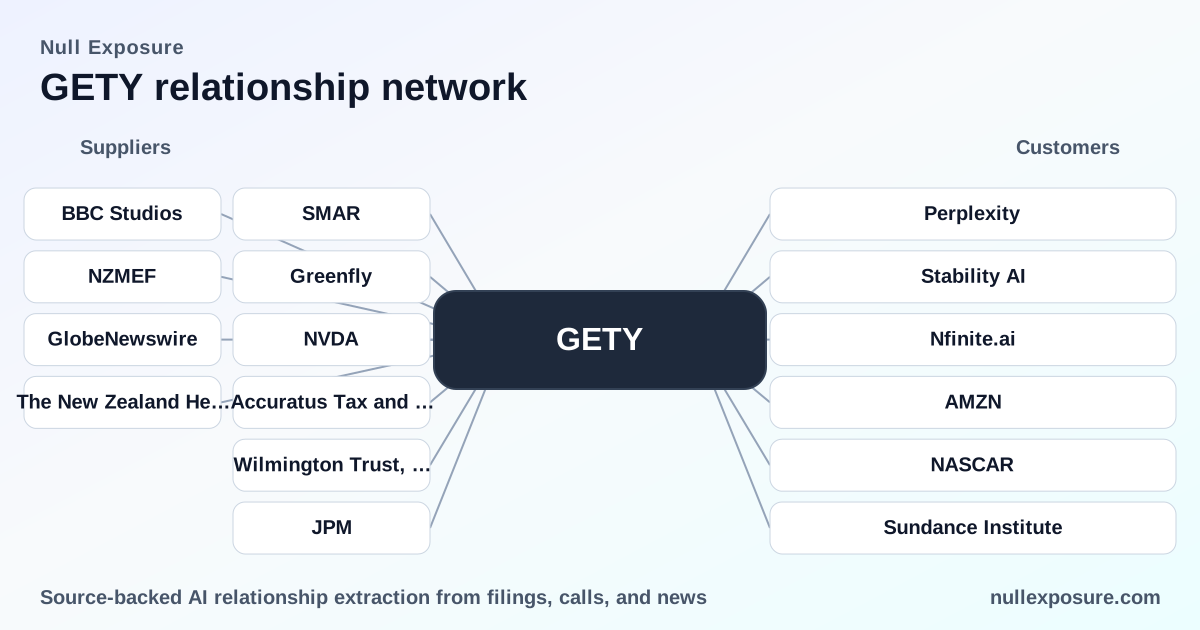
Getty Images (GETY): Customer Relationships that Drive the Visual Content Platform
Getty Images operates a two‑pronged commercial engine: a subscription-first marketplace that sells annual and credit‑based plans to businesses and creators, and a licensing services arm that supplies editorial and bespoke imagery to marquee partners. Revenue is recognized when content is downloaded or as subscription products are earned, and Getty combines high subscriber retention with a global sales footprint to monetize scale across enterprise and individual customers. For investors, the key structural themes are subscription revenue concentration, licensing variability tied to large agreements, and a diversified base of marquee partners that both drive brand value and create episodic volume swings. Learn more at https://nullexposure.com/.
The commercial model in plain English — subscriptions, licensing, and customers
Getty’s operating model is subscription-led but licensing-enabled. The company disclosed that annual subscriptions represented approximately 54% of total revenue for the year ended December 31, 2024, with deferred revenue earned as downloads occur or subscriptions expire; nearly all deferred balances are expected to be recognized within 12 months. Getty recognizes both capped subscription credit sales and single‑image licenses at the point of download, which makes headline usage metrics volatile if a single large partner generates outsized downloads.
Key operating signals:
- Subscription orientation and durability: annual subscriptions are the majority of revenue and the company reports a LTM annual subscriber retention rate of 92.9%, supporting recurring cash flow.
- Mixed counterparty base: Getty serves enterprises, SMBs and individual creators, with over 716,000 purchasing customers globally and localized e‑commerce across multiple currencies and languages.
- Global reach with North American bias: Americas (including the U.S.) account for the largest share of revenue (U.S. ~52% of total revenue as of Dec 31, 2024), with EMEA and APAC as meaningful second and third geographies.
- Product segmentation: revenue comes through Creative, Editorial and Other services across Getty’s brands (Getty Images, iStock, Unsplash).
What each customer relationship tells investors
Below I cover every partner mentioned in the collected coverage. Each entry includes a short, direct read and the reported source.
Perplexity — a content distribution deal for AI search
Getty granted Perplexity rights to display Getty Images content across its AI‑powered search tools, which extends Getty’s distribution into conversational search interfaces and broadens downstream exposure to licensing demand (SahmCapital, Nov 11, 2025).
Source: SahmCapital coverage of the Perplexity agreement (Nov 11, 2025).
NASCAR — long‑term editorial and photography partnership renewed
Getty renewed a multi‑year agreement as NASCAR’s Official Photography Partner, a relationship Getty has maintained since 2006 that preserves Getty’s position as the primary source for race day imagery and editorial licensing tied to a major sports franchise (Motorsports Newswire, Feb 13, 2026).
Source: Motorsports Newswire press release (Feb 13, 2026).
Stability AI / Stable Diffusion — litigation and IP contention
Getty has publicly asserted that Stability AI used Getty’s copyrighted images and metadata to train commercial models without license, a claim reported in The Verge (Jan 17, 2023) and discussed in later press coverage; CNBC also reported Getty acknowledging that some Getty Images were used to train Stable Diffusion (CNBC, May 28, 2025). This relationship is adversarial and highlights Getty’s strategic focus on copyright enforcement in the age of generative AI.
Sources: The Verge (Jan 17, 2023); CNBC interview/coverage (May 28, 2025).
Amazon (AMZN) — a high‑volume download agreement that skews usage metrics
Getty’s public filings and press materials repeatedly note an agreement with Amazon that generates potentially large download volume, and Getty excludes downloads tied to that agreement from certain usage metrics because the magnitude of downloads could materially distort period comparisons without corresponding revenue impact (Getty newsroom filings, FY2023–FY2026). This is a commercial relationship that can create episodic volume swings and complicate interpretation of content‑usage KPIs.
Source: Getty Images newsroom financial disclosures and earnings releases (Q3 2023; Q3 & Q4 FY2025 releases; FY2026 commentary).
Sundance Institute — festival photography services renewed
Getty was renewed as the Official Provider of Photography Services for the 2026 Sundance Film Festival, reinforcing the company’s role as the go‑to supplier for high‑profile cultural events and editorial coverage (SahmCapital, Jan 15, 2026).
Source: SahmCapital reporting on Getty’s Sundance renewal (Jan 15, 2026).
The Metropolitan Museum of Art / The Met Gala & Vogue — cultural branding and editorial reach
Getty was named Official Photographer of The Met Gala (Costume Institute Benefit) for 2026, and cited its long‑standing relationship with The Met and Vogue as part of that appointment. These associations drive brand prestige and high‑value editorial licensing (SahmCapital, Apr 27, 2026).
Source: SahmCapital coverage of Getty’s Met Gala appointment and mention of Vogue (Apr 27, 2026).
Nfinite.ai — converting 2D assets into 3D for immersive applications
Getty partnered with Nfinite.ai to provide on‑demand access to Getty’s creative library so selected images can be transformed into 3D assets, a strategic move to monetize content in emerging AR/3D markets and to extend licensing into physical‑AI workflows (SahmCapital, Jan 13, 2026).
Source: SahmCapital report on the Nfinite.ai collaboration (Jan 13, 2026).
BZFD / BuzzFeed — routine editorial licensing and image crediting
Getty content was credited in a BuzzFeed article, illustrating everyday editorial licensing and image attribution across large digital publishers, reinforcing Getty’s continued placement across high‑traffic media outlets (BuzzFeed, 2023).
Source: BuzzFeed article credit line (2023).
Strategic takeaways for investors
- Recurring revenue is the core defensive attribute: with annual subscriptions comprising a majority of revenue and a high retention rate, Getty’s cash flow profile benefits from predictability.
- Large partner agreements introduce volatility: high‑volume deals (for example, the agreement noted with Amazon) can distort content usage metrics without proportional current‑period revenue, complicating KPI analysis.
- IP enforcement is a strategic lever and a headline risk: litigation with generative AI firms like Stability AI underscores both Getty’s approach to protecting licensing economics and the regulatory/PR risk around AI training data.
- Brand partnerships are value enhancers: renewals with marquee partners (NASCAR, Sundance, The Met/Gala, Vogue) support editorial dominance and premium licensing rates.
What to watch next
- Changes in the mix of subscription vs. single‑license revenue and any movement in deferred revenue recognition windows.
- Progress or settlements in copyright litigation related to AI training, which will affect long‑term licensing leverage.
- Renewal cadence and terms with large distribution partners that can cause step‑function swings in downloads.
If you evaluate platform companies that monetize content and rights, Getty offers a subscription backbone combined with episodic, high‑value licensing relationships that create both durable recurring revenue and event‑driven upside — signposting a tradeoff investors should underwrite explicitly. For a consolidated view of Getty’s customer relationship intelligence, visit https://nullexposure.com/.