GE Vernova (GEV) — Customer Map and Commercial Signals for Investors
GE Vernova (NYSE: GEV) is a diversified energy equipment and services company that designs, manufactures and services power generation and grid infrastructure while also operating generation assets. The company monetizes through equipment sales (turbines, transformers, HVDC systems), long‑term service contracts and usage‑linked maintenance programs, with a meaningful recurring revenue backbone supported by a large installed base and reserved production capacity. For investors and operators evaluating GEV customer relationships, the commercial model is capital‑goods sales plus annuity service economics, concentrated in North America but global in scope. For additional context on GEV’s coverage and relationship analytics, visit https://nullexposure.com/.
Investment thesis up front
GE Vernova sells high‑value hardware and attaches long‑duration service economics to that hardware, producing a mix of lumpy equipment revenue and predictable aftermarket cash flow. Key value drivers are backlog/RPO scale, installed‑base service penetration, and slot reservation agreements that convert market demand into multi‑year production schedules. The company’s risk profile is dominated by project execution and timing (installation delays and contract loss accruals), backlog concentration by region and product, and the operational criticality of gas turbines and grid equipment to large utility customers.
How GEV contracts and delivers — what the filings tell us
GEV’s FY2025 disclosures describe an operating posture that combines long‑term, fixed commitments with usage‑based service billing. The company disclosed approximately $94.4 billion in remaining performance obligations (RPO) and a gas‑turbine installed base of roughly 7,000 units, with about 1,800 units covered by long‑term service agreements and an average remaining contract life of ~10 years, indicating deep service optionality tied to installed equipment. Customers are billed either through time/usage models (per operating hour) or event‑driven major maintenance payments, supporting recurring cash flow once turbines are in service (FY2025 Form 10‑K, filed Feb 14, 2026). These are company‑level signals: long contract tails, hybrid usage pricing, and global footprint with material concentration in the U.S. market (see revenue split below).
Geography and commercial concentration
GEV reports revenue by region for 2025 that highlights a dominant North American business: U.S. 17,341; Europe 7,594; Middle East & Africa 5,389; Asia 4,629; Americas (ex‑U.S.) 3,116, signaling that while operations are global, North America is the primary commercial center and onshore wind equipment RPO is materially skewed to the U.S. (FY2025 10‑K). The company’s product mix is also concentrated: “workhorse” products account for ~75% of equipment RPO, implying that a relatively narrow set of core platforms underpins the majority of future revenue.
Business model characteristics investors should focus on
- Contracting posture: Predominantly long‑term service agreements with an important layer of usage‑based billing for maintenance events — this produces recurring revenue with periodic material spikes for outages and major overhauls (FY2025 10‑K).
- Concentration & criticality: Large utilities and IPPs that reserve production slots for turbines create concentrated but high‑value relationships; those customers are critical because turbine delivery slots and service continuity materially affect earnings.
- Maturity & durability: A large installed base and long average contract life indicate mature, annuity‑like components to revenue; however, equipment sales remain lumpy and sensitive to project timing.
- Segment mix: Revenue streams span hardware (gas and wind turbines, transformers, HVDC), services (parts, maintenance, extended warranties), and electrification software for grid orchestration — a cross‑sell advantage but also multi‑modal execution risk.
For deeper relationship analytics and scenario planning, see https://nullexposure.com/.
Relationship rundown — who GEV is working with today
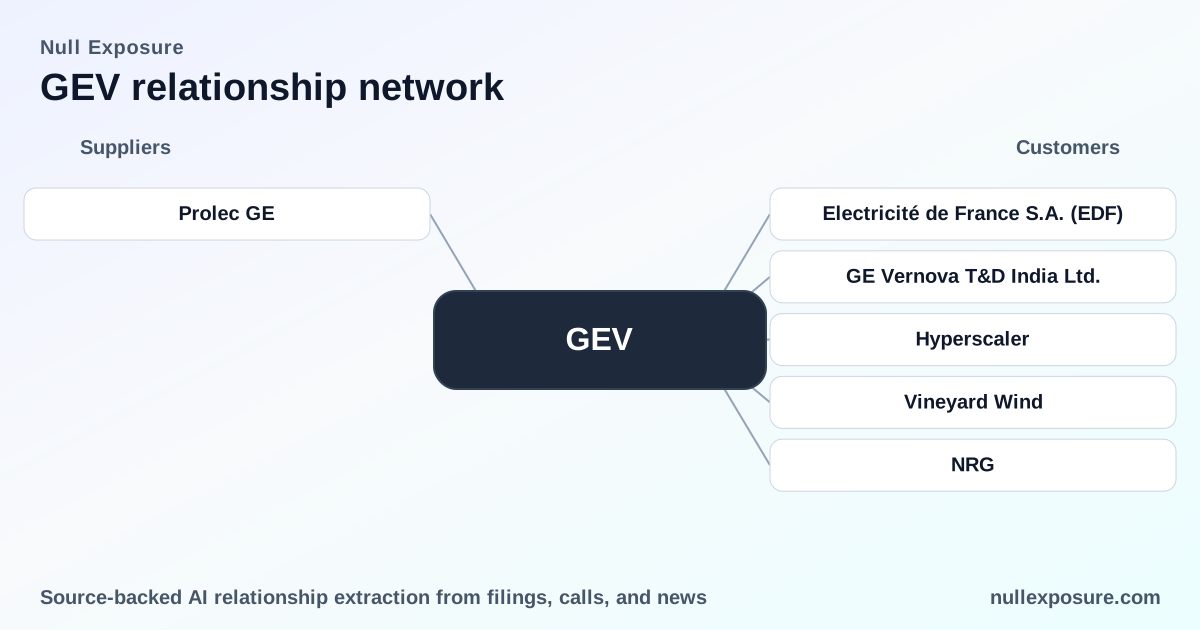
Below I cover every customer relationship identified in the underlying results, each with a plain‑English summary and a concise source note.
Vineyard Wind — project execution delay and accrual
Vineyard Wind’s order led GE Vernova to estimate incremental contract losses and accrue costs after an installation‑work extension that created at least a 90‑day delay, signaling execution risk on offshore or large installation projects. This was disclosed on the Q4 2025 earnings call (March 2026 earnings call transcript).
GE Vernova T&D India Ltd. — nonrecurrence of divestiture proceeds
GEV recorded the nonrecurrence of proceeds from the sale of approximately 24% of GE Vernova T&D India Ltd. in 2024, which had contributed about $0.9 billion in proceeds; this is a one‑time item reducing FY2025 comparables (FY2025 Form 10‑K, filed Feb 14, 2026).
Electricité de France (EDF) — prior asset sale gain not repeating
The company noted a $1.0 billion pre‑tax gain from sale of Steam Power nuclear activities to EDF in Q2 2024, a gain that did not recur in FY2025 and therefore affects year‑over‑year comparability (FY2025 Form 10‑K).
Hyperscaler — strategic technology pilots and deployments
GE Vernova referenced a relationship with a “Hyperscaler” in which it is advancing direct air capture, solid‑state transformers, and fuel cell programs, including a running direct air capture facility—an illustration of GEV’s customer engagements in emerging decarbonization and electrification technology projects (Q4 2025 earnings call).
NRG — large slot reservations and expanding turbine commitments
NRG has a slot reservation agreement with GEV for procurement of 1.2 GW of 7HA gas turbines (NRG FY2024 10‑K), and market reports in 2026 linked NRG’s planned $6 billion of new gas capacity to a surge in GEV turbine and grid backlog and noted additional secured slots totaling ~5.4 GW, underscoring sizable, multi‑year production demand (market reports, Feb–May 2026).
SLNH (Soluna) — turbines specified on a recent wind acquisition
Soluna’s Briscoe wind farm acquisition was reported to utilize a GE Vernova turbine system with ERCOT interconnection, indicating GEV equipment deployment in distributed renewables projects (news reports, May 2026).
AIRJ (AirJoule / Montana Technologies JV) — joint venture for sorbent materials
GE Vernova entered a 50/50 joint venture (AirJoule) to integrate GE Vernova’s proprietary sorbent materials into Montana Technologies’ AirJoule dehumidification and atmospheric water systems — a technology partnership combining materials and systems for climate‑control and water harvesting (PR Newswire and CoolingPost coverage, FY2024/FY2025).
XEL (Xcel Energy) — strategic alliances across generation and T&D
Xcel Energy publicly acknowledged alliances and strategic agreements with GE Vernova (and NextEra) to support a portfolio of renewable and gas generation and T&D projects, emphasizing GEV’s role as a Tier‑1 equipment and services partner for utility investment pipelines (Xcel Q1 2026 earnings call transcript).
What investors should watch next
- Backlog conversion and slot fulfillment: Track how reserved turbine slots and slot‑reservation agreements convert into revenue and margin over the next 12–36 months. NRG and other large IPP commitments are critical to near‑term production planning.
- Project execution discipline: Delays like the Vineyard Wind installation extension can produce meaningful accruals; execution trends will inform margin stability.
- Service attach rates and utilization billing: Continued growth in long‑term service agreements and per‑hour billing will underpin recurring cash flow and EPS durability.
- Regional demand cycles: With the U.S. dominant in RPO and onshore wind, regulatory and rate‑base drivers in North America will disproportionately affect GEV’s topline.
If you want a curated view of these customer exposures and alerts on material changes, NullExposure maintains ongoing coverage and scenario tools at https://nullexposure.com/.
Bold takeaways: GEV is a high‑value equipment seller with durable service economics and execution‑sensitive project revenue; large utility commitments and reserved turbine slots drive backlog visibility, while project delays and one‑time divestiture gains affect near‑term comparability.