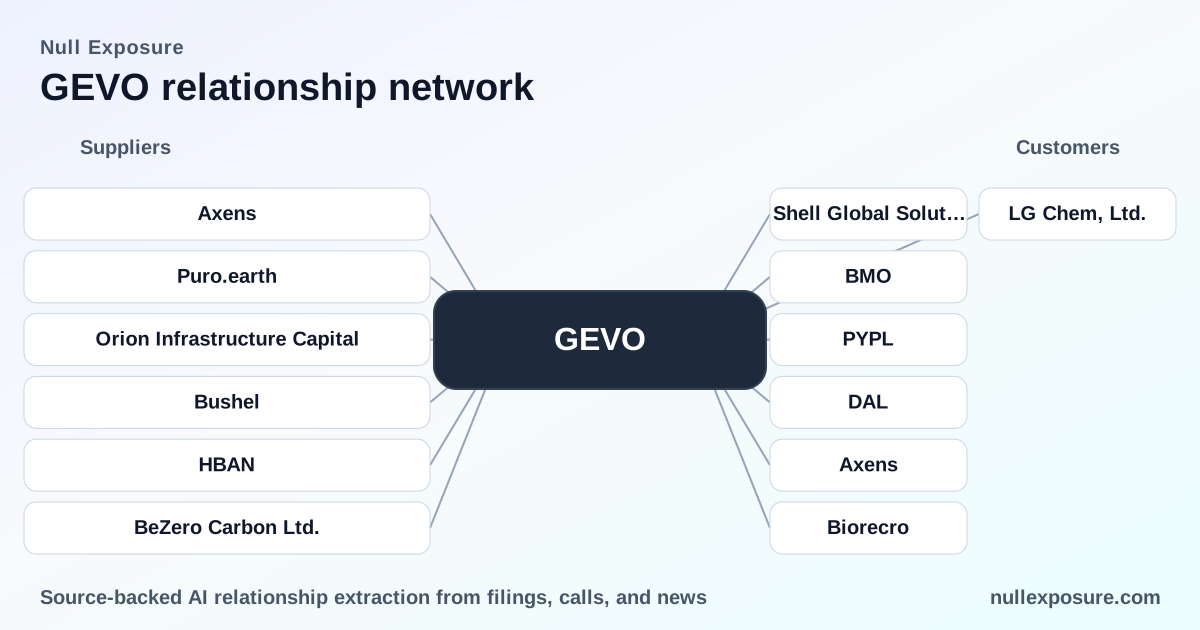
Gevo’s customer map: who pays for its fuels, credits and technology
Gevo operates as a vertically integrated renewable fuels and carbon solutions company that monetizes through product sales (bio-based jet fuel, renewable natural gas and hydrocarbon blendstocks), the sale of carbon removal/credits, technology licensing, and emerging software-enabled verification services. Revenue flows come from a mix of long-term offtake contracts, spot monetizations and strategic licensing/partnership agreements that position Gevo between commodity buyers (airlines, energy traders) and industrial buyers (chemical partners) while capturing value along conversion and verification. For deeper enquiry, visit the research hub at https://nullexposure.com/.
How to read this customer map — what the relationships imply about the model
Gevo’s customer mix and contractual profile reveal several operating characteristics that drive both upside and concentration risk. Revenue concentration is acute: company disclosures show one customer contributing the overwhelming majority of receivables and revenue in recent years, indicating material counterparty reliance. Gevo uses a combination of long-term offtake structures (including take-or-pay language) alongside opportunistic spot transactions to monetize tax credits and other assets, which produces a hybrid cashflow profile: predictable when tied to contracts, episodic when monetizing credits. Gevo is also commercializing technology via licensing and alliances, and expanding a software-enabled measurement and verification capability after acquiring CultivateAI, which supports recurring-software revenue potential linked to its physical product sales.
Relationship roll call — concise, source-backed notes
Below are each of the relationships surfaced in the company materials and public coverage, with a short plain-English takeaway and the source for verification.
Shell Global Solutions Deutschland GmbH
Gevo entered a purchase contract with Shell on August 16, 2024 to supply hydrocarbon-based performance racing blend stock (2GFuel) and potentially additional products under mutual agreement, signaling commercial supply to a global energy trading and technology affiliate. Source: Gevo Form 10‑K for FY2024.
Delta Air Lines
Gevo announced expansion of alcohol-to-jet (ATJ) bio-SAF production with a South Dakota facility, partnering with Delta to supply 100 million gallons annually of bio-based jet fuel, a volume agreement that positions Delta as a strategic offtaker for airline decarbonization. Source: OpenPR market report referencing October 2025 production expansion (reported FY2026).
DAL (duplicate entry of Delta Air Lines)
The same OpenPR item is recorded again in the dataset noting the October 2025 South Dakota ATJ expansion and the 100 million gallon Delta supply arrangement; this confirms coverage across multiple outlets. Source: OpenPR (FY2026).
PayPal
Gevo’s 2025 Q4 earnings call reported that PayPal is among new corporate customers purchasing carbon dioxide removal (CDR) credits, expanding Gevo’s institutional buyer list beyond public institutions and exchanges. Source: Gevo 2025 Q4 earnings call (reported March 2026).
Bank of Montreal
The 2025 Q4 earnings call lists Bank of Montreal as another corporate buyer of CDR credits, demonstrating Gevo’s reach into financial services clients seeking net‑zero offsets or removals. Source: Gevo 2025 Q4 earnings call (reported March 2026).
PYPL (duplicate entry of PayPal)
A repeat of the earnings-call disclosure confirms PayPal (ticker PYPL) as a CDR credit buyer and illustrates multiple references to the same customer wins across investor communications. Source: Gevo 2025 Q4 earnings call.
Axens
Gevo licensed its ETO (ethanol-to-olefins) technology to Axens and formed an alliance to accelerate fuels development, which represents a licensing/partner strategy for scaling technology and sharing commercialization risk while opening a route into fuel and chemical markets. Source: Globenewswire/ManilaTimes summary of Gevo’s FY2025 financial results and business update (reported FY2026).
BP
Gevo sells RNG into the California market through an agreement involving BP entities, with BP obtaining renewable natural gas from Gevo projects and reselling in regulated markets — a distribution channel that ties Gevo to established energy market participants and California demand centers. Source: Rigzone report (original reporting Aug 2021; referenced in recent dataset as FY2026).
Biorecro
Public reporting indicates Gevo delivered a first batch of carbon credits under an agreement with Biorecro, signaling active project-level fulfillment on carbon removal or credit generation arrangements. Source: Carbon Herald (news report FY2026).
LG Chem, Ltd.
Gevo is collaborating with LG Chem to deploy its next‑generation ETO process for renewable chemical applications, indicating multi‑industry commercialization intent beyond fuels into specialty chemicals and polymers. Source: Chemanalyst news (FY2026).
Constraints that shape revenue predictability and strategic runway
These are company-level operating constraints and their implications; only the BP‑California geography is attributed to a relationship, because the supporting excerpt names BP explicitly.
- Concentration risk is high and material: Gevo disclosed that a single customer accounted for 93% of total revenue in the most recent annual period, and similarly dominated trade receivables. That level of concentration makes contract terms and counterparty credit essential to valuation and near-term cashflow stability. (Company disclosure in FY2024 10‑K.)
- Contract mix includes long‑term offtakes with take‑or‑pay elements: The business uses long‑term offtake arrangements that include buyer obligations to pay if product is not taken, increasing cashflow visibility where those contracts are enforced. (Company disclosure reference.)
- Spot monetizations are part of the playbook: Gevo monetized Investment Tax Credits via a spot sale in September 2024, illustrating the firm uses one‑off transactions to accelerate liquidity when assets permit. (Company disclosure of ITC sale, FY2024 activity.)
- Geographic concentration into North America / California market presence via BP: Gevo sells RNG into the California market through agreements with BP entities, coupling revenue exposure to California regulatory dynamics and carbon/RNG pricing. (Company disclosure regarding BP and California sales.)
- Active commercial pipeline and partnership maturity: Gevo reports multiple contracted ethanol producers and a growing set of customers for CDR credits, indicating relationships are operational and expanding rather than conceptual. (Company investor communications.)
- Emerging software/verification segment: The CultivateAI SaaS acquisition and integration with Verity’s MRV platform point to an integrated product + verification model that could generate recurring service revenue and make Gevo’s credits and fuels more granularly verifiable for corporate buyers.
What investors should monitor next
- Revenue concentration unwind: any sign of customer diversification (additional long‑term offtakes or expansion of airline and industrial offtakers) materially reduces counterparty risk and should drive re‑rating.
- Contract enforcement and cash collections: given high receivable concentration, tracking collections and counterparty credit is essential to near‑term liquidity forecasts.
- Scale of Delta supply and BP RNG flows: execution against the Delta ATJ commitment and sustained RNG supplies into California via BP will determine how product volume translates to recurring revenue.
- License adoption for ETO technology: partnerships with Axens and LG Chem convert IP into non‑commodity revenue and lower volumetric risk if licensing accelerates.
- Growth of CDR credit customer list: the addition of PayPal, BMO and others demonstrates demand from financial and tech buyers; broadened institutional participation would validate the credits business as a repeatable revenue stream.
For a structured view of counterparty exposure and contractual posture, see our research portal at https://nullexposure.com/ for analyst‑ready briefs.
In summary, Gevo combines contract-backed product sales, opportunistic asset monetization, technology licensing and emerging software verification to monetize decarbonization, but the company’s near-term valuation is highly sensitive to counterparty concentration, execution on large airline and energy contracts, and the pace at which non‑commodity licensing and software revenue scale.