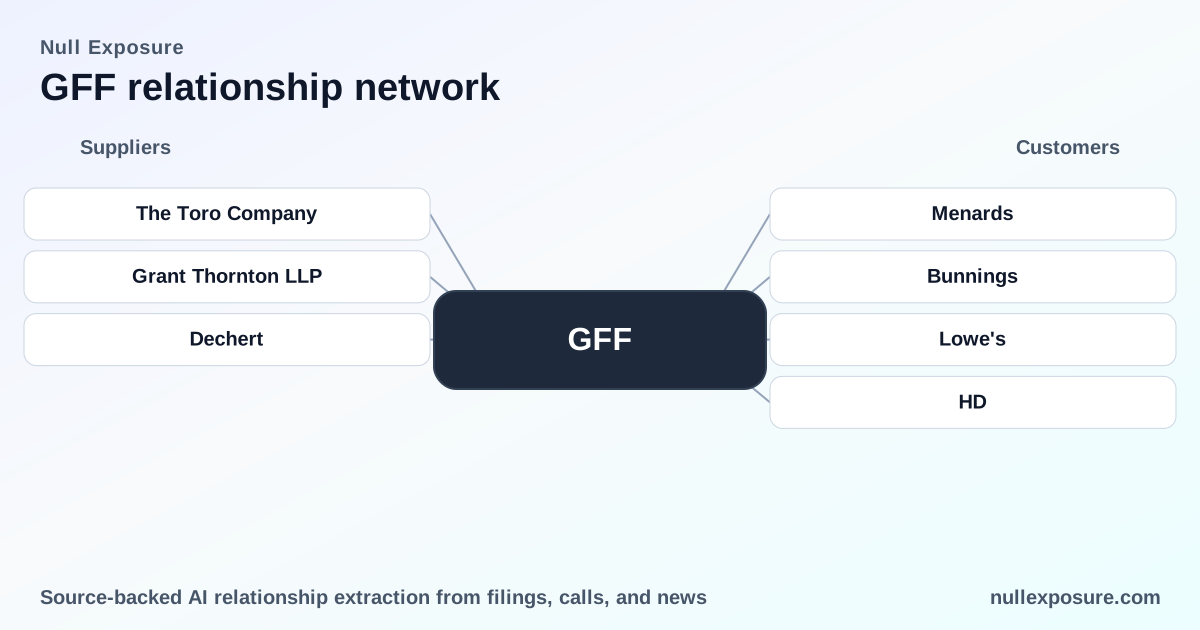
Griffon (GFF) — who actually buys the product and why it matters to investors
Griffon Corporation operates and monetizes through two manufacturing-led segments: Home and Building Products (HBP) — led by Clopay, the largest North American garage door manufacturer — and Consumer and Professional Products (CPP) — a global branded-products seller (tools, fans, storage, outdoor). Revenue is recognized on short-cycle shipments to dealers, national home centers and distribution partners; profitability comes from branded manufacturing, scale supply agreements with major retailers, and steady replacement/renovation demand. For deeper counterparty mapping and contract maturity signals, see Null Exposure. Null Exposure
Customer roster: who drives the top line today
Griffon discloses a small set of retailers that account for a material share of revenues across HBP and CPP, creating concentrated counterparty exposure. Below I list every customer relationship referenced in the company’s FY2025 filing, with a concise plain-English note and the source.
Menards
Clopay is the exclusive supplier of residential and commercial garage doors to Menards locations across North America and has maintained that relationship for over 30 years, reflecting entrenched distribution for HBP products. According to Griffon’s FY2025 Form 10‑K, Menards is a significant channel partner for Clopay and HBP. (Griffon FY2025 10‑K)
Bunnings
Bunnings is named among the significant customers of CPP, alongside Home Depot and Lowe’s, indicating CPP’s exposure to large home‑improvement retail chains in markets beyond the U.S. The FY2025 10‑K lists Bunnings as a material retail customer for CPP’s branded products. (Griffon FY2025 10‑K)
Lowe’s
Lowe’s is identified as a significant CPP customer, confirming that a portion of CPP’s branded tools and home‑improvement products flows through North America’s other major big‑box retailer. This relationship is documented in Griffon’s FY2025 Form 10‑K. (Griffon FY2025 10‑K)
HD (ticker: HD)
Home Depot accounted for approximately 10% of Griffon’s consolidated revenue in FY2025, representing 9% of HBP revenue and 12% of CPP revenue — a clear material single‑customer concentration across both segments. These revenue shares are disclosed in Griffon’s FY2025 10‑K. (Griffon FY2025 10‑K)
Home Depot
Griffon reiterates that Home Depot is a top customer, with long-standing purchase volumes across Clopay/HBP and CPP product lines; the FY2025 filing quantifies Home Depot as contributing ~10% of consolidated revenue and higher shares within each operating segment. This is drawn from Griffon’s FY2025 Form 10‑K. (Griffon FY2025 10‑K)
How these customer ties shape the operating model
Griffon’s customer mix and contract characteristics create a distinctive commercial posture investors should price into valuation and risk models.
- Contracting posture — short‑cycle sales: Revenue is largely recognized on shipments within one year with no material long‑term financing component, which makes cash flow predictable in the near term but also sensitive to order volatility across retail channels. The FY2025 filing describes revenue as predominantly short cycle. (Griffon FY2025 10‑K)
- Concentration and criticality — material single customers: A small number of large retailers, especially Home Depot, account for a substantial portion of consolidated revenue, creating real counterparty concentration risk should buying patterns change. Griffon explicitly warns that losing volume from these customers could materially impact liquidity and operations. (Griffon FY2025 10‑K)
- Customer mix — large enterprises and small dealers: Griffon serves both large enterprise retailers (Home Depot, Lowe’s, Bunnings, Menards) and local dealerships supported by Clopay, which underwrites a blended exposure to big‑box purchasing cycles and local replacement demand. The filing describes both channels. (Griffon FY2025 10‑K)
- Geographic footprint — North America centric with global CPP reach: HBP’s garage‑door business is sold throughout North America, while CPP is described as a global provider of branded products; this dual footprint gives Griffon geographic diversification but keeps HBP concentrated in the U.S./NA retail ecosystem. (Griffon FY2025 10‑K)
- Relationship maturity and role — established seller/reseller channels: Relationships are long‑standing and mature, with Clopay maintaining multi‑decade ties to major retailers; Griffon operates primarily as a manufacturer/seller while retailers function as resellers and distribution partners. (Griffon FY2025 10‑K)
- Business model segment signal — manufacturing‑led: HBP is explicitly a manufacturing business (Clopay is the largest North American garage‑door manufacturer), signaling capital intensity and margin structure tied to production efficiencies and raw‑material input costs. (Griffon FY2025 10‑K)
For a structured view of counterparties and disclosure trends across filings, Null Exposure maintains linked reference pages. Null Exposure
Investor implications and risk profile
- Revenue durability is strong but concentrated. The long-standing nature of retailer relationships supports repeatable demand, yet Home Depot’s ~10% contribution to consolidated revenue and higher segment exposure is a clear concentration risk that investors must monitor alongside retail inventory cycles.
- Short-cycle sales lower term credit risk but increase sensitivity to order flow. Because revenue is recognized on near‑term shipments, Griffon’s cash flow is responsive to retailer reorder patterns — a benefit in normal markets but a liability when large buyers pull back.
- Manufacturing exposure to commodity and supply pressures remains the dominant operational risk. CPP’s global reach diversifies market demand but does not eliminate input price and logistics exposure for manufactured goods.
- Contract maturity and counterparty composition are reassuring from a relationship depth perspective. Multi‑decade ties with key retailers reduce the probability of abrupt contract termination, but they do not eliminate economic renegotiation risk on price, slotting, and promotional terms.
Bottom line: position the thesis around concentration and operational leverage
Griffon’s model is manufacturing‑driven with durable distribution through major home‑improvement retailers, producing steady, short-cycle revenue streams that benefit from brand scale. The principal investment tradeoff is between stable demand from entrenched retail partners and material counterparty concentration (notably Home Depot), which amplifies downside in retail disruptions or contract renegotiations. Active monitoring of retailer order patterns, inventory levels, and HBP/CPP margin trends is essential for investors allocating to GFF.
For a deeper breakdown of counterparty disclosures across filings and to track shifts in customer concentration over time, explore the research hub at Null Exposure. Null Exposure