Greenfire Resources (GFR): Rights offering, large-shareholder backstop, and what investors should price in
Greenfire Resources (GFR) operates as a North American oil & gas exploration and production company that monetizes through upstream hydrocarbon sales, strategic asset acquisitions, and recurring capital markets activity to optimize its balance sheet and fund growth. The company blends production cash flow with periodic equity transactions—most recently a fully subscribed rights offering supported by a pre-arranged standby commitment—to pull forward liquidity and de-risk near-term financing. For deeper, structured coverage of corporate investor relationships, visit https://nullexposure.com/.
Why the Waterous relationship matters to the capital story
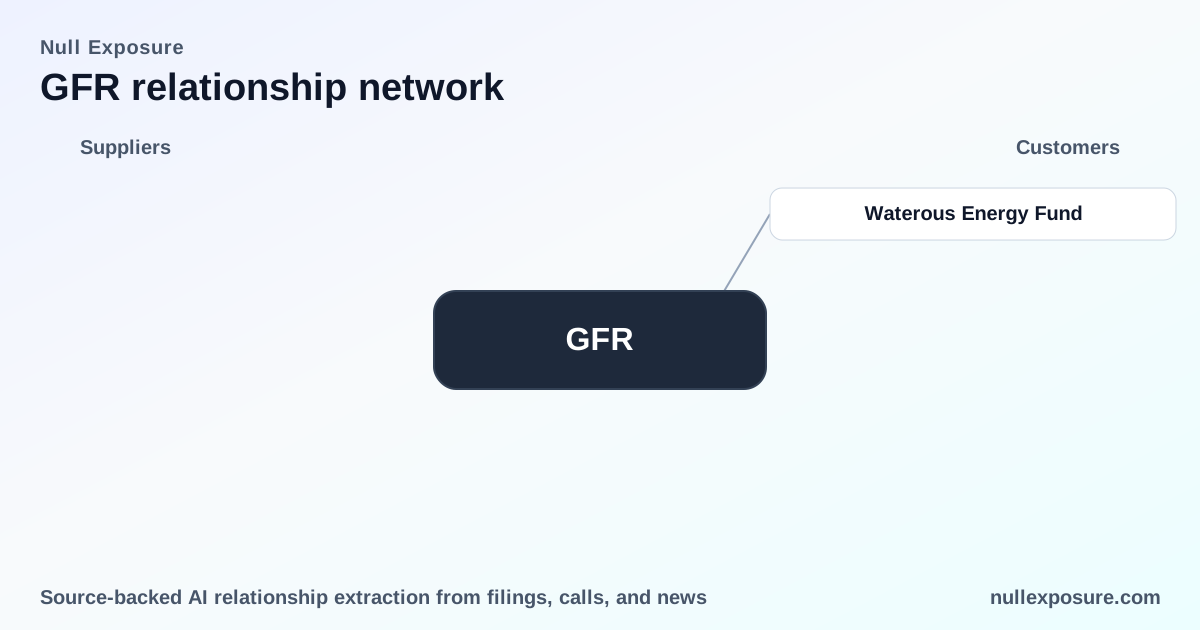
Greenfire’s most material customer/partner signal in public reporting over the last year is its interaction with the Waterous Energy Fund (WEF) in the context of a C$300 million rights offering and associated standby purchase agreement. WEF’s role as a potential backstop and large shareholder alters Greenfire’s contracting posture: the company can lean on committed private capital to execute equity raises quickly and with a predictable outcome. The optics of that relationship influence governance, dilution outcomes, and refinancing optionality for investors.
Detailed relationship entries: every mention in the public record
Below are concise, plain-English summaries for each relationship mention captured in our review, with source context for verification.
-
Greenfire did not draw on a previously announced standby commitment from limited partnerships comprising Waterous Energy Fund because the rights offering was fully subscribed. Reported in Boereport on December 19, 2025.
Source: Boereport, Dec 19, 2025. -
At preliminary results for the rights offering, Greenfire stated it expects to issue 55,147,058 common shares—the maximum under the offer—without reliance on the standby commitment. Newsfile’s release summarized the outcome on March 9, 2026.
Source: Newsfile release, Mar 9, 2026. -
A Reuters-syndicated note (picked up on TradingView) reiterated that the previously announced standby commitment would have seen limited partnerships within Waterous Energy Fund acquire any unsubscribed shares, underscoring that a formal backstop had been arranged in advance of the offer. Reported March 9, 2026.
Source: Reuters / TradingView, Mar 9, 2026. -
An alternate Boereport AMP publication repeated that the rights offering was fully subscribed and therefore the WEF standby commitment was not used, confirming consistent press coverage across outlets. Published Dec 19, 2025 (AMP).
Source: Boereport AMP, Dec 19, 2025. -
Prior to closing, Greenfire announced its intent to enter into a standby purchase agreement with limited partnerships comprising Waterous Energy Fund, noting WEF as a current holder of approximately 55.9% of the company’s outstanding common shares and committing up to an aggregate of C$300 million under the standby facility. This was disclosed in the March 9, 2026 Newsfile announcement about the rights offering.
Source: Newsfile release (Intent to Conduct C$300M Rights Offering), Mar 9, 2026. -
At closing of the rights offering and refinancing initiatives, Greenfire reconfirmed that because the rights offering was fully subscribed it did not utilize the previously announced standby commitment from limited partnerships comprising Waterous Energy Fund, as summarized in a May 3, 2026 Newsfile release.
Source: Newsfile release (Closing of Rights Offering), May 3, 2026.
What this relationship and the public record mean for investors
-
Concentration and shareholder influence. Public disclosures tied WEF to roughly 55.9% ownership prior to the closing sequence, a level that creates a single-shareholder influence over governance, recapitalization strategy, and dilution outcomes. Investors should treat large-shareholder dynamics as a structural feature of Greenfire’s capital management.
-
Contracting posture: proactive and backstopped. Greenfire structured a rights offering with an explicit standby purchase agreement—an aggressive and deliberate posture that prioritizes predictable execution of equity raises. Even though the backstop was not executed (the offer was fully subscribed), the existence of a committed facility improved transaction certainty.
-
Capital-market readiness and liquidity access. The company’s ability to mount a C$300 million rights offering and secure a standby commitment signals institutional access to capital; the fully subscribed result indicates ample investor appetite or pre-commitment execution for the specific raise.
-
Operational maturity and risk profile. Greenfire posts a positive operating margin and EBITDA that support ongoing operations, yet it still uses equity markets for balance-sheet management—consistent with a mid-cycle E&P operator that combines cash flow with periodic capital raises. Expect episodic financing events to be a recurring feature of the story.
Constraints and company-level signals for diligence
There were no explicit constraints captured in the relationship-focused review to attach to these third-party mentions. At the company level, observable signals are:
- High shareholder concentration, which provides financing optionality but reduces the influence of minority holders.
- A contracting approach that uses pre-arranged backstops, improving execution certainty for equity offers and lowering market-execution risk.
- A financing cadence where equity issuance is an active tool alongside production cash flow and refinancing initiatives.
These signals should inform valuation scenarios: model for occasional dilution events and treat large-shareholder support as a secondary liquidity layer rather than guaranteed ongoing funding.
Investment implications and investor playbook
- If you value predictability: Backstopped rights offerings reduce execution risk, which is positive for liquidity-sensitive investors; the fully subscribed outcome removes immediate dilution anxiety and demonstrates market demand.
- If you value governance independence: The WEF majority position (as reported) constrains minority governance options and concentrates decision-making; price for control influence in any takeover or strategic transaction scenario.
- If you value cash-flow resilience: Greenfire’s operating margins and EBITDA provide a base case for sustainable production, but episodic equity activity should be priced into forward per-share metrics.
Bold takeaway: Greenfire combines operational cash generation with proactive, shareholder-backed capital actions—this reduces near-term financing risk but increases structural concentration risk that investors must price.
For structured relationship analytics and ongoing updates to how partner commitments affect capital structure, see our coverage hub at https://nullexposure.com/.
Authoritative view: Greenfire’s recent transactional sequence is not an outlier; it is how the company executes growth and balance-sheet management. Investors should build models that reflect both the upside of committed financing sources and the downside of concentrated shareholder control.