Greenfire Resources (GFR-R): Sponsor-backed capital management and what investors should read into recent support activity
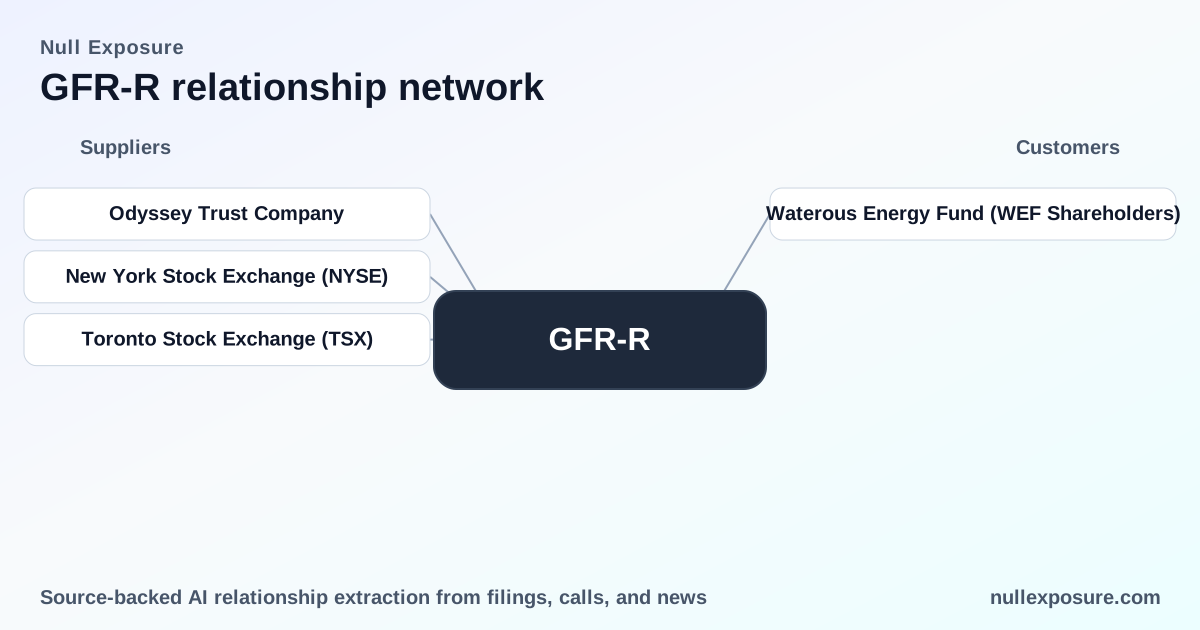
Greenfire Resources (GFR-R) finances its near-term liquidity and debt-reduction strategy primarily through capital markets actions—not operating cash flow—and relies on a controlling sponsor, Waterous Energy Fund, to underwrite and backstop equity raises. The economic model is therefore capital-markets-dependent with a high degree of shareholder concentration and sponsor-critical financing support. For a focused map of corporate backstops and counterparty posture, see https://nullexposure.com/.
Sponsor support is the structural story investors must price
Waterous Energy Fund functions as the financial anchor for Greenfire: the sponsor both controls the equity base and has contractually committed to backstop a major rights offering designed to redeem secured notes. That 55.9% ownership stake by WEF gives the sponsor decisive governance leverage and a de facto financing guarantee for transactions where it has a standby commitment. According to a Newsfile Corp release in FY2025 (filed March 9, 2026), the WEF Shareholders agreed to exercise their basic subscription privilege in full and to purchase unsubscribed shares on a pro rata basis under the Rights Offering. This commitment is a defining operating feature for GFR-R: capital access is concentrated and effectively sponsored, reducing immediate dilution risk for the company’s ability to complete recapitalizations but increasing single‑counterparty concentration risk for minority holders.
What the public record shows — three discrete reports, one consistent story
Investors evaluating counterparties and customer-like relationships should read the three public items together; each entry confirms sponsor control and practical liquidity support.
-
Investing.com reported on May 3, 2026 that Greenfire completed a C$300 million refinancing and did not need to utilize the previously announced standby commitment from Waterous Energy Fund, as unsubscribed shares were not an issue after the financing closed. (Investing.com, May 3, 2026)
-
A Newsfile Corp press release in FY2025 (March 9, 2026) documents that the WEF Shareholders own approximately 55.9% of Greenfire’s common shares and agreed—subject to terms—to exercise subscription privileges in full and to purchase any unsubscribed shares on a proportionate basis (the “Standby Commitment”). (Newsfile Corp, March 9, 2026)
-
A separate Investing.com company-news item (May 3, 2026) covering Greenfire’s C$300 million rights offering noted that Waterous will exercise its basic subscription privilege and buy any unsubscribed shares through a standby commitment arrangement, and that no standby fee will be paid to Waterous. This documentation frames the sponsor arrangement as explicit support without incremental compensation to the backstop provider. (Investing.com, May 3, 2026)
Contracting posture and what it signals about counterparty risk
The contractual design of the rights offering and the announced standby commitment reveal a few high-confidence operating characteristics for investors:
-
Sponsor backstop, not market-priced insurance: The absence of a standby fee to Waterous indicates the sponsor is providing support as a governance or strategic action rather than as a market-priced liquidity service. That reduces explicit cash cost for Greenfire but concentrates downside on minority holders if additional sponsor purchases occur.
-
High counterparty concentration: With WEF at ~55.9% ownership, single‑party influence is material; any operational or strategic decision will be viewed through the lens of sponsor alignment. This is a deliberate corporate posture—investors should treat the sponsor as a primary customer/credit counterparty given its role in providing capital.
-
Criticality of sponsor to solvency path: The rights offering was structured to redeem senior secured notes due 2028 (per the conditional notice accompanying the offering), so sponsor support is functionally critical to debt extinguishment and covenant management. That elevates Waterous from passive investor to active financial counterparty.
Financial maturity and recapitalization dynamics
Greenfire’s C$300 million refinancing and concurrent rights offering are typical of companies that depend on episodic capital raises to address near-term maturities. Completed refinancing reduced the need to draw on the standby purchase commitment in the immediate instance, but the rights offering’s explicit aim to redeem senior secured notes due 2028 signals a focus on liability management and balance-sheet extension. The net effect for investors:
- Liquidity risk has been actively managed through sponsor-backed capital markets transactions.
- Refinancing reduces immediate default probability, but the company remains dependent on repeat access to sponsor-backed capital if operating cash flow does not replace market financing over time.
Risk map: what to watch next
-
Concentration risk: The sponsor’s majority stake is positive for short-term capital certainty but negative for minority governance protections and price discovery in equity raises. Monitor any NRC or governance changes that shift sponsor incentives.
-
Sponsor economics: The lack of a standby fee reduces direct financing cost but transfers economic burden into ownership dilution and implicit governance control—watch for subsequent share issuance terms and proportionality of future buys.
-
Debt extinguishment execution: The rights offering was explicitly tied to redemption of senior secured notes due 2028; investors should track the closing mechanics and any conditional redemptions or partial redemptions described in the issuer notices.
Bottom line — a sponsor-led financing model with clear consequences
Greenfire’s financing architecture is sponsor-centric: Waterous Energy Fund anchors equity and stands ready to backstop capital raises without a standalone standby fee, while the company uses rights offerings and secured-note redemptions to manage maturities. That structure lowers immediate liquidity risk but raises single-counterparty concentration and governance risk for public investors.
For further analysis of sponsor relationships and counterparty maps, visit https://nullexposure.com/ for structured customer and investor relationship intelligence.