GFR-R-W: What the Waterous Backstop Reveals About Capital Strategy and Counterparty Risk
Greenfire Resources (ticker GFR-R-W) funds operations and liquidity through capital-market transactions—issuing secured notes and running rights offerings—while relying on institutional backstops to firm up financing plans. The company monetizes through structured financings rather than operating cash flow, and its counterparty web for those financings is a primary driver of near-term credit and execution risk.
For immediate access to the full document set and signal feed on this relationship, visit https://nullexposure.com/.
The investor thesis in one paragraph
Greenfire’s trajectory is driven by episodic capital raises and liability management rather than recurring operating revenue. Rights offerings and conditional redemptions of senior secured notes indicate a financing-first business model, where outcomes for equity and note holders depend heavily on the company’s ability to secure committed support from a small set of financial counterparties. Investors should treat counterparty commitments—standby purchase agreements and limited-partnership backstops—as central to valuation and downside protection.
What the data shows about counterparties
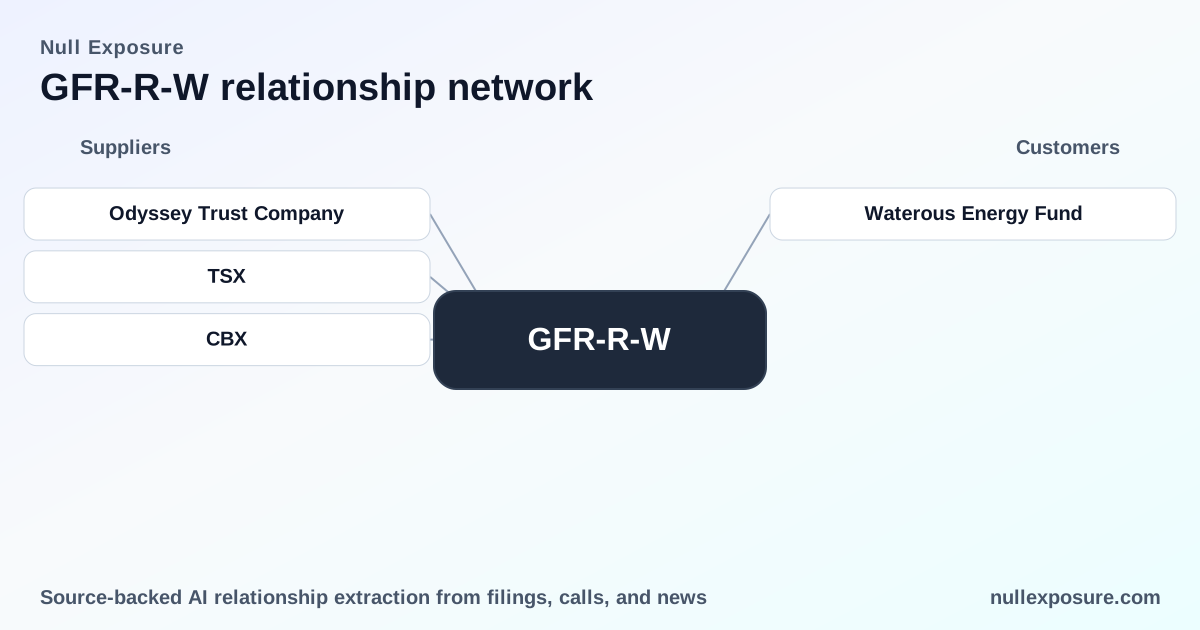
A single, material customer/partner relationship surfaces in the public signal set: Waterous Energy Fund. The relationship is transactional and financing-focused rather than operationally integrated.
- Waterous Energy Fund — Greenfire entered a standby purchase agreement with limited partnerships comprising Waterous Energy Fund to backstop a rights offering and a conditional redemption notice for Greenfire’s senior secured notes due 2028. Source: Chronicle Journal Markets press release, Nov 6, 2025 (newsfile distributed on the markets section); https://markets.chroniclejournal.com/chroniclejournal/article/newsfile-2025-11-6-greenfire-resources-announces-launch-of-rights-offering-and-conditional-notice-of-redemption-for-its-senior-secured-notes-due-2028.
This arrangement is explicitly financial: it is not a commercial customer contract for goods or services, but a liquidity backstop intended to ensure a rights offering satisfies subscription or funding thresholds.
Relationship-by-relationship breakdown
Below is a concise plain-English summary for every relationship surfaced in the data set.
- Waterous Energy Fund: Greenfire executed a standby purchase agreement with limited partnerships that make up Waterous Energy Fund to support a rights offering and to enable a conditional notice of redemption on its senior secured notes due 2028. This is a pre-arranged capital commitment meant to secure the success of the financing event. Source: Chronicle Journal Markets, Nov 6, 2025 — press release detailing the rights offering and standby purchase agreement; https://markets.chroniclejournal.com/chroniclejournal/article/newsfile-2025-11-6-greenfire-resources-announces-launch-of-rights-offering-and-conditional-notice-of-redemption-for-its-senior-secured-notes-due-2028.
(There are no additional customer relationships recorded in the supplied results.)
What the backstop tells investors about operating model and business model constraints
The signals available point to a capital-structure-centric operating posture. Because explicit contractual constraints in the dataset are absent, the following are company-level signals derived from the financing event:
- Contracting posture: Greenfire uses bespoke financing commitments (standby purchase agreements) rather than mass-market retail capital, indicating direct negotiation with sophisticated limited partners and a preference for concentrated, negotiated funding lines over syndicated bank facilities.
- Concentration: The reliance on a named institutional backstop implies concentrated counterparty exposure; a small number of limited partnerships are pivotal to the success of discrete financings.
- Criticality: For the rights offering and conditional redemption to succeed, the Waterous-backed standby purchase agreement is critical—it underpins the company’s ability to re-shape its capital structure and to execute on liability management for the senior secured notes due 2028.
- Maturity and timing: The transaction explicitly ties to near-term debt management (notes maturing in 2028) and thus compresses execution risk into a finite window where committed capital must be delivered.
- Visibility and transparency: Public signals are limited to press disclosure of the standby agreement; detailed legal terms, commitment size, and covenants are not in the supplied results, producing limited visibility into the full contractual economics.
These characteristics are company-level signals because no constraint excerpt in the record assigns contractual detail beyond the announcement of the standby commitment.
Investment implications and risk map
The Waterous engagement changes the risk profile in measurable ways:
- Execution risk shifts to counterparty performance. The success of the rights offering—and any planned redemption—depends on Waterous and related limited partnerships honoring the standby commitment. That converts market risk into counterparty credit/operational risk.
- Concentration raises counterparty default consequences. If the standby provider fails to fund, Greenfire faces dilution if it turns to alternative financing, or liquidity shortfall if alternatives are unavailable.
- Near-term liability management is elevated in priority. The conditional redemption of senior secured notes due 2028 indicates proactive balance-sheet management; successful completion could reduce near-term refinancing pressure and interest cost, improving credit metrics.
- Governance and negotiation leverage. Institutional backstops commonly extract protective covenants and pricing concessions; expect future cash flows and strategic optionality to be constrained by the terms of these financing arrangements (the precise covenants are not disclosed in the public announcement).
What investors should watch next
- Confirmation that the standby purchase agreement completed funding when the rights offering closed, and disclosure of the committed and executed amounts.
- Any filing or press update that discloses covenants, milestones, or triggers attached to the standby commitment.
- Changes to the redemption status of the senior secured notes due 2028—particularly whether redemption is conditional on funding or other covenant tests.
For a structured view of these and related signals, researchers should benchmark Greenfire’s financing counterparties against peers and track subsequent filings for covenant language and actual purchase amounts. For quick access to the compiled signals, visit https://nullexposure.com/.
Bottom line
Greenfire’s financing strategy centers on negotiated institutional backstops rather than broad market liquidity. That structure reduces market execution risk but concentrates counterparty exposure and places the success of liability management squarely in the hands of a few financial partners. Investors must monitor consummation of the standby funding, follow-up covenant disclosures, and the ultimate impact on the senior secured notes due 2028 to assess credit recovery and equity dilution pathways.