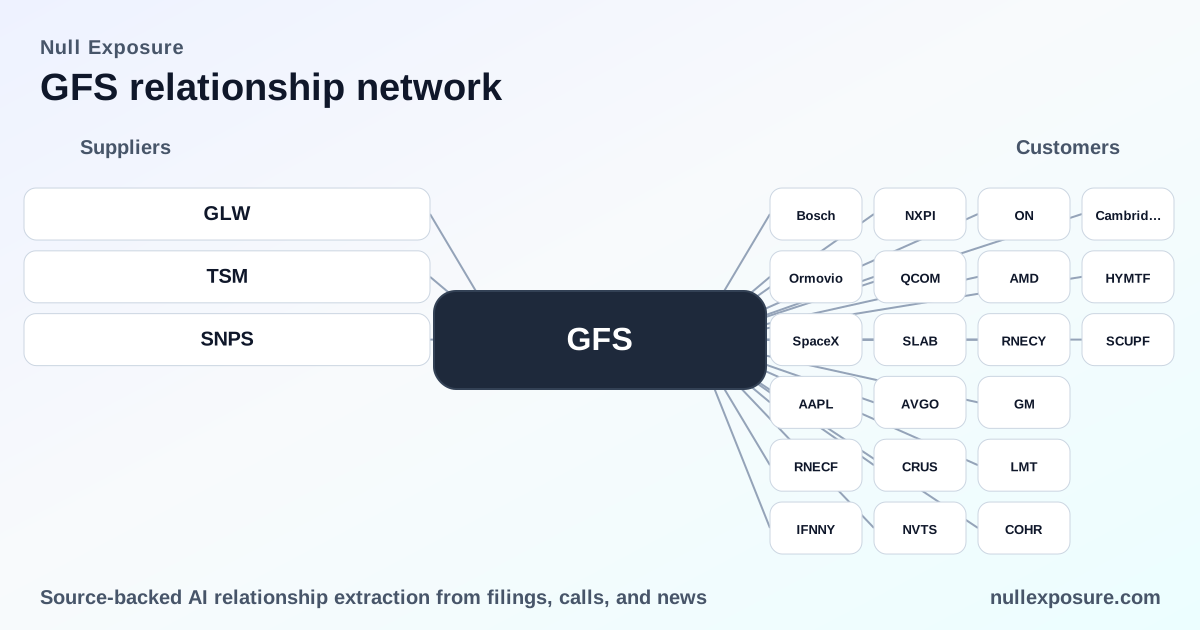
GlobalFoundries (GFS): Customer Map and What It Means for Investors
GlobalFoundries operates as a specialty semiconductor foundry that monetizes by selling wafer fabrication capacity and differentiated process platforms (FDX, BCD, CBIC, 12LP, silicon photonics) to OEMs and chip designers under multi‑year manufacturing and technology partnerships. Its revenue model is driven by long‑term capacity commitments from large customers in mobile, automotive, industrial, and defense markets, supplemented by strategic collaborations that de‑risk capital expansion and lock in demand for new fabs and packaging lines. For investors, the key read is simple: GFS is an anchor foundry with concentrated, mission‑critical relationships that justify heavy, multi‑billion-dollar capex while exposing the company to customer concentration and technology‑transition execution risk.
Learn more about how we source relationship intelligence at https://nullexposure.com/.
Why customer relationships drive the thesis
GlobalFoundries’ business is capital‑intensive and scale‑dependent: fabs are expensive to build and profitable only when run at sustained utilization. That makes the quality and duration of customer relationships the single most important determinant of GFS’s cash flow profile. The company’s recent announcements—and the press coverage surrounding them—show a deliberate strategy to secure long‑term anchor customers across multiple end markets while expanding US and EU manufacturing capacity.
The customer roster, one relationship at a time
Below is a concise, source‑linked summary of every customer relationship recorded in the available results. Each entry explains how the counterparty engages with GlobalFoundries.
-
Apple (AAPL) — GlobalFoundries expanded a long‑standing partnership to produce wireless‑connectivity and power‑management chips in U.S. fabs, signalling Apple will host certain components at GF’s Malta site. Source: GFS 2025 Q4 earnings call transcript (reported Mar 7–8, 2026) and follow‑on press coverage in April–May 2026.
-
AMD (AMD) — AMD is a supporting anchor for GF’s capital expansion and a development partner for moving selected fab work from 200mm to 300mm processes; recent coverage highlights GF’s role in AMD’s packaging and co‑development plans. Source: GFS 2025 Q3 earnings call (Mar 8, 2026) and SiliconANGLE coverage (Feb–Mar 2026).
-
Qualcomm (QCOM) — Cited by management among the half‑dozen customers that backed GF’s expanded US investment plan, indicating Qualcomm is a strategic manufacturing customer for RF and connectivity components. Source: GFS 2025 Q3 earnings call (Mar 8, 2026).
-
NXP (NXPI) — Named as one of the key customers supporting GF’s $16 billion US manufacturing expansion, consistent with demand for EU and U.S. specialty manufacturing for automotive and connectivity chips. Source: GFS 2025 Q3 earnings call (Mar 8, 2026).
-
SpaceX — Identified as a participating customer in the company’s investment expansion, suggesting SpaceX sources specialty or custom silicon capacity from GF. Source: GFS 2025 Q3 earnings call (Mar 8, 2026).
-
Bosch — Mentioned alongside other European OEMs as a driver of GF’s EU‑based manufacturing initiatives to meet regional requirements. Source: GFS 2025 Q3 earnings call (Mar 8, 2026).
-
Ormovio — Called out as a European customer whose needs reinforce GF’s EU site positioning for regional manufacturing. Source: GFS 2025 Q3 earnings call (Mar 8, 2026).
-
Infineon (IFNNY) — Listed as a key European customer whose product and regulatory needs support GF’s EU facility strategy. Source: GFS 2025 Q3 earnings call (Mar 8, 2026).
-
Silicon Labs (SLAB) — Announced an expanded partnership to manufacture wireless SoCs on GF’s new ultra‑low‑power platform out of Malta, confirming a design‑to‑volume relationship for IoT/wireless markets. Source: GFS 2025 Q3 earnings call and Silicon Labs release (Mar 2026).
-
Broadcom (AVGO) — Selected GF’s CBIC platform for a low‑noise RF amplifier, representing adoption of a newly launched RF platform by a major silicon customer. Source: GFS 2025 Q4 earnings call transcript (Mar 7, 2026).
-
Cirrus Logic (CRUS) — Deepened collaboration to develop and commercialize next‑gen BCD and GaN power technologies in the U.S., indicating joint development plus volume aspirations. Source: GFS 2025 Q4 earnings call (Mar 7, 2026).
-
Navitas (NVTS) — Entered a long‑term technology and manufacturing partnership to develop and scale 650V/100V GaN devices at GF’s Vermont facility, with development planned for early 2026 and production expected later that year. Source: Navitas filings and press coverage (Mar 10, 2026) and GFS 2025 Q4 remarks (Mar 7, 2026).
-
onsemi (ON) — Partnering with GF to accelerate GaN technology scaling for AI data center power and other high‑voltage applications, reinforcing GF’s positioning in power electronics. Source: GFS 2025 Q4 earnings call and press (Mar 7–9, 2026).
-
Renesas Electronics Corporation (RNECF / RNECY) — Entered a multi‑billion‑dollar strategic manufacturing partnership to broaden Renesas’ access to GF platforms (FDX, BCD, advanced CMOS), effectively anchoring automotive and industrial capacity. Source: GF and Renesas announcement and widespread coverage (Mar 9, 2026).
-
QuickLogic (QUIK) — Delivered design files and confirmed wafer fabrication of an SRH FPGA test chip on GF’s 12LP process, including U.S. production for radiation‑hardened applications. Source: QuickLogic news releases and industry coverage (Mar 2026).
-
Lightwave Logic (LWLG) — Integrated its electro‑optic modulator platform into GF’s silicon photonics ecosystem (GDSFactory inclusion and foundry runs), signalling silicon photonics manufacturing collaborations for data center interconnect. Source: Lightwave Logic disclosures and coverage (May 3, 2026).
-
indie Semiconductor (INDI) — Announced a strategic collaboration with GF to manufacture 77 GHz and 120 GHz radar SoCs on the 22FDX platform for ADAS and industrial radar applications. Source: GF press release and embedded industry coverage (Mar 10, 2026).
-
Coherent (COHR) — Won a significant optical network design engagement with GF, reflecting business development in optical components and photonics. Source: GFS 2025 Q3 earnings call (Mar 8, 2026).
-
Everspin / MRAM (MRAM) — Everspin amended its STT‑MRAM joint development agreement with GF, extending cooperative MRAM development to 12nm, demonstrating ongoing specialty memory collaboration. Source: TechPowerUp coverage of the JDA amendment (reported Mar 10, 2026; reference to earlier JDA activity).
-
General Motors (GM) — Listed by the company (and in prior coverage) as a major client, indicating automotive OEM demand for GF’s specialty and mainstream silicon. Source: CNBC coverage referencing major clients (July 2024).
-
Lockheed Martin (LMT) — Named in prior industry reporting among major clients, evidencing defense/space market engagements for specialized silicon. Source: CNBC coverage (July 2024).
-
Hyundai Motor Group (HYMTF) — Signed an MOU leveraging GF expertise to equip next‑generation vehicles with enhanced connectivity and power efficiency, indicating strategic automotive R&D collaboration. Source: GFS 2025 Q3 earnings call (Mar 8, 2026).
-
Cambridge Mechatronics — Won a camera controller program for premium‑tier Android devices on GF’s FinFET platform, representing design‑win progress in mobile imaging components. Source: Earnings call coverage and press (InsiderMonkey report, Mar 9, 2026).
-
Aegis (SCUPF) — Announced a partnership to produce next‑generation smart sensors on GF’s VCD platform in Singapore following GF’s Global Technology Summit in Asia. Source: GFS 2025 Q3 earnings call (Mar 8, 2026).
What this customer map implies for investors
-
Contracting posture: Across multiple disclosures, GF pursues multi‑year strategic foundry partnerships and MOUs, not transactional wafer buys—this is a deliberate, lock‑in approach to secure utilization before heavy capex. (Company‑level signal from multiple earnings calls and press coverage.)
-
Concentration and anchors: While GF serves many customers, several relationships (Apple, Renesas, AMD, Broadcom) function as anchor contracts that materially de‑risk large investments. That concentration works both ways: anchors stabilize utilization but create counterparty risk if one major customer reduces demand.
-
Criticality: GF’s customers span automotive, defense, mobile, and AI power/photonic markets, all of which require supply‑security and regional manufacturing — elevating GF’s strategic importance to customers and governments.
-
Technology / maturity: GF is commercializing a range of specialty platforms (FDX, BCD, CBIC, 12LP, silicon photonics); the company’s monetization depends on successful migration of customer designs onto these platforms at scale.
-
Capital and execution risk: The business model demands sustained capex and flawless fab ramp execution; investor returns hinge on converting design wins into high‑utilization production lines.
Bottom line and next steps
GlobalFoundries has systematically converted design partnerships into long‑term manufacturing commitments across high‑value end markets. For investors, the trade‑off is clear: exposure to secular demand in automotive, power and photonics with the offset of capital intensity and a handful of anchor customers that disproportionately determine utilization and margins.
If you evaluate counterparty risk or need deeper relationship evidence for model inputs, explore our platform for original source links and document‑level traces at https://nullexposure.com/.
For bespoke briefs or portfolio‑level supplier risk maps, contact the NullExposure research team through our site.