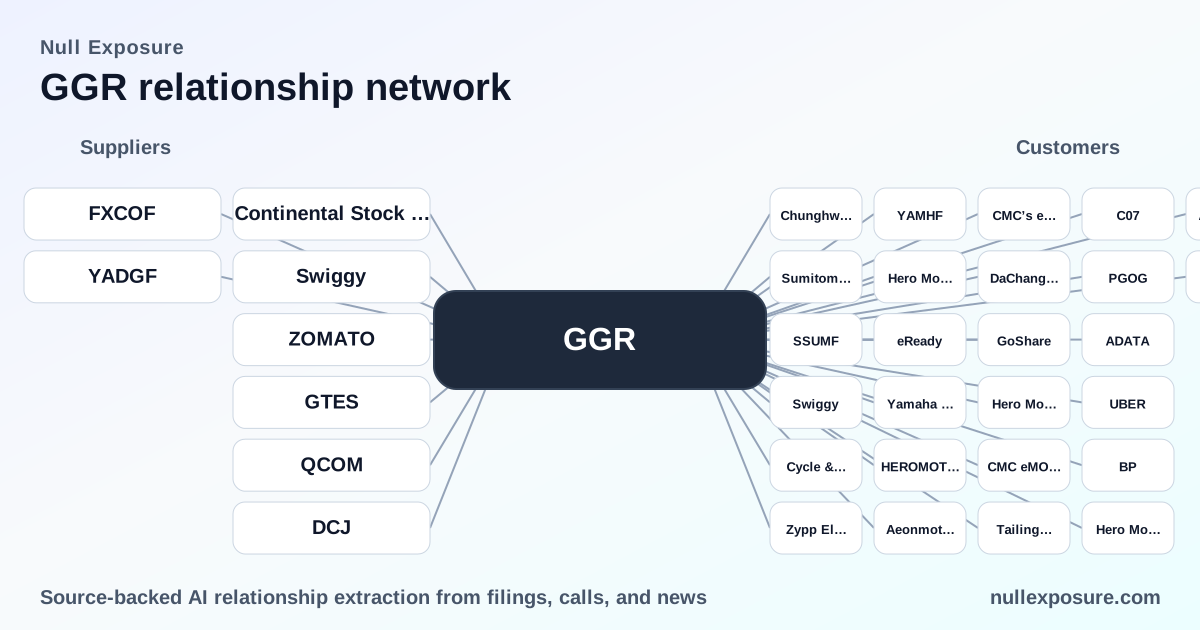
Gogoro (GGR): customer map and what partner traction means for growth
Gogoro builds and monetizes a battery‑swapping ecosystem: it sells Smartscooters and hardware, licenses its swap platform to vehicle-makers and operators, and collects recurring revenue from battery swapping and network services. Revenue drivers are a hybrid of product sales, platform partnerships, and recurring swap-service economics, with growth driven by strategic distribution and joint‑venture relationships across Asia and beyond. For investors evaluating customer risk and upside, the company’s value hinges on partner scale, exclusivity in local markets, and the pace at which pilots convert into operator rollouts. Learn more about the data behind these relationships at https://nullexposure.com/.
What the partnership footprint tells investors about the operating model
Gogoro operates as a platform company that converts hardware adoption into recurring network economics. That creates a set of company‑level signals investors should factor into valuation and risk assessment:
- Contracting posture: Gogoro pursues joint ventures, exclusive distributors, and pilot agreements rather than one‑off sales—evidence it prioritizes long‑term network monetization over merely selling scooters.
- Concentration and geographic strategy: Partnerships cluster in Taiwan, India, Southeast Asia and select Latin American markets, indicating a staged international expansion where local partners provide market access and distribution muscle.
- Criticality and maturity: Several partners are incumbent vehicle manufacturers and large energy/retail brands, implying Gogoro’s swap technology is seen as a strategic electrification solution, not a commodity accessory.
- Revenue profile: Expect a mix of upfront product revenue from scooters and slower‑ramping but higher‑durability recurring revenue from swapping infrastructure, network services and JV economics.
These are company‑level signals drawn from announced partnerships and public commentary; they shape how investors should model adoption curves and margin expansion.
The customer list — partner by partner (compact summaries)
Below is a concise, source‑backed run‑down of every partner relationship reported in the public record for GGR. Each entry is one to two sentences with the publication context.
- Chunghwa Post — Taiwan’s government postal service added over 1,000 Gogoro Crossover S units to its fleet for postal delivery, highlighting fleet durability and adoption by public logistics operators (Gogoro Q4 2025 earnings call, FY2025).
- Sumitomo Corporation / SSUMF — Sumitomo and Sumitomo Mitsui Finance & Leasing entered a partnership to accelerate Gogoro’s global expansion by leveraging Gogoro Smart Batteries and swapping to expand mobility and second‑life battery use cases (PR Newswire; FY2024).
- Sumitomo Mitsui Finance and Leasing (SMFL) — SMFL participation provides leasing and financing capabilities to deploy Gogoro hardware and swap networks, supporting scale in new markets (Electrek and PR Newswire coverage; FY2024).
- Swiggy — Gogoro committed Smartscooters and battery‑swapping infrastructure to Swiggy’s delivery fleet as part of a commercial partnership in India, signalling B2B delivery adoption (Times of India; FY2023).
- Zypp Electric — Zypp runs a B2B pilot with Gogoro in India that includes battery swapping and Smartscooters for last‑mile deliveries, showing operational pilots moving toward scale (Gogoro news & EV Reporter; FY2023).
- Cycle & Carriage (Jardine Cycle & Carriage / C07) — An exclusive distribution and operator agreement gives Cycle & Carriage responsibility for launching Gogoro swapping and Smartscooters in Singapore under a sandbox pilot with the LTA (Gogoro press release & PR Newswire; FY2022–FY2024).
- Yamaha (YAMHF / Yamaha Motor Co., Ltd.) — Yamaha has multiple Go‑Network integrations and models (e.g., CuxiE, QC, EMF) built to use Gogoro’s swap stations, demonstrating deep OEM engagement and productized partnerships (Gogoro news, earnings calls, Yamaha press; FY2020–FY2025).
- CMC’s eMOVING — As part of the Powered by Gogoro Network alliance, CMC’s eMOVING supplies LEVs compatible with Gogoro’s swapping ecosystem, reflecting multi‑OEM uptake in Taiwan (Gogoro year‑in‑review; FY2020).
- Hero MotoCorp (HEROMOTOCO) — A strategic JV and cooperation to deploy battery swapping in India and produce Hero‑branded vehicles powered by the Gogoro Network positions Hero as a marquee OEM partner for large‑market expansion (PR Newswire & Gogoro releases; FY2021).
- Dachangjiang (DCJ) — DCJ is a Chinese partner working with Yadea to deploy the Gogoro Network and GoStations in cities such as Hangzhou, marking early mainland China deployments (FutureTransport‑News; FY2021).
- Aeonmotor — Aeonmotor is listed among vehicle‑maker partners in the Powered by Gogoro Network, contributing to a broad multi‑brand product ecosystem (Gogoro news; FY2020–FY2021).
- PGO (PGOG) — PGO is included in Gogoro’s partner portfolio supplying LEVs built to integrate with the swap network, supporting multi‑brand availability for consumers (Gogoro news; FY2020–FY2021).
- Tailing eReady / eReady — Tailing eReady, a JV with Suzuki in Taiwan, is part of Gogoro’s partner list, another sign of local OEM partnerships anchoring the network (Gogoro partnership disclosures; FY2021).
- Awayspeed — Named among collaborators in China and Taiwan efforts, Awayspeed’s inclusion underscores Gogoro’s partnership breadth with regional vehicle assemblers (FutureTransport‑News; FY2021).
- GoShare — GoShare works with Gogoro technology and services to scale green transportation solutions, reflecting collaboration with platform delivery operators (Gogoro award announcement; FY2023).
- ADATA — ADATA’s heavy‑duty three‑wheelers are scaling with delivery platforms and were referenced by Gogoro management as part of the broader EV partner ecosystem (Gogoro Q4 2025 earnings call; FY2025).
- Uber Eats (UBER) — Gogoro collaborates with Uber Eats in Taiwan to convert delivery drivers to electric two‑wheelers, indicating demand from gig‑economy fleets (Taipei Times reporting; FY2023).
- BP / Castrol / Castrol BP — Gogoro has a joint venture arrangement in Vietnam with Castrol BP, with Gogoro contributing capital to develop distribution and battery‑swapping services — a notable energy‑brand JV (company financial disclosure and Sahm Capital reporting; FY2025).
- Terpel — Terpel partnered with Gogoro to launch two‑wheel battery swapping and Smartscooters in Colombia, indicating expansion into Latin American retail/energy channels (market reports; FY2022).
- Nebula Energy — Nebula Energy and Gogoro launched battery swapping and smartscooters in Nepal, extending Gogoro’s footprint in South Asia (SimplyWall.St summary of partnerships; FY2022).
- Copec — Copec and Gogoro launched battery‑swapping and Smartscooters in Chile, showing regional energy‑retailer distribution plays (SimplyWall.St; FY2022).
- Yadea (YADGF) — Yadea and Gogoro collaborated in China to deploy Swap & Go technology, a strategic OEM relationship for the world’s largest 2W market (FutureTransport‑News & Gogoro filings; FY2021).
- PGO / DCJ (additional mentions) — Multiple entries reference DCJ and PGO across press and Gogoro news—these reinforce Gogoro’s China and OEM expansion strategy rather than a single transactional tie (RideApart, Gogoro news; FY2021–FY2022).
What investors should watch next
- Conversion of pilots into revenue‑generating rollouts is the principal value inflection: pilots in Singapore, India, Vietnam and China must scale to deliver recurring swapping revenue. (See Cycle & Carriage, Swiggy, Hero, Castrol BP entries above.)
- Partner mix balances OEM credibility and local distribution: relationships with Yamaha, Hero and Sumitomo give Gogoro both manufacturing validation and distribution/financing scale—critical for capital‑intensive rollouts.
- JV economics and upfront capital will influence near‑term profitability since GW of GoStations and inventory require investment before recurring swap revenues mature.
If you’d like a structured spreadsheet of these partner entries for model inputs, visit https://nullexposure.com/ for a deeper extraction and cross‑reference service.
Bottom line
Gogoro’s customer map shows a deliberate playbook: convert OEM and large‑brand pilots into locally operated swap networks that generate durable, recurring revenue streams. For investors, the balance between product sales and recurring swap economics, plus the pace of JV and distributor rollouts, is the central determinant of upside and near‑term margin stabilization.