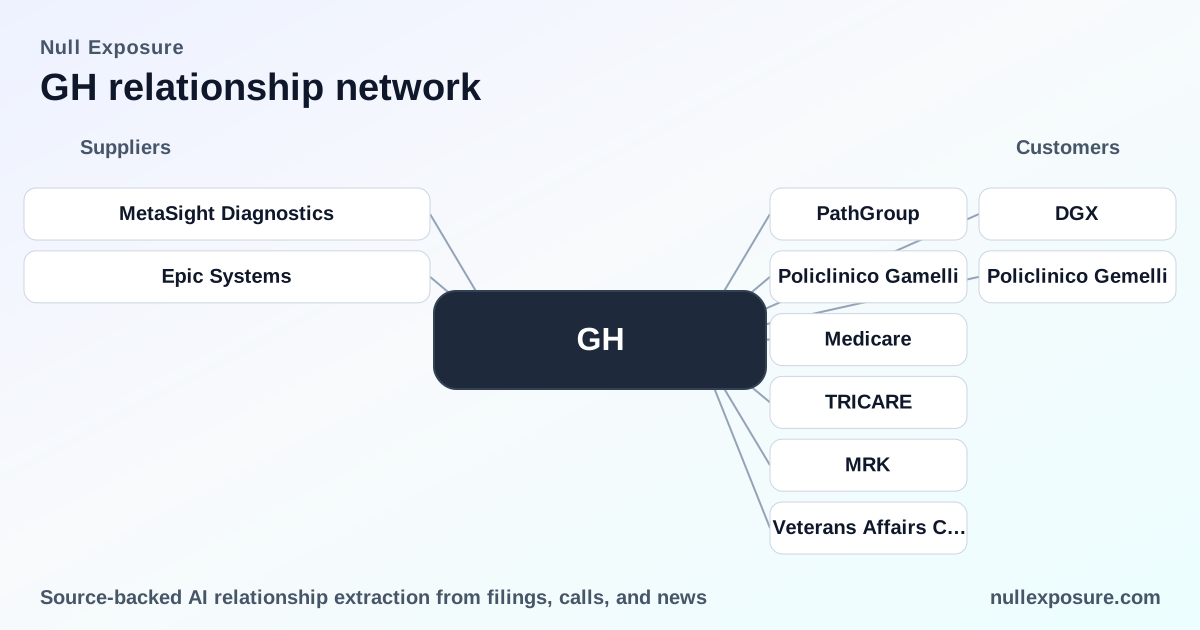
Guardant Health (GH) — Customer Relationships that Drive Revenue and Risk
Guardant Health sells advanced liquid- and tissue-based oncology tests and real‑world evidence services to clinical providers, payers and biopharmaceutical customers, monetizing through per‑test diagnostics revenue and multi‑year strategic collaborations for companion diagnostics and RWE services. Revenue is concentrated in clinical testing performed out of a single Redwood City lab and materially driven by U.S. payers, especially Medicare, while strategic partner deals expand distribution and embed Guardant’s platforms into drug development and commercial launches. For more customer-level signal work, visit Null Exposure.
Why this customer roster matters to investors
Guardant’s commercial profile is a hybrid of point-of-care services and embedded enterprise relationships. Clinical tests generate the bulk of near‑term cash flow; biopharma collaborations and payer coverage decisions shape medium‑term growth and margin expansion. Key investment drivers are adoption of Shield and Guardant360 products by large labs, government coverage, and multi‑year pharma partnerships that convert one‑off tests into recurring streams.
Company‑level operating constraints and what they imply
- Contracting posture — spot: Historically Guardant performed many tests out‑of‑network in the U.S., which signals a spot-pricing orientation for some revenue lines and exposes the company to reimbursement volatility. This is a company‑level signal from Guardant’s public filings about the pre‑2025 operating model.
- Payer concentration and materiality — government: Medicare accounted for roughly 39–45% of precision oncology revenue (2022–2024). Government reimbursement is a material revenue driver and a principal risk if coverage standards change.
- Counterparty mix — large enterprises present both opportunity and constraint: Guardant sells into large commercial payers and national lab networks, but some major commercial payers have non‑coverage policies for tests lacking specific FDA approvals, constraining commercial access in segments.
- Geography — primarily North America with global reach: The majority of revenue is U.S. based, while samples and partnerships extend internationally; this creates growth optionality but keeps near‑term exposure tied to U.S. payer dynamics.
- Business model — services‑led with product DNA: The company derives most revenue from tests performed in its lab facility (services), while strategic partnerships and RWE position Guardant’s platforms as core productized offerings for pharma.
- Role and stage — active buyer and seller relationships: Guardant actively sells tests to clinical customers and serves as a partner/seller to biopharma, with an active pipeline of collaborations and distribution agreements.
These constraints collectively define Guardant as a diagnostics services company transitioning toward embedded, contractually recurring relationships with biopharma and large labs. A balanced view of clinical reimbursement trends and pharma collaborations is essential for valuation.
Relationship roll call — what every named customer/partner contributes
Below are the customer and partner relationships cited in recent documents; each entry includes a concise, investor‑oriented summary and the source.
Quest Diagnostics / DGX
Guardant’s collaboration with Quest enables Quest’s sales organization to order Shield and deliver results through Quest’s connectivity system, extending Shield distribution to roughly 650,000 clinician and hospital accounts. This was disclosed on Guardant’s Q4 2025 earnings call. (Guardant 2025 Q4 earnings call)
PathGroup
The PathGroup collaboration went live in Q4 and expands Shield’s reach into more than 250 health systems across 25 states, increasing clinical distribution footprint for Guardant’s Shield test. (Guardant 2025 Q4 earnings call)
Policlinico Gemelli / Policlinico Gamelli
Guardant launched Guardant360 CDx–based in‑house testing at Policlinico Gemelli in Rome, expanding European clinical access to Guardant’s FDA‑cleared technology. This initiative was cited in Guardant’s Q4 2025 commentary and subsequent press coverage. (Guardant 2025 Q4 earnings call; Guardant press/news coverage, March 2026)
Manulife
Guardant partnered with Manulife to offer the Shield multi‑cancer detection blood test to eligible customers in Hong Kong, Singapore and the Philippines beginning April 2026, establishing an insurer distribution channel in Asia. (Mugglehead report; SimplyWall.St coverage, May 2026)
Merck (MRK)
Guardant entered a multi‑year strategic collaboration with Merck to develop companion diagnostics and commercialize new oncology therapies using the Guardant Infinity Smart platform, integrating Guardant’s testing into Merck’s clinical programs. (Company press releases and Q4 2025 earnings commentary; January–March 2026 disclosures)
Nuvalent, Inc. (NUVL)
Guardant and Nuvalent announced a multi‑year collaboration to utilize Guardant’s liquid biopsy and tissue testing portfolio to support Nuvalent’s global clinical studies and potential commercialization of targeted therapies, positioning Guardant as the diagnostic supplier for Nuvalent trials. (Nuvalent press release / Business Wire, April 2026)
Verana Health
Guardant partnered with Verana Health to combine Guardant’s clinicogenomic testing data with Verana’s curated EHR‑derived RWD, offering biopharma researchers an integrated RWE plus genomic resource for drug development and regulatory support. (PR Newswire / Guardant & Verana press release, 2026)
Daiichi Sankyo
Guardant’s InfinityAI real‑world evidence platform was used alongside clinical trial data to support Japan’s approval of Daiichi Sankyo’s ENHERTU, demonstrating Guardant’s role in regulatory submissions and commercial launches for oncology drugs. (SimplyWall.St and market coverage, March–May 2026)
AstraZeneca
Publicly available FDA advisory‑committee materials around AstraZeneca’s camizestrant application referenced reliance on Guardant360 CDx for detecting ESR1 mutations, creating sensitivity between regulatory outcomes for AstraZeneca and demand for Guardant’s CDx testing. (QuiverQuant / TradingView coverage of FDA briefing materials, 2026)
Medicare
Shield is covered by Medicare for clinical use, which materially affects revenue capture and patient access across the U.S. given Medicare’s weight in Guardant’s precision oncology revenue mix. (Guardant investor press release on Shield coverage, March 2026)
TRICARE
Shield is also covered under TRICARE for active‑duty service members, expanding government program coverage beyond Medicare to include military healthcare beneficiaries. (Guardant investor press release, March 2026)
Veterans Affairs Community Care Network
Shield’s coverage in the Veterans Affairs Community Care Network broadens U.S. government payer reach and simplifies access for veterans receiving community care. (Guardant press release on Shield coverage, March 2026)
Investment implications and risk checklist
- Distribution leverage: Deals with Quest and PathGroup materially scale clinic access without equivalent SG&A expense; these partnerships accelerate Shield uptake.
- Regulatory & trial coupling: Relationships with Merck, Nuvalent and Daiichi Sankyo embed Guardant into drug development lifecycles and commercial launches, converting one‑off trials into sustained CDx demand.
- Payer concentration risk: Substantial reliance on Medicare and government coverage is a strength for current revenue but elevates policy risk; lack of coverage from some large commercial payers imposes a ceiling on broader commercial penetration.
- Geographic mix: U.S. revenue dominance keeps near‑term performance tied to domestic reimbursement; insurer partnerships in Asia (Manulife) present near‑term international commercial channels.
Guardant’s customer portfolio demonstrates a deliberate shift from spot, out‑of‑network testing toward strategic, higher‑value partnerships that embed its platforms in pharma workflows and national lab channels. Investors should weight adoption indicators from Quest/PathGroup, the cadence of pharma collaborations, and any changes to government reimbursement when modeling growth and margin trajectories.
For deeper customer‑level signal work and ongoing monitoring of Guardant’s commercial relationships, visit Null Exposure.