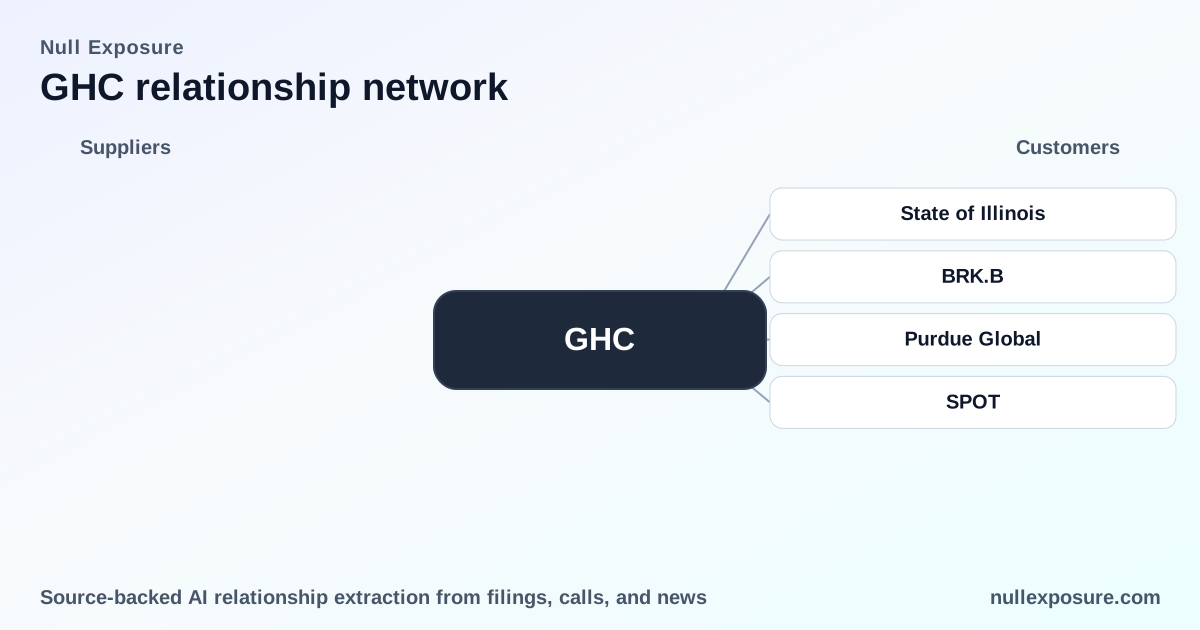
Graham Holdings (GHC) — customer relationships that drive Kaplan and the rest of the business
Graham Holdings monetizes through a diversified operating model centered on education services (Kaplan), broadcasting and media, and healthcare/consumer services; revenue mixes include long-term service contracts, subscription-style offerings and usage-based retransmission fees, with significant government and institutional customers. For investors, the critical lens is how Kaplan’s institutional partnerships and long-dated contracts (notably the Purdue Global TOSA) create recurring, predictable cash flow while selective asset sales and carve-outs (e.g., language business) reshape portfolio exposure. Learn more background at https://nullexposure.com/.
Why customers matter: concentrated partners, recurring mechanics, and institutional criticality
Graham’s customer base is bifurcated between individuals and large institutions, and that split drives revenue predictability and risk profile. Company-level signals show a significant individual end-market (Kaplan served over one million learners in 2024) alongside major institutional and government payors — including Medicare exposure in healthcare and state/university contracts in education. The operating model combines:
- Long-term service arrangements that lock in revenue streams and operational obligations (the Purdue Global Transition and Operations Support Agreement is a 30‑year example).
- Subscription economics for software or licensed access in select businesses, which smooths recognition and retention risk.
- Usage-based royalties and retransmission agreements in broadcasting, where revenue is tied to subscriber counts and distribution partners.
These characteristics imply high contractual maturity and recurring revenue, coupled with customer concentration in institutional relationships that are strategically critical to Kaplan’s market access and to some segment-level profitability.
How contractual and customer constraints shape valuation thinking
Company-level evidence indicates multiple contract types: long-term (30‑year TOSA), subscription-style revenue, and true usage-based royalties. Counterparty types include individual consumers, very large enterprises and government entities, and geography is predominantly North America with a material global footprint through Kaplan’s international operations. That mix implies:
- Lower near-term churn risk where institutional contracts are in place, but higher integration risk where services are bespoke (operations support vs. broad test-prep access).
- Regulatory and payor concentration risk where government programs (e.g., Medicare) form material revenue pools for healthcare segments.
- Geographic diversification that reduces single‑market exposure but maintains U.S. dominance (roughly 79% of revenue from U.S. sales in recent years).
These are company-level signals derived from filings and public reporting; the TOSA with Purdue Global is an explicit relationship-level contract noted in the filings.
Customer-by-customer review (concise, source-linked)
Below I summarize every customer relationship noted in the recent intelligence set, with a short, plain-English takeaway and the reporting source.
-
State of Illinois — Kaplan North America (KNA) was awarded a contract in 2024 to provide graduate school and licensure test preparation (LSAT, MCAT, GMAT, GRE) and license/certificate courses to all Illinois public university students and students at five community colleges. According to the company’s FY2024 10‑K filing, this is a material institutional program awarded in 2024.
-
BRK.B — A 2014 news report described an agreement where Berkshire Hathaway received a Graham subsidiary that included TV station WPLG along with an undisclosed amount of Berkshire shares and cash; this reflects historical asset disposition in the broadcasting portfolio. Reported in NBC Miami referencing FY2014 activity.
-
Berkshire Hathaway Inc. — The same NBC Miami FY2014 coverage reiterates that Graham transferred a Graham subsidiary (including WPLG) to Berkshire under a transaction that combined assets and equity consideration.
-
Illinois Student Assistance Commission (ISAC) — In FY2025, ISAC contracted Kaplan to provide free test-prep courses across Illinois’ 12 public universities and a five‑college pilot, expanding Kaplan’s institutional footprint in state-sponsored access programs (Marketscreener, FY2025).
-
Inspirit Capital (inkl.com coverage, FY2026) — Kaplan announced the sale of Kaplan Languages Group (KLG) — Kaplan International’s large language education unit — to Inspirit Capital, reflecting active portfolio reshaping and monetization of non-core international assets.
-
Kentucky State University — Kaplan partnered with Kentucky State to provide free test-prep access, evidencing Kaplan’s strategy to scale institutional “All Access” licensing and public‑sector reach (Marketscreener, FY2025).
-
Cleveland State University — Cleveland State is listed among institutional partners under Kaplan’s All Access License, demonstrating broad adoption by public universities (Marketscreener, FY2025).
-
Howard University — Howard is another named institutional partner in Kaplan’s All Access licensing program, indicating partnerships with historically Black colleges and universities (Marketscreener, FY2025).
-
Purdue Global — Kaplan Higher Education (KHE) provides non‑academic operations support to Purdue Global under a 30‑year Transition and Operations Support Agreement (TOSA); revenue under this agreement is recognized over time and the contract represents a series of daily service obligations. This contractual detail is explicitly disclosed in company reporting and underpins the longer-term service revenue stream (CityBiz coverage citing FY2021 filing details).
-
Spotify — The company sold its Megaphone podcast business to Spotify in December 2020, eliminating that operating relationship and converting a media asset into cash and strategic focus (CityBiz, FY2021 retrospective).
-
SPOT — Duplicate reporting of the Megaphone sale to Spotify, reflecting the same FY2021 transaction and its impact on the media portfolio (CityBiz, FY2021).
-
Spelman College — Spelman is included among institutional partners of Kaplan’s All Access License, reinforcing Kaplan’s penetration into HBCU institutional programs (Marketscreener, FY2025).
-
The State University of New York (SUNY) — SUNY began a collaboration to provide 1,500 students in the SUNY Arthur O. Eve Educational Opportunity Program with free test prep, showing targeted program rollouts within large public systems (Marketscreener, FY2025).
-
Xavier University of Louisiana — Xavier is listed alongside other institutional partners under Kaplan’s All Access License, indicating broad-based university adoption (Marketscreener, FY2025).
-
Inspirit Capital (intellectia.ai coverage, FY2026) — A second source confirms Inspirit Capital’s acquisition plans for Kaplan Languages Group and notes that conditions for the sale were met with completion dated May 1, demonstrating transaction finalization across multiple reports.
-
Higher Education Opportunity Program Professional Organization — This organization rolled out investments for students under programs tied to the All Access initiative, signaling third‑party adoption and programmatic scale at the institutional level (Marketscreener, FY2025).
Investment implications and risk checklist
- Positive: Predictable institutional revenue — long-term contracts and broad university/system licenses create recurring cash flows and customer stickiness. The Purdue Global TOSA is a structural revenue anchor.
- Watch: Concentration and policy risk — government and large institutional payors (state systems, Medicare) introduce single‑payer and regulatory exposure.
- Portfolio management: Active asset reshaping — disposals (e.g., Megaphone) and carve-outs (Kaplan Languages Group sale to Inspirit) materially change future top-line mix and operating margin dynamics.
- Geography: U.S. centric but international exposure remains — Kaplan’s global operations provide diversification but the dominant revenue source remains North America.
If you want a concise dataset of these relationships mapped to potential revenue lines and contract maturities for modeling, visit https://nullexposure.com/ for detailed access and investor-ready reports.
Bold takeaway: Graham’s customer base combines durable institutional contracts and high-volume individual education customers; valuation should reflect the stability of long-term service agreements alongside execution and policy risk from concentrated government and institutional payors.