GreenTree Hospitality Group (GHG): Customer Relationships and What They Signal for Investors
GreenTree Hospitality Group (GHG) operates as a franchisor and development partner in the midscale and upper-midscale hotel segment, monetizing through franchise fees, recurring royalty streams, and development-related income tied to exclusive agreements with local hotel operators. For investors evaluating customer relationships, the core question is how GHG converts development pipelines into recurring cash flow and how concentrated or contractual those customer ties are. For a concise view of GHG’s known public customer relationships and what they mean for growth and risk, read on. If you want a quick company overview and relationship scorecard, visit https://nullexposure.com/ for additional investor-focused research.
How GreenTree makes money and scales its brand
GreenTree’s operating model is asset-light and franchise-driven: the company grows footprint by signing franchise and development agreements with independent owners and regional operators, who bring capital and manage hotels under GreenTree brands. Revenue is principally composed of initial franchise or development fees and ongoing royalties and service fees tied to room revenue, while development agreements and exclusive territorial rights accelerate room additions without large corporate capital outlays. This structure creates high operating leverage on fee streams once room nights scale, but it also increases exposure to the contracting dynamics and credit profile of franchise partners.
The single documented customer relationship: what was reported
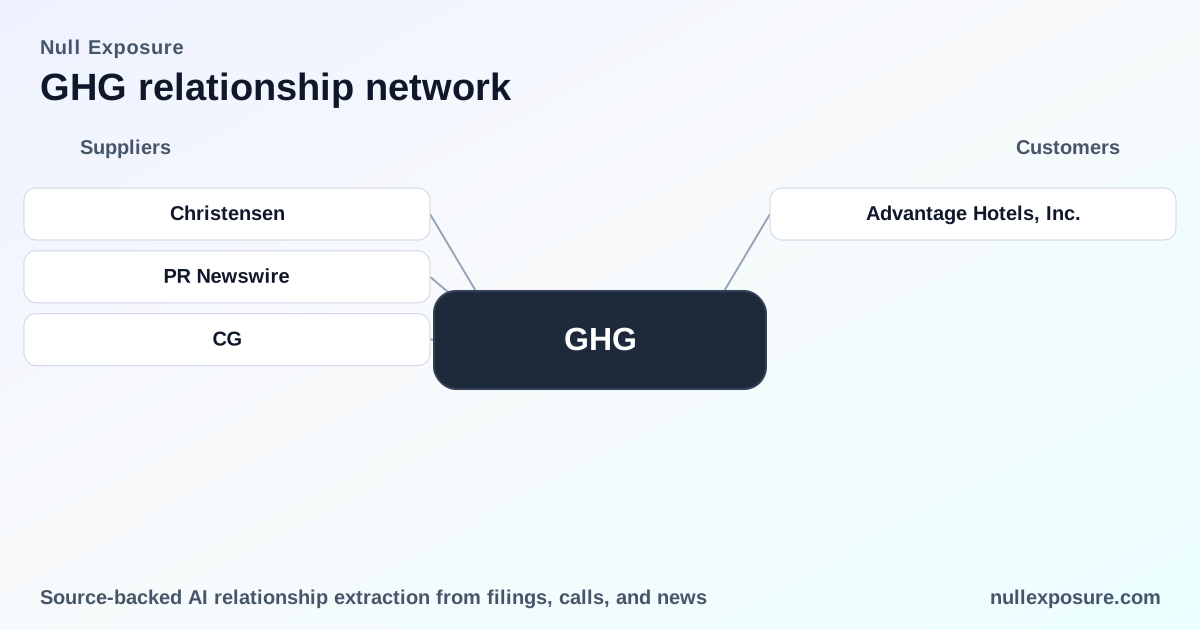
Advantage Hotels, Inc. signed a strategic relationship with GreenTree. Hotel Business reported on March 9, 2026, that Advantage Hotels, Inc. (AHI) entered an exclusive development agreement with GreenTree Hospitality Group Inc., a Phoenix-based franchise hotel chain, with the agreement dated to FY2020. The item describes the arrangement as strategic and exclusive, indicating a formal development pipeline relationship between AHI and GreenTree. (Source: Hotel Business, March 9, 2026.)
Why that relationship matters in plain English
- The AHI agreement is a classic signal of GreenTree’s growth-through-operator partnerships: exclusive development rights to a regional operator accelerate new openings while preserving GreenTree’s asset-light model. Hotel Business framed the deal as a strategic and exclusive development agreement reflecting a channel for room additions. (Source: Hotel Business, March 9, 2026.)
- An exclusive development pact with a single operator can concentrate execution risk regionally but also lock in a predictable franchise and royalty revenue stream for multi-year horizons if openings proceed as planned. The public report referenced FY2020 as the agreement date while coverage appeared in 2026, indicating either an earlier contract with ongoing relevance or public reporting that surfaced later. (Source: Hotel Business, March 9, 2026.)
What the public record does — and does not — show
The available public record for customer relationships is sparse: only one explicit customer relationship surfaced in the reviewed results. This limited visibility is itself an investment signal. From a company-level perspective:
- Contracting posture: GreenTree relies on exclusive development and franchise agreements to expand; these contracts emphasize development rights and brand control rather than corporate hotel ownership. That posture supports growth without heavy balance-sheet investment.
- Concentration: Publicly available relationship evidence is limited, producing uncertainty around customer concentration; a single documented partner in public reporting suggests investors should probe whether growth is driven by a handful of large operators or a broad base of small franchisees.
- Criticality: Development partners who execute large pipelines can be materially important to revenue scale because each operator converts to recurring royalty income once hotels open; exclusive agreements amplify that criticality by tying specific regions or operator networks to GreenTree’s brand expansion.
- Maturity: The FY2020 timestamp associated with the Advantage Hotels agreement implies multi-year commercial timelines common in franchisor-developer relationships, where site selection, construction, and opening stretch across several years before recurring royalties fully ramp.
These characteristics are company-level signals derived from the nature of franchisor business models and the single reported relationship; they are not extracted from any constraint excerpt tied to a specific counterparty.
Risks, execution checks, and what investors should ask
Investors evaluating GHG customer dynamics should focus on the following execution checks:
- Pipeline conversion: How many signed development or franchise agreements convert into opened hotels on schedule? Conversion rates determine when fee income becomes recurring royalties.
- Partner concentration: Are a small number of operator partners responsible for a large share of room additions? High concentration amplifies counterparty risk.
- Contract terms: What exclusivity provisions, termination rights, and performance milestones exist in development agreements? Those terms control downside and sponsor accountability.
- Regional exposure: Are development partners concentrated in specific geographies where demand volatility could compress occupancy and royalty revenue?
These are straightforward diligence points that determine whether GreenTree’s franchise-led revenue growth is durable or vulnerable to partner execution.
Investor takeaways — crisp and actionable
- Growth lever: Exclusive development agreements are a core mechanism for GreenTree to scale room count without heavy capital deployment; that is a structural advantage for margin and ROIC profiles. (Source: Hotel Business, March 9, 2026.)
- Execution risk: The public record currently documents one explicit customer partner, so investors should treat partner concentration and pipeline conversion as primary operational risk factors to vet in management conversations.
- Revenue conversion profile: Expect a two-stage monetization cadence—initial development/franchise fees upfront, then recurring royalties as hotels open and stabilize—so near-term fee spikes can precede longer-term recurring revenue growth.
If you want a focused briefing on how these customer relationships map to revenue sensitivity and downside scenarios, see our broader coverage at https://nullexposure.com/.
Final thought
GreenTree’s franchisor development model is powerful when partner pipelines are broad and conversion is reliable; when public relationship disclosures are thin, the onus is on investors to demand clarity on partner concentration, contract economics, and timeline transparency. The Advantage Hotels item is a useful datapoint that underscores the company’s exclusive development approach, but comprehensive diligence requires more systematic disclosure of customer partners and contract terms. (Source: Hotel Business, March 9, 2026.)