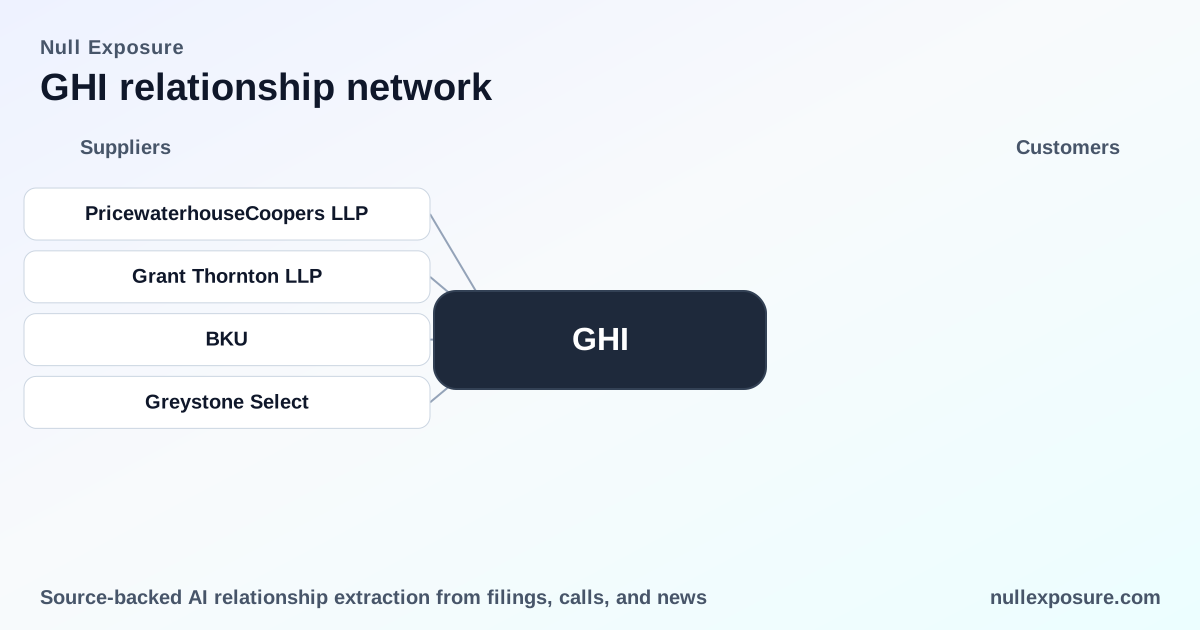
GHI customer relationships: where its capital comes from and what that means for investors
GHI operates as a capital markets intermediary and issuer in the affordable housing finance space, monetizing by originating or securitizing housing-related assets, selling securities to outside investors and banks, and capturing issuance proceeds and ongoing servicing spreads. Recent activity shows direct placements of preferred units into bank balance sheets alongside recurring securitization programs — a business model that converts illiquid housing cash flows into investor-facing securities and immediate funding.
For a concise view of counterparties and contract characteristics, see the full firm profile at https://nullexposure.com/.
A single counterparty transaction but an industry pattern
ServisFirst Bank purchased a block of preferred equity from GHI’s vehicle in a straightforward capital-raising move. According to a TipRanks company announcement dated May 3, 2026, Greystone Housing Impact Investors LP issued 500,000 Series B Preferred Units to ServisFirst Bank, producing $5.0 million in proceeds. This is a direct cash issuance to a bank buyer and represents a conventional funding leg for an issuer with ongoing capital needs. (TipRanks, May 3, 2026: https://www.tipranks.com/news/company-announcements/greystone-housing-secures-5m-from-preferred-units-sale)
What the transaction tells investors about GHI’s go-to-market
- Direct bank placements are part of the capital stack. The ServisFirst trade demonstrates GHI’s ability to place preferred equity into financial institutions rather than relying exclusively on broad retail markets.
- Deal sizes sit in the mid-market funding range. The $5 million placement is economically meaningful for a specific issuance and consistent with a pattern of mid-size capital raises implied by firm-level spend figures.
- Issuance proceeds are an immediate monetization lever. Selling preferred units is a cash-generating activity distinct from long-term securitization cash flows, which supports working capital and execution of new originations.
Learn more about how we compile counterparty mappings at https://nullexposure.com/ and review related relationships.
Company-level contract signals that shape operational risk and runway
A review of available contract excerpts and constraint signals provides a coherent picture of GHI’s operating posture. These are company-level signals — not tied to any single named counterparty unless explicitly stated.
- Long-term fixed-rate liabilities and cash flow duration. Company excerpts note that holders of Affordable Housing Multifamily Certificates are entitled to interest at a fixed 4.10% per annum, payable monthly, with principal payments tied to a securitization schedule that runs through September 2039. That creates a long-duration payment obligation and an associated asset-liability matching dynamic for the issuer.
- Counterparties include mission-driven non-profits. The firm discloses that certain borrowers in its Municipal or MRB-style investments are non-profit entities operating affordable multifamily housing, which influences credit characteristics (lower commercial upside, potentially higher policy support).
- Securitization and capital markets selling posture. GHI acts as a seller of senior securitized certificates (Class A TEBS Certificates) to unaffiliated investors, indicating regular use of capital markets to monetize pools of assets.
- Active lifecycle management and refinancing behavior. One financing (the M24 TEBS Financing) was paid in full and collapsed in December 2023 under prepayment provisions, signaling the firm manages facilities dynamically and exercises prepayment/refinance options when advantageous.
- Transaction scale is material but not giant. Financial excerpts indicate transaction or balance bands in the $10M–$100M range, with line-item figures showing totals in the vicinity of $57.1 million — a scale that supports meaningful portfolio activity while keeping GHI in a mid-market issuer category.
Taken together, these signals define a company with long-term contractual obligations, recurring securitization issuance, exposure to mission-oriented borrower credit, and mid-sized capital-raising activity.
Relationship-by-relationship roundup (complete inventory)
ServisFirst Bank (SFBS) — ServisFirst purchased 500,000 Series B Preferred Units issued by Greystone Housing Impact Investors LP, generating $5 million of proceeds for the issuer. This transaction is a direct preferred-equity placement into a bank and reflects GHI’s use of institutional buyers to fund issuance. (TipRanks company announcement, May 3, 2026: https://www.tipranks.com/news/company-announcements/greystone-housing-secures-5m-from-preferred-units-sale)
Investor implications: concentration, criticality, and timing
- Concentration risk is moderate but structural. The firm’s reliance on securitizations and targeted bank placements creates a concentrated funding model: a small number of large transactions provide most liquidity rather than many small retail investors.
- Counterparty criticality is asymmetric. Bank placements and institutional buyers provide reliable, fast funding; securitization buyers back long-term cash flow conversion. A disruption in either market — bank appetite for preferred units or demand for TEBS-style certificates — would increase refinancing risk rapidly.
- Maturity profile creates a predictable yet inflexible cash flow map. With certificates carrying fixed-rate obligations extending to 2039, GHI faces locked-in coupon requirements and limited ability to reprice that leg in a rising-rate environment without refinancing.
- Non-profit borrower base changes credit dynamics. Greater exposure to non-profit housing borrowers reduces commercial rent-up upside but can increase policy-backed stability and lower volatility in occupancy in subsidized portfolios.
Key takeaways and watchlist for the next 12–18 months
- Monitor securitization issuance cadence and bank placement frequency. These are the primary liquidity levers for GHI.
- Watch prepayment and refinancing activity as a signal of financing flexibility. The December 2023 collapse of the M24 facility under prepayment provisions is evidence GHI can actively reshape its capital structure.
- Assess policy and subsidy trends in affordable housing. Given the non-profit borrower mix, public funding and regulatory support materially affect borrower cash flow reliability.
- Track coupon and duration exposure. The fixed 4.10% obligations through 2039 create interest-rate sensitivity on the liability side that is material to valuation.
Conclusion: a mid-market issuer with securitization DNA
GHI operates a repeatable model of converting affordable housing cash flows into investor-facing securities and direct preferred placements with banks. The business model combines predictable, long-dated obligations with active capital markets execution, creating a profile attractive to investors who value stable, policy-linked cash flows but wary of concentrated funding routes and duration risk. For a detailed mapping of counterparties and contractual descriptors, visit https://nullexposure.com/ for the full company profile and relationship roster.