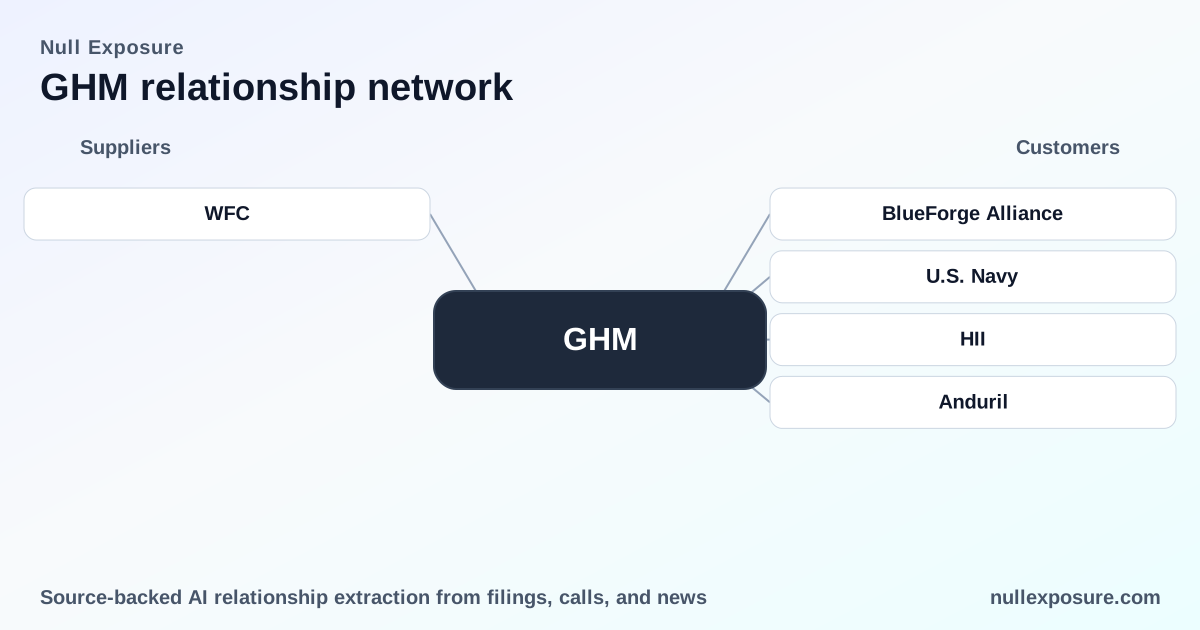
Graham Corporation (GHM) — customer map and strategic implications
Graham Corporation designs, manufactures and services mission‑critical vacuum, heat‑transfer and turbomachinery equipment and monetizes by selling engineered capital products and long‑cycle service/replacement parts to defense, energy and space customers. Revenue is driven by long‑term fixed‑price defense contracts, high domestic concentration, and recurring aftermarket spares and service, creating a hybrid capital‑goods cash profile that combines lumpy project revenue with durable aftermarket margins. For a consolidated view of these relationship signals, visit https://nullexposure.com/.
Why this customer set matters to investors
GHM’s customer base explains both growth levers and downside concentration risk. The company wins multi‑year fixed‑price engineering orders that can stretch beyond five years, while aftermarket parts and service smooth revenue between milestone shipments. Key investor implications: contracting posture is long‑term and fixed‑price; geographic exposure is heavily North America; customer concentration is material; and product criticality to defense programs gives pricing leverage but also single‑source risk.
- Contracting posture: Company filings disclose fixed‑price, long‑duration defense contracts with order‑to‑shipment cycles that can exceed five years, making backlog visibility central to near‑term revenue recognition.
- Concentration: The firm reported two customers accounting for 17% and 13% of consolidated net sales in FY2025, a persistent pattern across recent years—this is a structural concentration signal rather than a one‑off.
- Criticality and maturity: Products are mission‑critical components for submarine and torpedo programs; long standing supplier relationships and established manufacturing reflect a mature industrial posture.
- Geography and stability: Domestic sales dominate (roughly 80%+ of orders/sales in FY2025), so macro exposure is primarily to U.S. defense and industrial cycles.
If you want ongoing tracking of these customer dynamics and how they affect enterprise value, NullExposure maintains an updated feed at https://nullexposure.com/.
Customer roll call — what every relationship means for GHM
BlueForge Alliance
Graham disclosed a $2.1 million grant from BlueForge Alliance to expand a welder training program and equipment, signaling investment in skills and capacity to support manufacturing needs and workforce development. According to GHM’s 2025 Q4 earnings call, this grant funds training and equipment upgrades that support production capabilities for complex assemblies (2025 Q4 earnings call).
U.S. Navy
The U.S. Navy is a top strategic end‑customer: GHM is a key supplier on Columbia‑ and Virginia‑class submarine programs and related shipbuilding initiatives, with multiple follow‑on awards supporting torpedo hardware and submarine components. Coverage includes a $136.5 million follow‑on contract to support the Virginia‑class program and a roughly $25.5 million follow‑on order to produce heavyweight torpedo hardware (GovConWire, FY2025; RBJ, FY2025).
T. Rowe Price Investment Management / T. Rowe Price
T. Rowe Price‑advised accounts bought equity in a financing that directly affects GHM’s capital structure: Graham sold $50 million of common stock to accounts advised by T. Rowe Price at $83.36 per share, a dilutive financing that strengthens liquidity and provides balance‑sheet flexibility to support defense program ramp and facility expansion (TradingView, FY2026; Intellectia AI reporting, FY2026).
HII
HII is a program contractor/customer channel for submarine programs: GHM has an historical multi‑year supplier relationship to produce MK‑21 air turbine pumps and other submarine components for HII programs, linking GHM’s manufacturing output directly into prime shipbuilder supply chains (GovConWire, FY2025).
HII NNS
HII Newport News Shipbuilding (HII NNS) specifically contracted with GHM in multi‑year work for Virginia‑class systems; this relationship embeds GHM into long‑cycle prime contractor schedules and the associated production cadence for submarine delivery (GovConWire, FY2025).
Anduril
Anduril is identified as a key end user of GHM technology, indicating GHM’s reach into next‑generation defense systems and non‑traditional prime contractors that use Graham’s engineered components (InsiderMonkey transcript coverage, FY2026).
What the relationship mix implies for risk and upside
GHM’s customer set is concentrated in high‑value defense programs with long production cycles. That creates a profile where backlog and contract awards drive near‑term revenue visibility and aftermarket/service sales underpin margin resilience. At the same time, reliance on a handful of large defense customers produces earnings volatility tied to award timing, program funding and prime‑contractor schedules.
- Upside: Large follow‑on awards (e.g., $136.5M for Virginia‑class work) and expanding aftermarket/domain expertise create durable revenue streams and pricing power on critical components.
- Risk: Fixed‑price, long‑term contracts expose GHM to schedule risk and cost inflation; customer concentration means any prime contractor delay or program re‑scoping transmits directly to GHM revenue and utilization.
Operational constraints and company‑level signals
Company disclosures and recent commentary reveal structured operating constraints investors should treat as persistent signals rather than incidental facts:
- Long‑term fixed‑price contracts dominate the defense portion of revenue and can extend beyond five years, which makes backlog quality and contract costing discipline principal drivers of profitability.
- Government end‑customers drive demand and program timing, concentrating commercial risk on U.S. defense budgets and procurement cycles.
- North American revenue concentration (roughly 80%+) reduces currency and geopolitical diversification but aligns GHM with stable U.S. defense spending.
- Material customer concentration is persistent—two customers consistently represent double‑digit percentages of consolidated net sales—so client retention and program continuity are material to valuation.
- Seller role and manufacturing segment maturity signal an incumbent supplier with engineering scale, installed base for spares, and the ability to monetize aftermarket service.
Bottom line for investors
GHM is a specialized industrial supplier whose valuation will track defense award cadence, backlog conversion, and aftermarket growth. The customer relationships described—particularly with the U.S. Navy and prime contractors—are both the company’s primary revenue engine and its main source of concentration risk. Monitor contract award timing, backlog composition and margin performance on fixed‑price projects as the decisive signals for near‑term earnings and longer‑term upside.
For a concise, continuously updated mapping of GHM’s customer landscape and other corporate signals, visit https://nullexposure.com/.