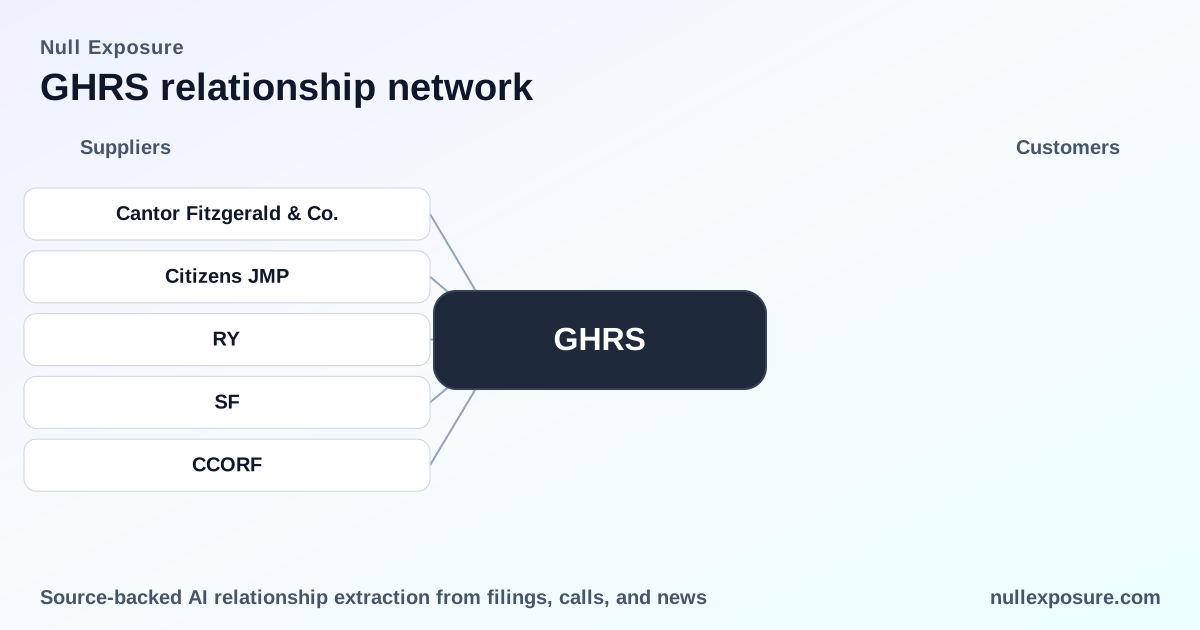
GH Research: who’s buying in — and what that capital says about runway and risk
GH Research PLC develops psilocybin-based therapeutics aimed at psychiatric and neurodegenerative disorders. The company is clinical-stage and monetizes through milestone-driven value creation: advancing trials to regulatory inflection points that justify licensing, strategic partnerships, or eventual product commercialization, while relying on equity and underwritten financings to fund operations until revenue generation. Capital markets access and institutional backers are therefore central to GHRS’s operating model. Explore more company intelligence at Null Exposure.
The financing that updates the playbook
GH Research priced a $117.5 million underwritten offering in late April 2026, a transaction initiated by Lynx1 Capital Management with participation from Deep Track Capital and Foresite Capital. That deal is the most recent concrete signal about GHRS’s funding strategy: the company is actively leaning on institutional investors and underwritten equity to sustain clinical development and bridge to key data readouts. For a clinical-stage biotech with zero revenue and negative EBITDA, these underwritten placements are a primary mechanism of survival and optionality. (GlobeNewswire, April 29, 2026)
Who backed the deal — short, plain-English summaries
-
Deep Track Capital backed the underwritten offering as a participating investor, contributing capital alongside other institutions to the $117.5 million raise. This participation signals continued institutional willingness to finance GHRS’s clinical pathway. (GlobeNewswire, April 29, 2026)
-
Foresite Capital participated in the same offering, joining Deep Track and Lynx1 in the syndicate that purchased newly issued shares. Foresite’s involvement indicates participation from established healthcare-focused allocators rather than boutique retail placements. (GlobeNewswire, April 29, 2026)
-
Lynx1 Capital Management initiated the offering and acted as a lead in arranging the deal, positioning itself as a prominent execution partner in GHRS’s capital strategy. Lynx1’s role as initiating manager highlights the importance of lead underwriters in accessing sizable institutional demand. (GlobeNewswire, April 29, 2026)
No explicit contracting constraints found — what that implies
The collected relationship signals contain no formal constraints or contractual caveats such as exclusivity clauses, minimum purchase commitments, or vendor lock-in language. At the company level, that absence should be read alongside GH Research’s broader business characteristics: GHRS is a clinical-stage biotech with no reported revenue through FY2025, negative EBITDA, and a business model that is inherently financing-dependent (company profile and FY2025 metrics). The lack of explicit constraints in the transactions described suggests these capital providers engaged via standard underwritten equity mechanisms rather than long-term service or supply contracts.
Operating posture, concentration and criticality — an investor lens
-
Contracting posture: GHRS is capital-constrained and finance-driven, using underwritten offerings to fund operations; counterparties in this context (banks and institutional investors) supply liquidity rather than product or service inputs.
-
Concentration: While the most recent offering shows multiple institutional participants, reliance on episodic large financings creates concentration risk around key underwriters and anchor investors — a small number of institutional allocations can determine successful execution.
-
Criticality: For GHRS, capital providers are functionally critical to continuing development; without timely financings the company’s clinical programs and timelines would decelerate materially.
-
Maturity: GHRS remains in an early commercial maturity stage — clinical assets but no commercial revenue, consistent with the firm’s negative EPS and zero RevenueTTM profile as of its latest reporting cycle (LatestQuarter: 2025-12-31).
What investors should watch next
- Cash runway and financing cadence. Underwritten offerings are the current primary funding source; monitor the timing and size of future placements to infer runway and dilution risk.
- Clinical milestones and regulatory readouts. Positive trial data materially increases bargaining power and alternative funding routes (partners, licensing), reducing capital-market dependency.
- Investor mix and lead managers. Repeated participation by healthcare-specialist firms or the same lead underwriters is a vote of confidence; rotating or shrinking syndicates increase execution risk.
- Ownership dynamics. GHRS reports sizeable institutional ownership (about 68%) and meaningful insider stakes (~24%), implying active institutional oversight and potential alignment between management and long-term shareholders in value realization.
Risk and opportunity — concise takeaways
-
Risk: Funding-dependent model. GH Research has zero revenue and negative operating cash flow, so success depends on continued access to institutional capital. The April 2026 $117.5M offering illustrates both access and dependency. (GlobeNewswire, April 29, 2026)
-
Opportunity: High leverage to trial outcomes. As a clinical-stage biopharma, a favorable trial result or regulatory progress would re-rate the equity and open non-dilutive options such as partnerships or royalties.
-
Counterparty signal: institutional interest matters. Participation by Foresite, Deep Track and an initiating manager in Lynx1 suggests sustained institutional appetite at current valuation levels, which reduces short-term execution risk for funding but not programmatic or clinical risk.
Where to follow for the next signal
Monitor press releases for additional underwritten offerings or anchor investor announcements, SEC filings for the offering prospectus and dilution schedules, and clinical trial registries for milestone dates. GH Research’s corporate site and filings provide baseline governance and pipeline updates; the GlobeNewswire release on April 29, 2026 is the immediate primary source for the recent transaction. Active monitoring of financing transactions is as consequential as the science when valuing GHRS. (GH Research corporate communications; GlobeNewswire, April 29, 2026)
If you evaluate biotech capital structures regularly, these relationships are the practical lens through which GHRS’s runway and execution risk are judged. For more curated relationship intelligence and deal tracking, visit Null Exposure: https://nullexposure.com/